It’s supposedly a modern American take on David Copperfield.
1 Like
Knocked this over in one sitting, given how deeply the plot sucked me in and how great was my desire to see what happened next.
Set mostly in the Dandenong Ranges over one night, the story alternates chapter by chapter from the viewpoints of a young woman who has been abducted and a mother desperately looking for her daughter.
The book has a much greater element of horror than White’s previous work and is peppered with suspense, intrigue, surprises and a killer twist to top it all off. Excellent. 9/10
He does do that swapping from person to person’s viewpoint a bit.
I jumped on The Missing by Fleur McDonald. It’s a missing teen in Kalgoorlie.
Just ordered this based on these posts.
Sounds right up my alley but had never heard of it.
Blitz Bookclub delivers.
2 Likes
Just finished the Christian White…the last third was a bit hard to follow and I’m not sure I grasped it all, but that’s the sort of writer her is. His major plot twist is reminiscent of one of his previous novels.
I was having lunch at a new joint outside Warrnambool Target this arvo and get grilled about where I’d bought by a mother and daughter. We had a fair chat about Oz crime novelists.
They were hoping to get this one on the cheap at Target, but no go! Mustn’t be quite popular enough. I bought it round the corner at Collins. I did pick up Bryan Brown’s new book The Hidden and Judy Nunn’s Pilbara at Target though. $18 compared to $34.99
I had enjoyed Fleur McDonald’s The Missing, set in Kalgoorlie. I’m not sure it’ll ever reach the pantheon of great Australian crime novels, but it was very readable.
Have you read any of his other stuff and, if so, what did you think? There’s a good interview with him in today’s Age.
Bryan Brown hated English as a kid. One book changed everything
Literature meant nothing to the future actor when he was growing up in Sydney. But a long plane flight unlocked his inner storyteller.
November 7, 2025
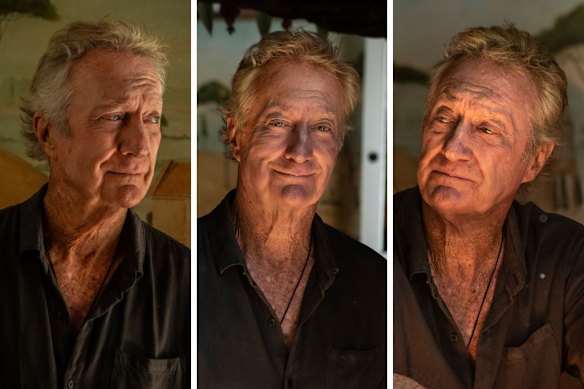
Credit: Steven Siewert
Bryan Brown, in person, is exactly as you’d expect – ruggedly handsome, charismatic, and swears like a f—ing champion. He’s older than you might think (78!) but still instantly recognisable after starring in seemingly everything – classics from the “event TV era”, such as The Thorn Birds, films including Breaker Morant, and alongside Hollywood big-hitters such as Tom Cruise in Cocktail and Sigourney Weaver in Gorillas In The Mist.
These days, he’s also a bestselling author. And not just the Hollywood memoir type, but a bona fide crime writer. He published his first book, Sweet Jimmy, a collection of short stories, in 2021, and his debut novel The Drowning in 2023. This month his third, The Hidden, is released.
Not bad for a bloke who grew up disliking reading. “I hated English at school,” he says. “Hated it! Because we got things like Great Expectations to read …”
He concedes now that the Dickens classic is a great novel, but “not when you’re bloody 12 and 14 and 16, and you want to play sport…”
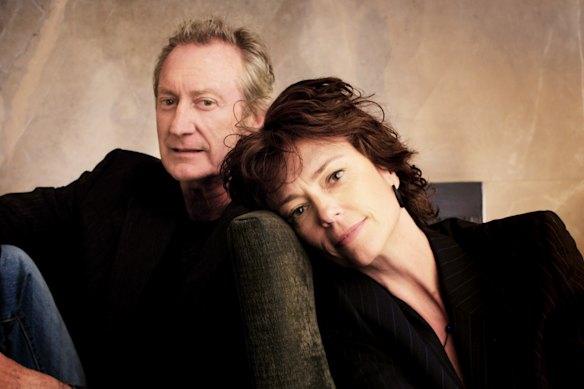
Bryan Brown and Rachel Ward in 2009.Credit:Rob Banks
We meet for lunch in Fitzroy; Brown lives in Sydney with wife and fellow actor/director Rachel Ward, but he’s in Melbourne for a podcast appearance (“I’ve never listened to a podcast, ever,” he says).
Growing up in working-class Bankstown in Sydney’s west, English lessons, he says, bore no relationship to his life. “And they didn’t bother to try and find a way to make it … part of our world. I wasn’t a dummy, so I worked out what they’d want from the bloody exams and gave them that. But as for inhaling it and, and, you know, wanting it to build something in me. No, it was just a f—ing passing parade.”
Brown excelled at maths though (he still catches up with his old maths teacher, 60 years on), and began his working life as an actuary at AMP. But four years in, he realised it was “boring as batshit”.
“And all the blokes that were having a good time were the salesmen, so I’d say ‘Mum, I’m going to become a salesman’.” Brown lived with his single mum, Molly, and his younger sister, Kristine, until he was 25 – “I was too smart to go and pay rent to someone, but I did pay Mum something” – until he left home to become an actor.
“She probably thought, my son’s going into a profession, he’s going to be all right,” Brown says. “And then I said, ‘Mum, I’m going to be a salesman’ – and it was probably like, ‘oh, f—, that’s what your father was and he was useless’. But she never did say that.”
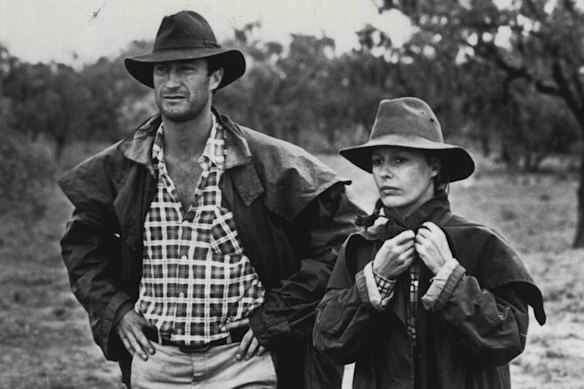
Bryan Brown with Helen Morse in A Town Like Alice.
He was doing well as a salesman until he discovered the company’s theatre club, which ignited something. “So then I tell Mum, ‘I’m going to go to England to become an actor’.”
She was, he says, very accepting about it. “When I think about it now, it must have been like a kick in the guts. She just wanted me to be secure. But still, what you want for your kid, and what they’ve chosen to do is a big deal. They want your life to be good…” Brown peters off, tearing up a bit, before adding that “eventually, I did a show called A Town like Alice and the whole f—ing country knew me and she was happy.”
Molly Brown would, he reckons, be chuffed that he’s added author to the CV. Especially as it wasn’t until he boarded that plane to England that he began reading for pleasure.
“I thought I’d better buy a book to take with me because I’m going on a long plane flight. And I bought Bury My Heart at Wounded Knee by Dee Brown, [about] the history of the American Indians. Fabulous book. ”
Slowly, he says, that started him on reading. “Before I became a professional actor, I was reading plays, even as an amateur actor, but the Dee Brown book was the first book that I bought, and I really read.”
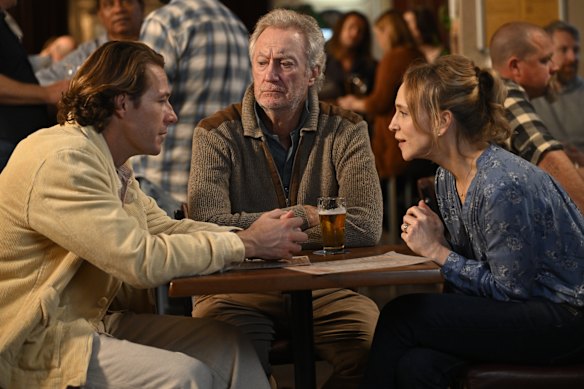
Brown, with Luke Bracey and Susie Porter, in his latest film, The Travellers.Credit:David Dare Parker
These days, he reads a couple of books a week. “And crime is my escape, the fun ones.”
He fell into the other side of crime novels, he says, by accident, after a news report about Australians caught carrying drugs in Hong Kong piqued his interest.
“They were drug mules, and didn’t know what they were carrying, and they’d all gone to jail,” he explains. “I was watching this news story after they’d got out, and they were having dinner and I went, ‘wow, if I was one of those people, I’d just want to know who was behind getting me there’. And then I went, ‘that’s not a bad idea’. So I started writing.”
That tale became the first story in Sweet Jimmy, although he wrote initially thinking he would pitch it as a TV series. “But I kept enjoying the writing. And when I’d finished the story and people read it, they went, ‘bloody good short story’. So I started thinking, hmm, wonder if I’ve got any other short stories – and that ended up being the book.”
Sweet Jimmy was favourably reviewed – this masthead called the collection dazzling, with the iconic actor’s stories “rendered with brilliant idiomatic control”.
Brown thought the collection would be a one-off, but “then, guess what I did!”
Clearly, then he enjoys the writing process? “I do enjoy it. As an actor, I get a page of stuff that a producer’s had something to do with, a director’s had something to do with it, the writers have had something to do with it. It’s all there, and then I get to interpret it my way. Sitting at a screen, you know, there’s nothing there! What am I going to put there? So it’s very different.”
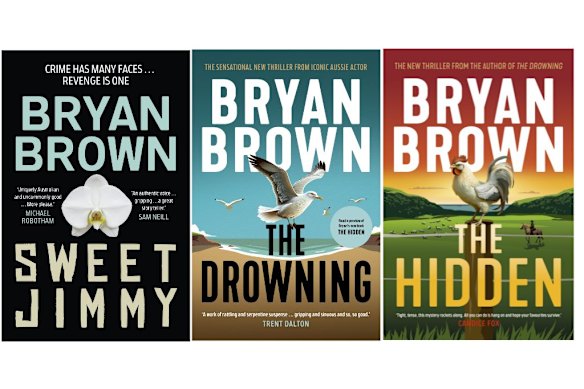
The Hidden follows the inhabitants of a small coastal town; his first novel, The Drowning was also set in a rural community.
“I like small communities because in small communities people know everyone – or think they do, you know? But you never fully know everyone…”
The large cast of characters in *The Hidden’*s fictional town The Heads include battling farmers, local business owners, caring schoolteachers and the town’s police sergeant, busy trying to get to the bottom of a local drug overdose. On the surface, The Heads seems like many a quiet country community – but every town has hidden undercurrents, and Brown’s story has several nefarious goings-on, including a dodgy gambling ring and some seriously creepy voyeurism involving a local tradesman. Suffice to say, it may put you off having solar panels installed.
It was a bloke installing an aerial on Brown’s own house that inspired one of the main threads in The Hidden.
“I told him I wanted this idea in the book, and asked him, tell me how it works, and he was happy to tell me everything! You know, you have to trust people – people get access to our lives in all sorts of ways.”
Flawed – and worse – characters are part of what appeals to Brown about the genre.
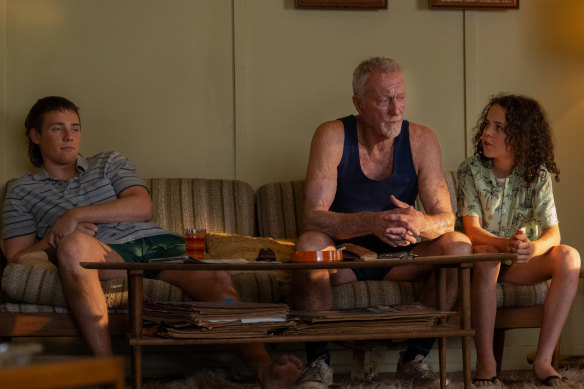
Lee Tiger Halley (left) with Bryan Brown and Felix Cameron in Boy Swallows Universe.
“It’s the opportunity to deal with what we are, and the things that people don’t know about us that we deal with,” he says. “I just love the fact that we think we know people and there’s a whole section that we don’t know about a person. Not because they’re hiding it, but, like that’s particular to them, and there’s no point in them bringing us into that world. You know, even with my best mates, I know there are things I don’t know.”
As for his process, Brown says he’s not one of those authors who map out a book first; once he starts, he says, he just lets it run.
“I don’t know what it’s going to be – I’ll think OK, let’s go with this character. You’re a character in a milk bar, let’s see what happens in a milk bar. What’s this character gonna do now? And then basically you’ve got to work it all out,” he says. “You get three quarters of the way through and go, ‘now I’ve got to bring them all around together in some way’.”
Brown’s writing is very distinctive; you can hear him delivering most of the lines.
“There’s not a lot of adjectives; they’re short, sharp sentences,” he says. “It feels right to write like that.”
There are definitely some adjectives in there. Brown’s descriptions of the characters are bang on; anyone who’s spent time in a country town will recognise some of them. “Yeah, there are some. But I can’t be flowery,” Brown says. “I can read flowery, but I can’t write it.”
Presumably his decades of working in film plays into his newfound career? The Hidden is certainly something you can see working as a film (The Drowning has already been optioned for adaptation). “That probably plays into it, doesn’t it? I mean, I’m unaware of that,” he says. “I’m sort of telling a story how I want to tell a story. But yeah, that’s to do with 50 years of how you frame stories.”
Fifty! “Did I lie? No, it’s been 50 years!”
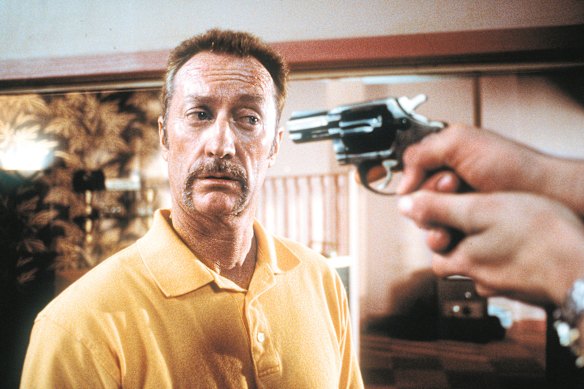
Brown as the gangster Pando in the Australian crime film Two Hands.
Since the 1970s, he’s racked up more than 80 film and TV credits, playing mostly good guys. Except of course, for his memorable role as underworld boss Pando in the 1999 film Two Hands.
“I loved him,” Brown says of the psychotic crime lord. “The first scene I shot for that is where I’m doing origami with my son, it’s my favourite scene. I’m doing origami and the phone goes. So you meet this character, and you know, what a lovely father playing with his son. Then the phone goes, and I pick it up, and I go ‘kill the c—’. It’s great to be handed a character like that.”
Mostly though, he plays a nice bloke who’s rough around the edges. (His favourite, he says, is Macauley in the 1987 miniseries The Shiralee.)
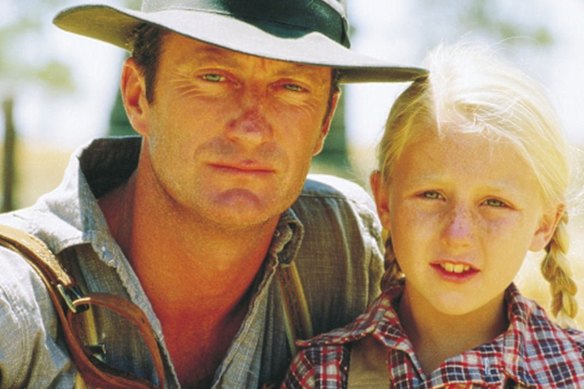
Bryan Brown as Macauley and Rebecca Smart as Buster in the 1988 TV miniseries The Shiralee.
Having conducted a mini Bryan Brown festival in my lounge room ahead of our chat, I discover that among the directors he’s worked with – frequent collaborator Bruce Beresford, Michael Apted, Baz Luhrmann – there was one shock. A film by – insert record scratch here – Ken Russell, the famously provocative British arthouse director, whose experimental work often attracted controversy. Russell’s flamboyant films, such as The Devils, Tommy and The Lair of the White Worm, are known for their surreal religious and sexual imagery.
“Oh yeah, Ken,” Brown says when I mention the 1998 made-for-TV film Dog Boys. “What a lovely man.”
Was he bonkers? “No! When you think of all that stuff he did, there was some mad stuff but … that had all started to peter out, and he couldn’t get any of those sorts of things any more – he’d had his run on being a quite innovative filmmaker.”
In Dog Boys, filmed (cheaply) in Canada and co-starring Dean Cain and Tia Carrere, Brown is a sadistic officer at a high-security prison where inmates are used as bait for a canine tracking program.
“I rode a horse too, didn’t I?” Brown asks. He did. “I think that’s why I did it. It’s quite a different film for him – he wasn’t good on the action stuff, it wasn’t his thing. But like a lot of those blokes, he just wanted to keep working…”
A bit like Brown, then, who has a new film out, The Travellers, as well as a new book to promote. No sign of retirement here; Brown is even still a regular surfer.
“I’m really just doing what I’ve always done,” he says, digging into my affogato dessert. “I tell stories.”
==============================================================
The Christian White twist is lot to get one’s head around and it took a bit of an effort to make sense of it all.
As you noted, it does have similarities to a device he employed in a previous book.
1 Like
Didn’t mind his stuff at all.
He started his working life as an actuarial assistant at AMP in Sydney with a few mates of mine. He was legendary as a tight-arse. The lads would head down to the pub on Circular Quay after work on Friday and he was famous as skedaddling after 2n-1 beers where n was the number of blokes in the shout.
One of my mates was watching A Town Like Alice with his wife when BB’s character offered the smokes around, and my mate said that he’d never that to happen and that BB smoked OP’s other people’s.
1 Like
Love this for him, and I’m sure he’d be very good at it, but it really feels like this is every Australian book ever right now.
Edit: and has been for a while.
1 Like
If you’re a fan of terrible writing, then I can highly recommend this.
I think it might have been the inspiration for Michael Scott’s Threat Level Midnight script.
I’ll pay that. It’s possibly even worse than Dan Brown.
1 Like
So many wonderful lines…
His lean, firm-jawed features were turning serious. Tension tightened his powerful body.
“It must be important, Case,” Karin said. “They’re using your code call.
They wouldn’t do that unless it was urgent.”
New York blasted! That could have been an accident.
Case got out of the chute and ran to him, slid expert hands over the man, and felt the messy pulp that had once been a face. The pilot hadn’t known how to fall properly.
Just finished Gunpowder Creek, debut novel for Alex Dook.
Emily is a Perth office worker, finishing up her Excel work for the week when she gets a frantic phone call from her layabout son, Zach, saying he’d failed in a job he had to do and if he didn’t get a car to Gunpowder Creek by a specified time, he’d be killed.
She takes on the job to save him, and goes through a number of dangerous adventures to get the job done. It was pretty good, worth a read, but it did fail to hold me to not putting it down. A solid 7/10.
I think I’ll give Bryan Brown a go now.
In a bit of a departure from my usual genre, I’m reading some books by William McInnes, who is better known as an actor.
His stuff is easy reading, humorous, informative and very, very Australian.
I’ve also ordered some Bryan Brown so it’s Oz lit for me for a while.
I have 20 books on the back of the couch. 2 English, 2 Spanish, 1 French, 15 Oz.
The Spanish and French are translated into American English which can be extremely annoying, seeing the guy leading the investigation, in French le juge d’instruction, called the DA is a PITFA.
1 Like
I’m reading Man’s Search for Meaning by Victor Frankl. It’s as compelling as everyone says it is.
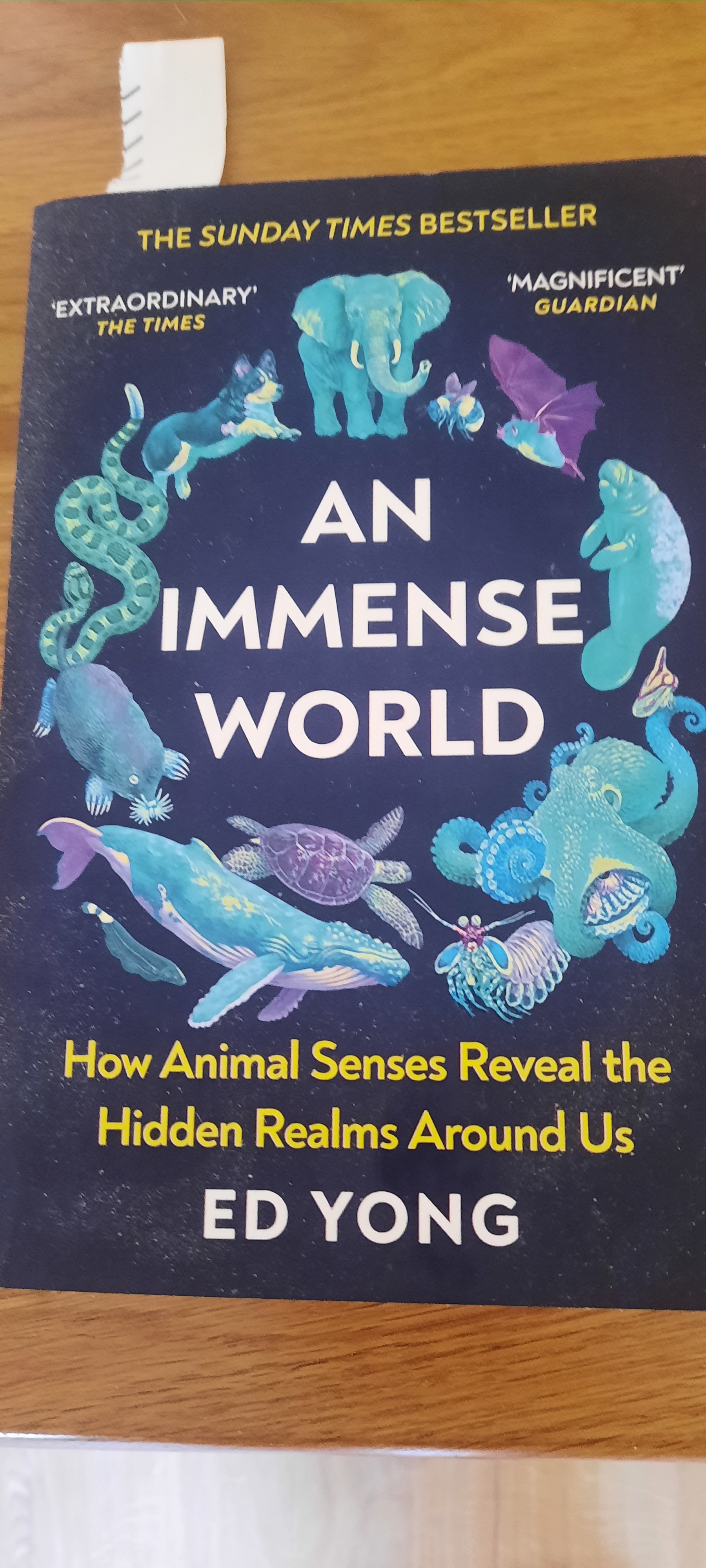
Anyone read this? I’ve only read the first two chapters and the first one focuses on canine olfaction, so I’m hooked. There is a lot to take in so this one might be a slow burn. Ed first got my attention during the covid times when he was working for the Atlantic - he was one writer I made sure I read.
I really liked his first two books.
Especially the cricket one.
1 Like
Just finished that one yesterday. Go the mighty Yarraville West Fourths!!
1 Like
If you want to read about the travails of a local cricket club, Gideon Haigh’s “The Vincibles” about South Yarra Cricket Club, mainly their seconds and thirds where Gideon is the resident left-arm orthodox bowler and lower order batsman.
1 Like
I love Gideon’s writing about cricket and have no doubt that it’s a great book, but I can’t find a copy that comes anywhere near being reasonably priced.
For a book that came out in 2009, you’d expect some cheapish second hand jobs on Ebay. Maybe it’s so good that people are hanging onto their copies.