Ed Milliband’s speech to the House of Commons on Israel and Palestine.
Gutsy from Ed
Tranzie Hq ·
Follow
·
 Ghana’s President John Dramani Mahama has taken the demand for slavery reparations directly to British lawmakers, calling for acknowledgement, an apology and concrete steps towards justice.
Speaking at a cross-party parliamentary meeting in London, Mahama said Ghana’s position centres on recognition, dialogue and addressing historical wrongs. He made clear that the appeal goes beyond financial compensation.
Ghana is proposing practical cooperation on restitution, preserving historical records and heritage, and education.
For Mahama, acknowledging slavery must lead to action that supports healing and a fairer relationship between nations. Recognition is the beginning of that process.

2 Likes
1 Like
The slave trade was started by people in his and neighbouring countries. What does he propose that his country do about reparations
2 Likes
The lettuce was more interesting than her anyway
Interesting story on compensation paid by the British government to the British people involved to stop the slave trade. The slavers were mostly British parliamentarians at the time slavery ended. They made the deal which paid themselves more than the slave trade was worth.
And the interest repayments for the loan to pay them their compensation was finally paid off by the UK taxpayer in the 2010’s approximately 150 years later.
2 Likes
There was a big outcry when those charged with attempting a terrorist attack on an RAF airbase were released on bail. Turns out it was an intelligence gathering operation, the suspects were closely monitored and led investigators to their handlers. They’ve since been placed back behind bars.
5 Likes

Meanwhile .. the UK moves ever closer to a formal war footing with the sustained Russian hassling and threats.
https://www.thetimes.com/article/c1b75f25-23a4-436c-9838-61cb66548562
Things that make you go Hmmm…
Do immigrants from some countries commit more sex crimes?
A hard look at Britain’s data suggests so. But it is hardly an epidemic

Photograph: Alamy
Oct 25th 2026|5 min read
In Bristol last November three men and a 17-year-old boy, all Afghans, gang-raped a 17-year-old girl over several hours. Beforehand they had groomed her on Snapchat and plied her with alcohol; afterwards they fled to France in a lorry. The French authorities returned them to Britain, where they were convicted and, on October 6th, sentenced to long jail terms. In court the girl described how “listening to it all again from the lawyers kept me reliving everything that happened to me”.
Such horrors fuel suspicion of migrants. So did a recent state-issued booklet about Britain for asylum-seekers. Page five clarified that the legal age of consent is 16 and that rape is a serious crime. “I’ve never heard of someone who decided not to rape because they received a leaflet,” said Kemi Badenoch, the Tory leader. The clumsy campaign fed the idea that some immigrants—notably men seeking asylum—are responsible for a disproportionate share of sex offences. Nick Timothy, the shadow justice secretary, claims that “Afghans are over TWENTY times more likely to commit sex crimes than Brits.”
Is that true? The government does not publish crime rates by immigration status. The limited data it does release are raw counts of offences by those of each nationality, from a countrywide police database. The “20 times” claim was based on there being 13,000 Afghans in Britain, an estimate from the Office for National Statistics’ Annual Population Survey. That figure is unreliable, however, having been extrapolated from a sample of fewer than 60 individuals. In 2021 the ONS stopped publishing this population estimate owing to plummeting survey-response rates.
*The Economist’*s analysis suggests that the “20 times” claim is a wild exaggeration. But our numbers are hardly reassuring.
The Migration Observatory, a think-tank based at Oxford University, obtained figures through freedom-of-information requests to the Ministry of Justice. These count cautions and convictions in England and Wales, split by offenders’ nationality, between 2010 and 2024. The data detail 8m crimes, of which 106,000 are sex offences ranging from rape to consensual sex in public. The police’s recording of offenders’ nationality is messy, but we found that four-fifths of sex crimes were committed by British people. Just 0.39%—409 offences over the 15-year period—were committed by people who said they were Afghan.
Whether 409 crimes is a lot or a little depends on how many Afghans are in the country. In March 2021 the last census reported 14,300 Afghan passport-holders living in England and Wales, and another 7,100 without a passport who said they were Afghan: a total population of 21,400.
The census is just a snapshot in time. Since 2021 some 3m people have settled in Britain and the foreign-born population has risen from 16% to 19% of the total. After the Taliban seized Kabul, in August 2021, some 38,000 Afghans flocked to Britain over the next year and a half. Accounting for those who later left and those who became citizens, we estimate that the Afghan population of England and Wales had doubled to 45,000 by the end of 2022.

Chart: The Economist
To capture more than the snapshot we analysed convictions during a three-year period, 2020-22, and averaged our population estimate over those three years. We then standardised our estimate to account for age and sex (men commit 98% of sex crimes, for example, and Afghans are about ten years younger than the population at large). This suggested Afghans are convicted of sex crimes at seven times the British rate—a far cry from Mr Timothy’s “over 20 times”, but disturbing nevertheless (see chart). Our number is still uncertain: it may be skewed by a few serial offenders, by quirks in reporting and detection rates for such crimes.
Evidence from other countries, using different methods, suggests that this may not be solely a British problem. The perception is certainly not. “The main group, of the worst crimes, like raping, like killing people…the main category are Syrians and Afghans,” Alice Weidel, leader of Germany’s populist Alternative for Germany party, told The Economist. In Austria, Denmark, Finland, Germany and Sweden immigrants from the Middle East, North Africa, Central Asia and the Horn of Africa are over-represented among suspects and convicts—especially for sex crimes. Where age-standardised analysis exists for those countries, the over-representation shrinks, as in Britain, but it does not vanish.
Looking at convictions by ethnicity, rather than nationality, is less unsettling. The Ministry of Justice produces detailed data on prosecutions and convictions by age and sex for 18 ethnicities. We used these to repeat our age-standardised analysis, for the same 2020-22 window. Our results suggested that Pakistani (an ethnicity, not a nationality, in those data), other Asian and other non-black minority men were no more likely to have been convicted of sex offences than white British men.
It should not be surprising that conviction rates differ between nationalities. Ben Brindle of the Migration Observatory notes that many migrants will have witnessed violence, or come from poor backgrounds. This drives criminality, and being socially isolated and jobless in Britain doesn’t help. “Just as large differences in conviction rates exist among British citizens, they will be present across different nationalities, too,” he says.
And the numbers need to be kept in perspective. In 2010-12 Afghan nationals were convicted of 92 sex crimes; in 2022-24 the total was 102. Ten additional sex crimes, after the Afghan population has roughly tripled, is not an epidemic. ■
4 Likes
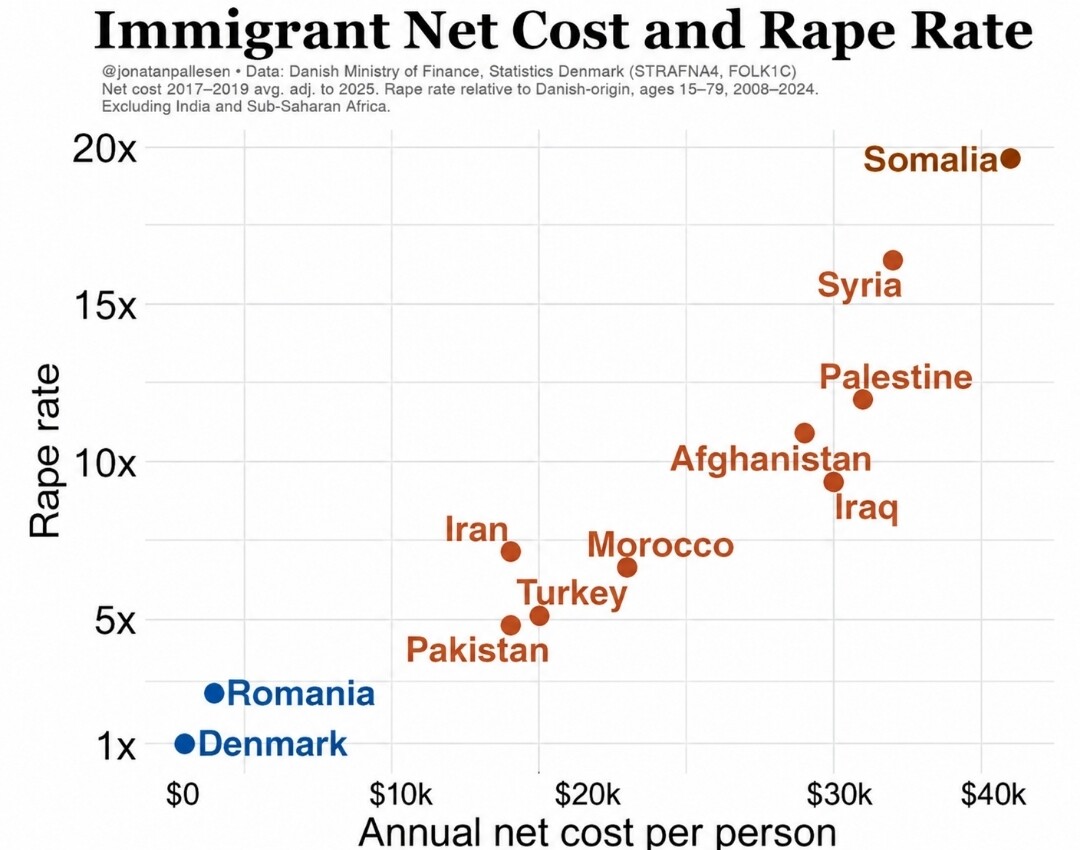
If you look at the crime data from all the Nordic countries and places like Germany who do collect this data though, the numbers are pretty extraordinary and uniform across those countries, so you’d assume similar applies in England.
Male immigrants from the middle east and north Africa are from some countries 20 to 40x more likely to commit sexual offences compared to the native population. The serious crime rates are really high as well. A few examples below.


1 Like

Madam Headcase strikes again .. and plugging her book to boot. And afaik and can detect, she’s copping a bit of ahem, diverging opinion on the socials.
1 Like
“Indentured labourers” were not the same as slaves. Many poor people from the UK went as indentured labourers to work in the West Indies. Robbie Burns was nearly one of them.
Yeah but if you didn’t work during the day they took away your teeth at meal times.
Pretty brutal terms.
2 Likes
That’s a semantic distinction, reflecting the idea that only blacks or “people of colour” were slaves. Did these poor people from the UK have any choice in the matter ? The Irish who were packed off to the WI certainly didn’t.
1 Like
Well Burns did as he decided to stay home. But I will leave itthere as I don’t want to defend the iniquities of the poms