I don’t suggest you go out looking / listening for the cockpit transmission to ATC. It’s horrendous.
8 Likes
The weather looked horrendous, possible icing causing stall of wings. The horizontal stabilizer looks missing in the photo due to the high air speed? Hit the ground at Mach 1.
3 Likes
Yeah looks like they lost the stab.
3 Likes
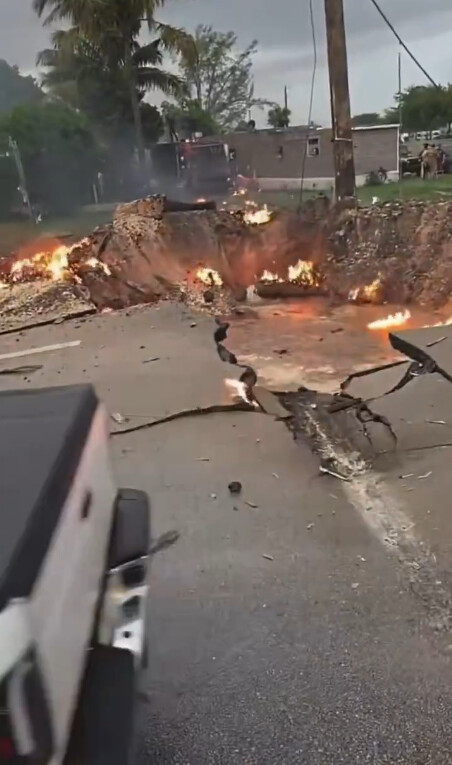
Listened to it a few times to try and understand what happened, wish I didn’t, horrifying.
2 Likes

Decent explanation of incident from online.
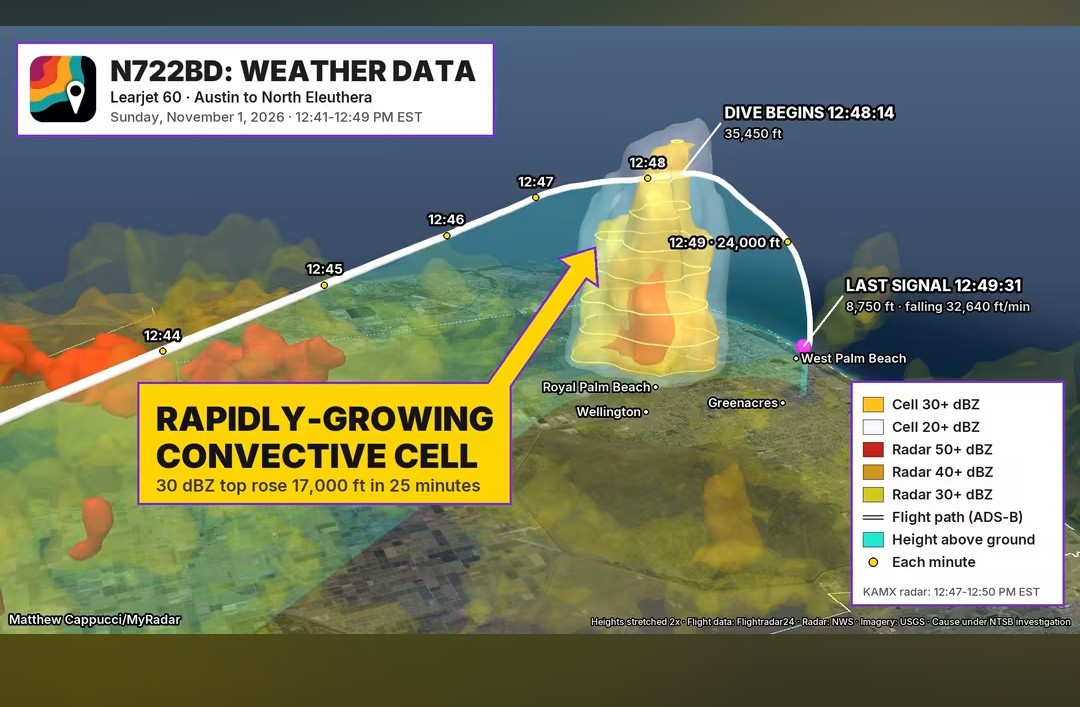
– At 12:47-48 p.m. ET, the aircraft passed over Royal Palm Beach/Loxahatchee Groves/Westlake, Florida, about 8 miles west of Palm Beach.
– A developing thunderstorm was present at that location slowly drifting northwest
– Pilots were given permission from Miami Center Air Traffic Control to “deviate left and right” due to “moderate precipitation… to the southeast.”
– ATC described the weather as “pretty nasty” as the aircraft was crossing the Florida Peninsula
– At 12:36 p.m., that thunderstorm was just under 33,000 feet tall. By 12:56 p.m., it was 48,300 feet tall. That’s an increase of more than 15,000 feet in 20 minutes, signifying VERY intense updrafts
– At 12:37 p.m., the captain said “[we] may need a slight left deviation for that weather up ahead”. Deviations were approved by Air Traffic Control. The aircraft was still about 8 minutes, and 80 miles, away from the thunderstorm cell it would later enter
– The rapid vertical development of the thunderstorm was likely accompanied by extreme turbulence
– Temperatures at the aircraft’s altitude were probably around minus-45 degrees Fahrenheit OUTSIDE the storm. Ordinarily, that would be too cold to support robust icing. (Clear glaze is most prevalent between 14 and 32 degrees, with mixing of clear/rime ice at colder temperatures. Rime ice is a danger below 0 Fahrenheit, but once you get to colder temperatures, there aren’t many supercooled water droplets left. HOWEVER, a rapidly-growing thunderstorm cloud can lift warmer temperatures, and more liquid water content, vertically upward. That can lead to extremely rapid icing in environments at altitudes where it otherwise would be a lesser concern.
– Within the cloud, it’s probable that severe turbulence was present
– At 12:47 p.m., the first officer said “we have light clear ice that is manageable and moderate turbulence.” The aircraft was entering the convective cell.
– At 12:48 p.m., the first officer asked to climb to 37,000 feet from 35,000 feet, noting an increase in precipitation
– The mayday call came approximately 20 seconds later
– Icing can occur extremely quickly, leading to rapid changes in the aerodynamic behavior of the aircraft. In severe icing situations, entire loss of maneuverability can occur.
The NTSB will be tasked with determining the cause and contributing factors. It’s likely that entering the rapidly-growing convective cloud played a role. The NTSB will investigate whether icing was a factor.
There are multiple accounts on social media, as well as compelling video footage, that appears to show the ill-fated aircraft missing its horizontal stabilizer moments before impact. It’s impossible to confirm if that was the case, but it’s reasonable to infer that extreme force may have caused substantial, or crippling, damage to the airframe. It’s unclear if damage occurred in the convective cloud or during the dive – and it’s unknown if any damage was a cause, or result, of said dive.
9 Likes
One of the more gruesome incidents I think I’ve ever seen and heard. Very confronting if you aren’t prepared for it.
4 Likes







2 Likes
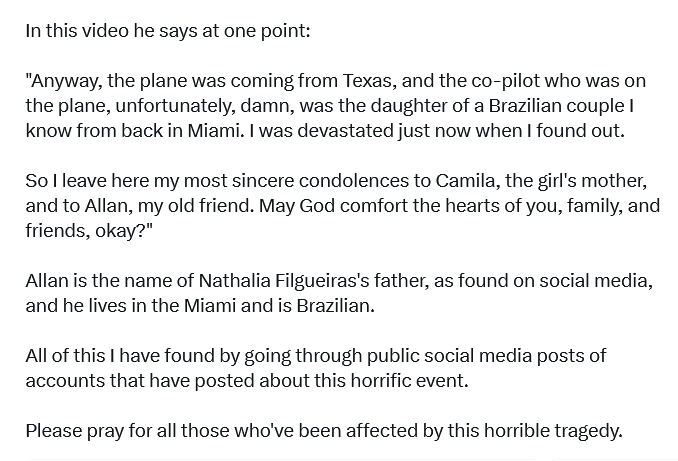
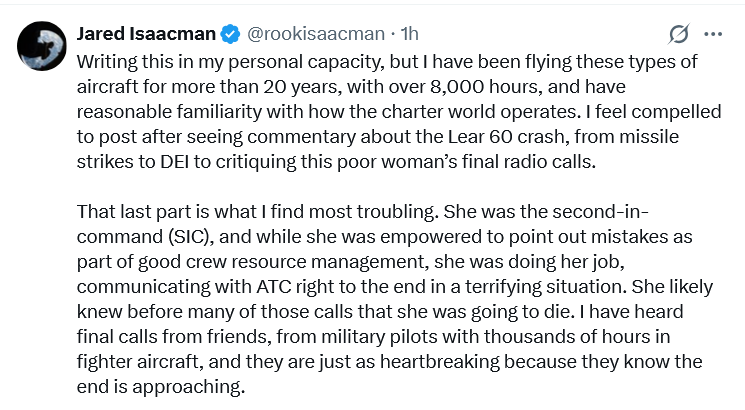
All those killed in the accident have been named.
The pilot has been identified as 55-year-old Jeff Gregory, an experienced pilot from Pennsylvania.
1 Like

1 Like
Good roundup but he didn’t slow down the impact video for a clearer look at the aircraft or even once mention the (apparently) missing horizontal stabilizer as a potential cause of the accident. He focuses on ice accumulation on the wings as a contributor to loss of lift and the aircraft stalling.
This is after he recounts how locals said that this was the worst thunderstorm they had seen in their lifetimes. A storm with (As reported by the FAA and the weather channel) tops above 40 000ft. Imagine the wind shear in the top of that. The co-pilot reporting “moderate” turbulence of +/- 700ft. Taking all this into account, catastrophic failure of the airframe (loss of the rear stabilizer) due to the forces imposed on it looks like a credible cause for the loss of control and subsequent impact.
1 Like
Not sure slowing the video down to show the impact for the purpose of this analysis has any bearing on the fundamental cause of the incident.
As for the missing horizontal stablizer safe to say that most likely broke apart due to the intense air speed , approximately 480 to 800 km/h which would not be the route cause of the incident and he does mention the possibility of the plane breaking apart.
Independent analysis suggests the aircraft may have peaked at Mach 0.9.
He clearly mentions 3 distinct possible causes, pilot, environmental (weather) and the plane that investigators will look at.
3 Likes
It would probably be safer to say that the tremendous lateral (vertical) loads from the storm’s powerful wind shear overstressed the tail, or the pilot’s extreme control inputs while attempting to recover from the storm-induced turbulence (+/- 700 feet!) inadvertently ripped the horizontal stabilizers off.
But, I am just conjecturing. Will await the outcomes of the investigation.
Yeah, impossible to say if the turbulence broke the aircraft up or the overspeed condition, after loss of control (which could have been severe icing).
A lot of fairly useless speculation occuring at this time.
3 Likes
Ouch. Lol.
3 Likes
I wasn’t meaning here, more aimed at the pundits on YouTube.
3 Likes
Please avoid self-confessed media expert clickbait. Bar the usual few, the pilot community is respectfully silent. Let the NTSB do their job.
4 Likes