8 Likes
Important article. Posting in full.



The remaining 19 percent of Ukrainian-held Donetsk Oblast is critical for Ukraine’s defense. Ukraine’s Fortress Belt is a concentration of four large cities in Donetsk Oblast and their satellite settlements running north to south along the H-20 Kostyantynivka-Slovyansk highway. The belt is 50 kilometers long (roughly 31 miles, about the distance between Washington, D.C., and Baltimore, Maryland) and had a pre-invasion population of over 380,000 people. Ukraine has spent the last 11 years pouring time, money, and effort into reinforcing the Fortress Belt and establishing significant defensive infrastructure in and around these cities.
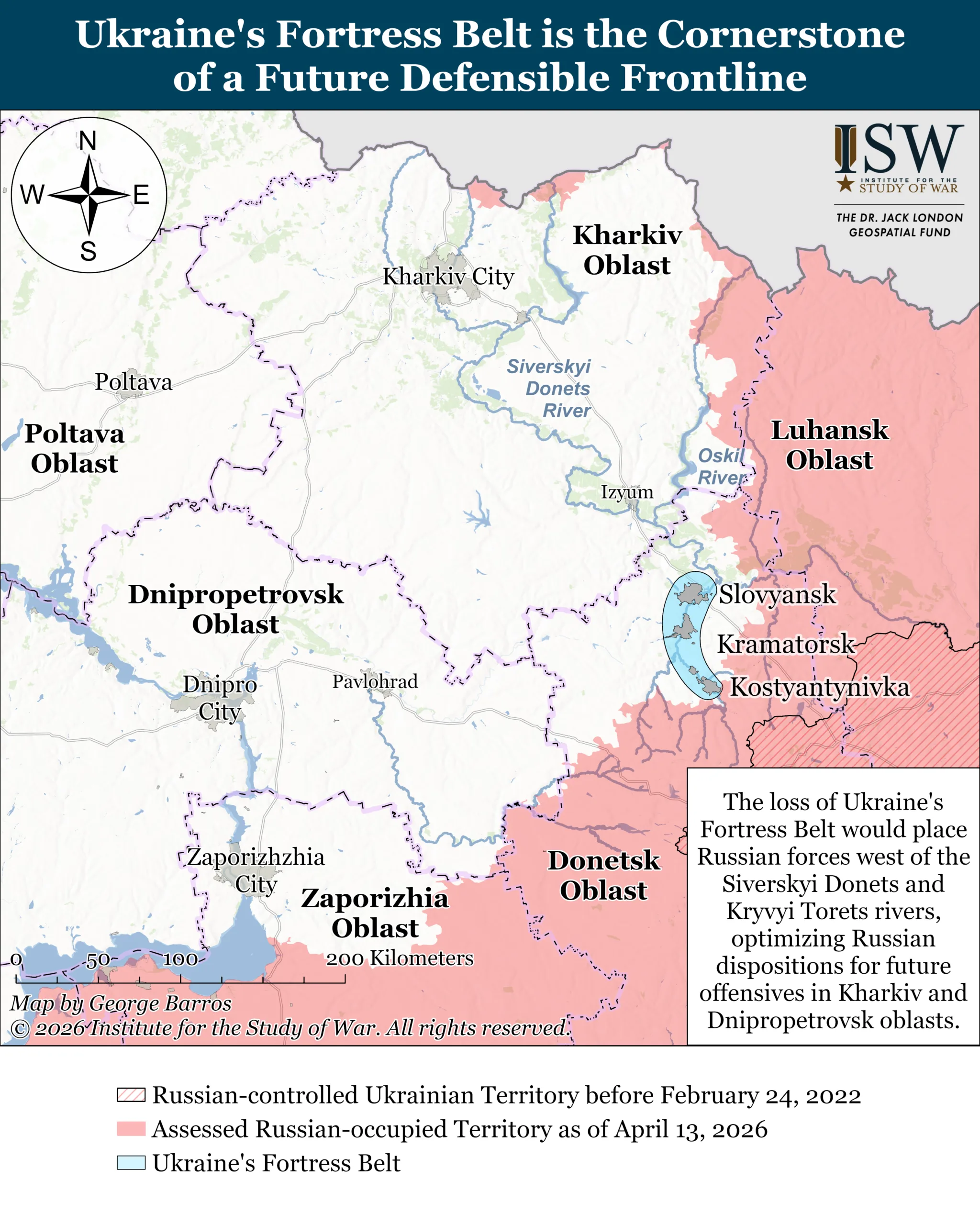
The Fortress Belt is essential to ensuring that Ukraine maintains a geographically defensible frontline in eastern Ukraine. Understanding the topographical significance of the Fortress Belt is highly relevant for US policy. For the past year, the Trump Administration has been leading negotiations with Russia and Ukraine to find an end to the war. One of the prerequisites for a robust and sustainable peace is ensuring that Ukraine maintains a geographically defensible front line to deny Russia from restarting offensives.
The military terrain analysis in this study assesses the Fortress Belt’s terrain on four characteristics: population density and urban development (including land use), water features, elevation and slope, and prepared defensive fortifications.
Population Density and Urban Development
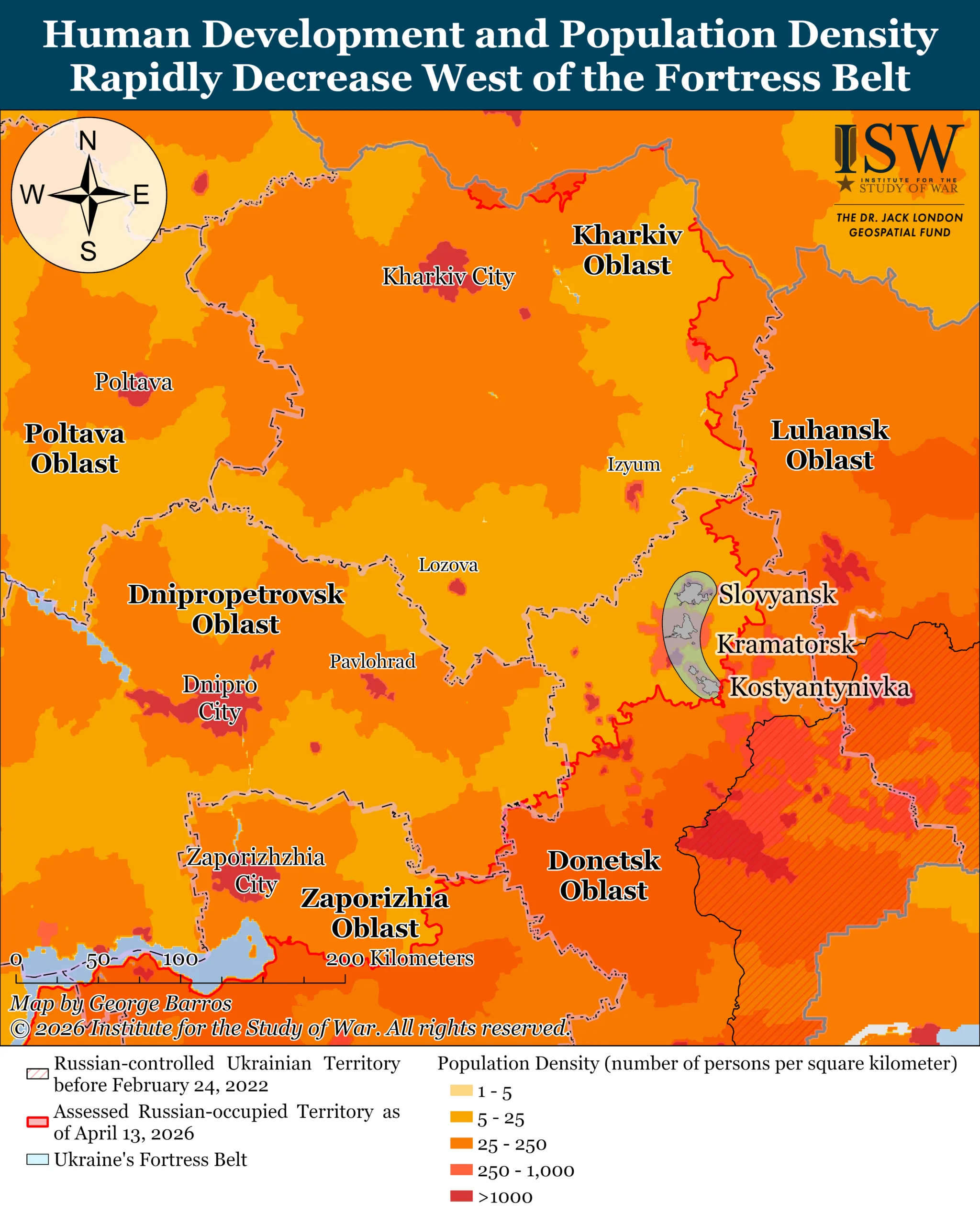
The urban buildup of the Fortress Belt and its satellite towns provides Ukraine with a significant advantage. Urban terrain magnifies the power of defenders and requires attackers to pay high costs to overcome defenders’ advantages. The Russian way of urban warfare is grueling, slow, and attritional. The high costs that Russia paid in the Battle of Bakhmut or the campaign for Pokrovsk will pale in comparison to those necessary to seize the Fortress Belt, assuming that Russian forces can even succeed. It took Russian forces a protracted campaign of nine months to seize Bakhmut — a town of 71,000 — and a campaign of 22 months to seize Pokrovsk — a town of 60,000 people. The average population of the Fortress Belt’s four key cities is 93,000, with Kramatorsk and Slovyansk having populations of 147,000 and 105,000, respectively. The urban area of the Fortress Belt’s main four major cities is over four times larger than the area of Bakhmut, and over seven times larger than that of Pokrovsk.
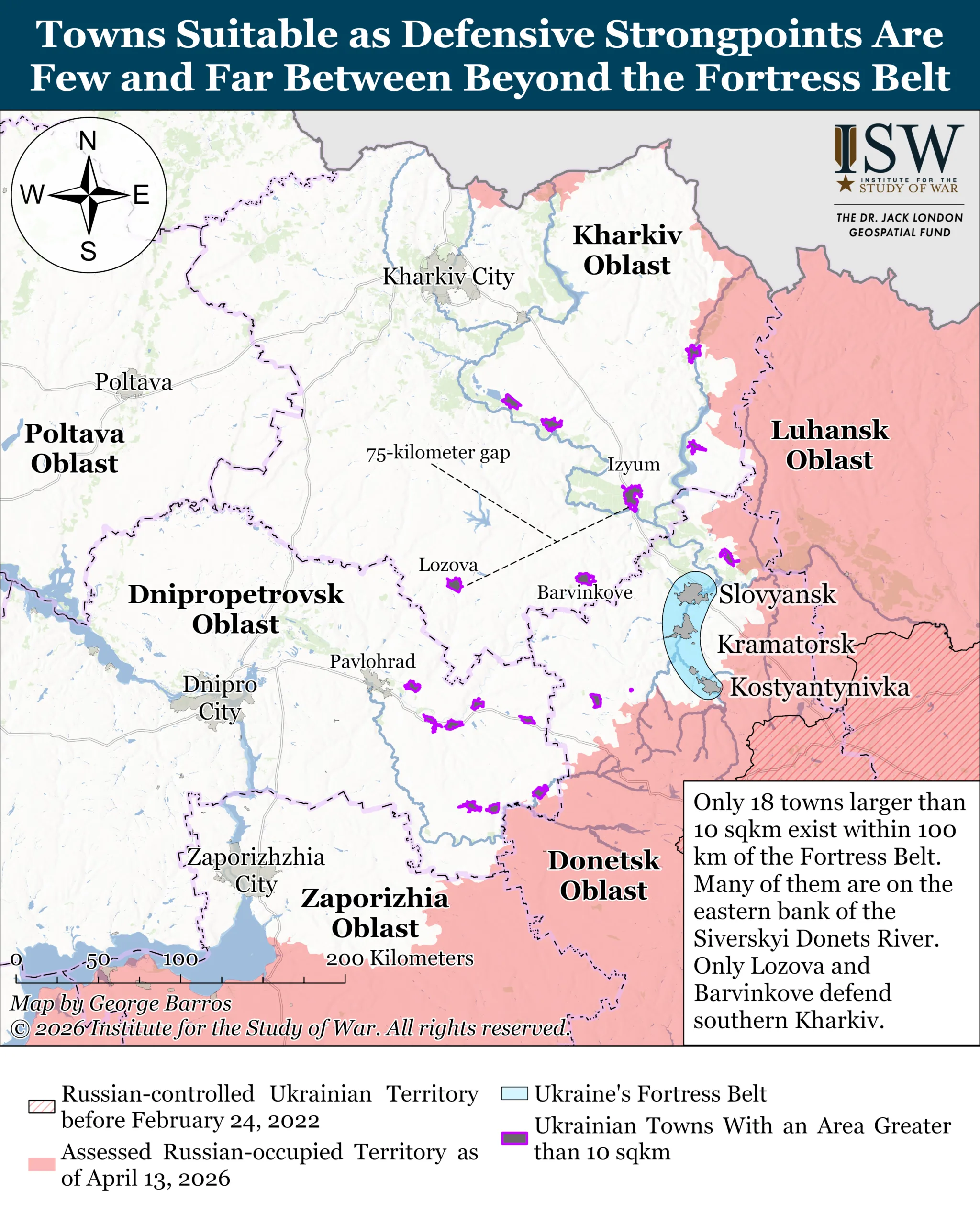
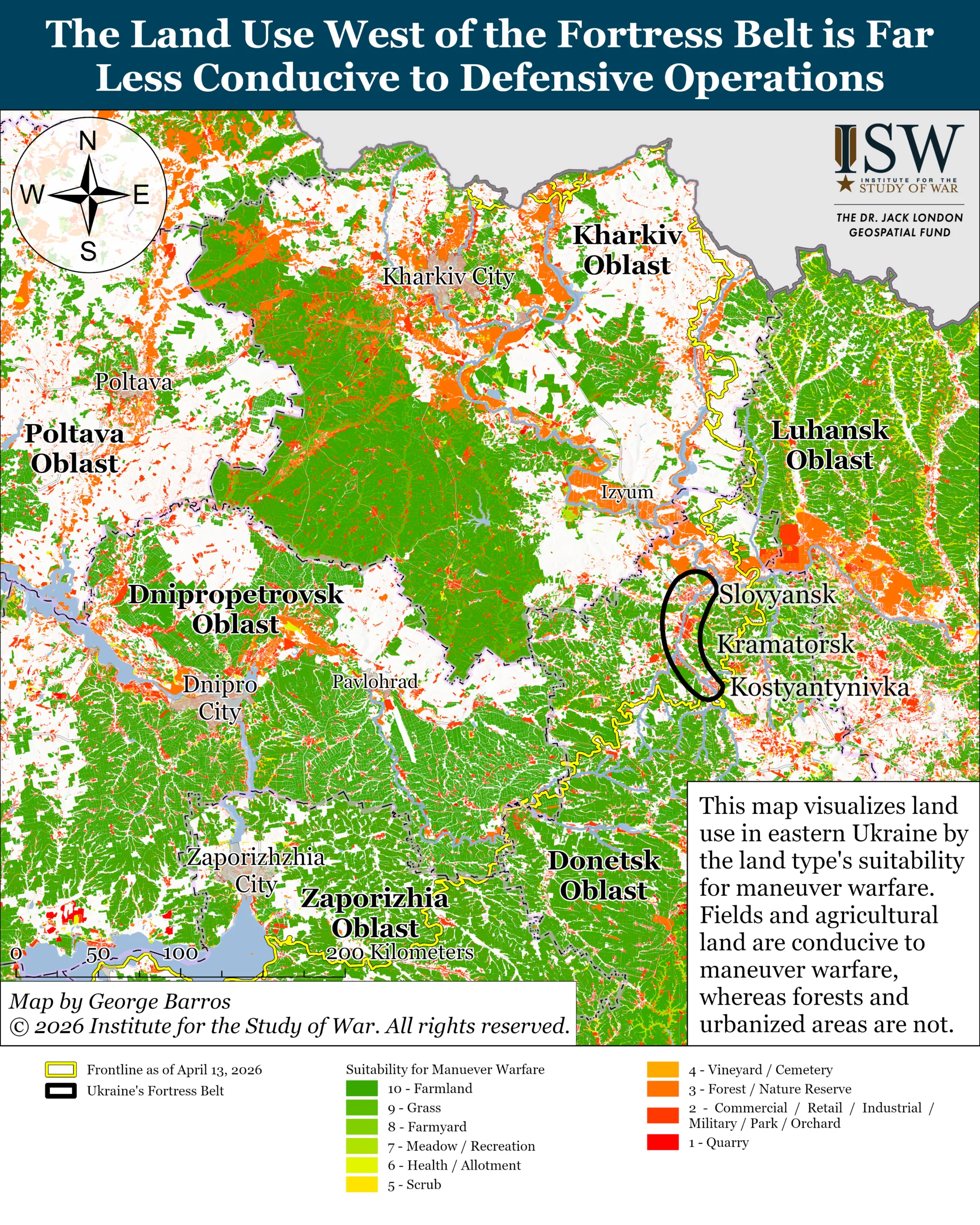
By contrast, the terrain west of the Fortress Belt in southern Kharkiv is sparsely populated. This area contains fewer settlements capable of serving as strongpoints to anchor a Ukrainian defensive line and fewer roads to support Ukrainian logistics. Most settlements in the area are small agricultural hamlets and villages. There are only 18 Ukrainian-controlled towns of moderate size within 100 kilometers of the Fortress Belt. The largest by population is Lozova in Southern Kharkiv (pre-war population of 53,000), but it is over 80 kilometers from the Fortress Belt, and it stands in isolation, far from other towns that could form a line. The data showing population density, locations of moderately-sized towns, and land use paint a clear picture. There is a geographically vulnerable gap that would be easier for Russian forces to exploit, should Russia control the Fortress Belt. The rural corridor between Lozova and the Izyum forest is particularly concerning in this regard.
Water features
Water features present major obstacles to maneuver warfare and even in positional warfare, and crossing defended water obstacles has been an exceedingly difficult task for the Russian military throughout the war.[1] The water features of eastern Ukraine play a significant role in making the Fortress Belt’s terrain inherently favorable for defense. The Fortress Belt’s northern flank is protected by the Siverskyi Donets and Oskil rivers. The curvature of the Siverskyi Donets forces Russian attackers to approach the Fortress Belt’s prepared defenses from the eastern direction head-on.
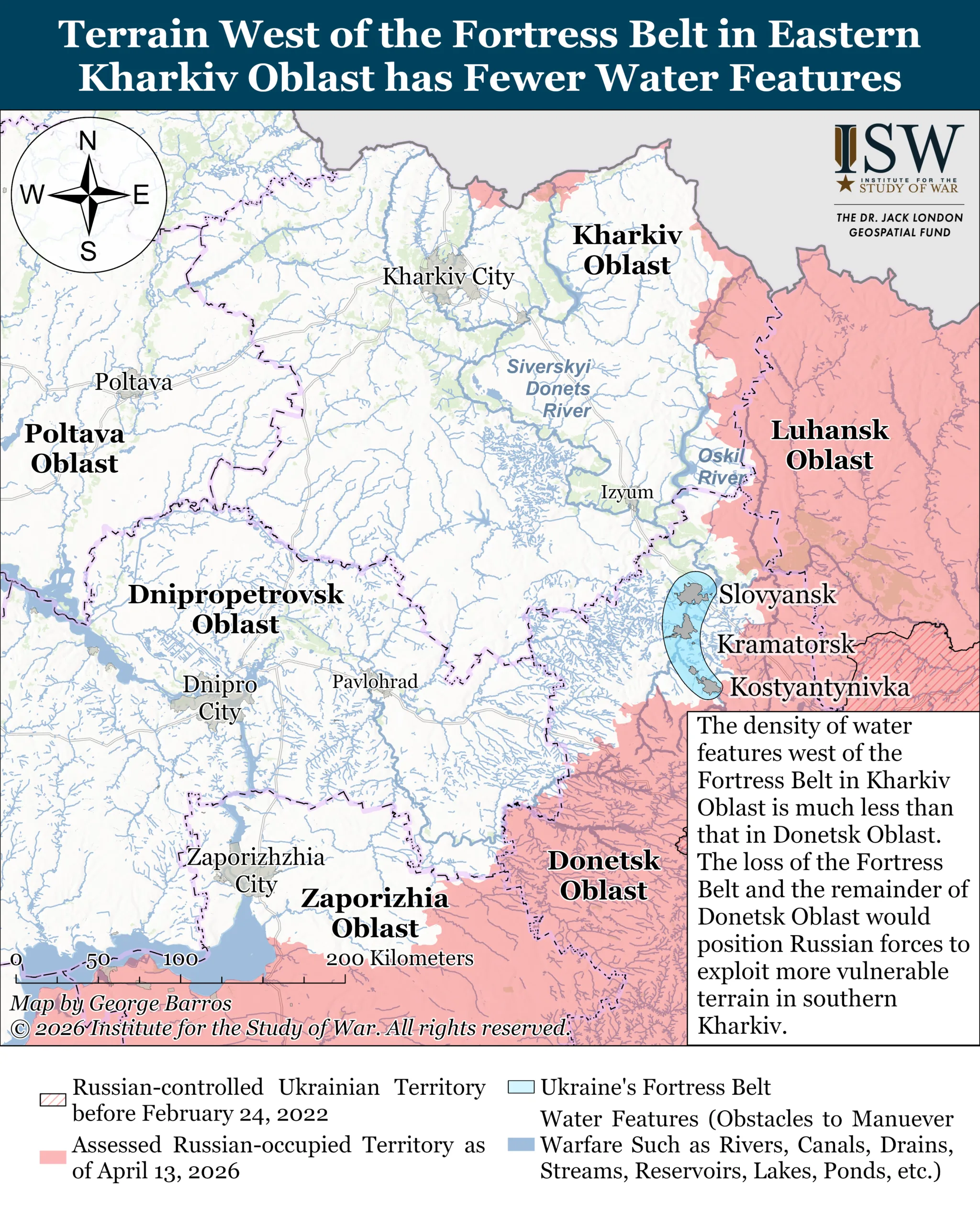
In contrast, the terrain west of the Fortress Belt has significantly fewer water obstacles around which Ukrainian forces can organize defenses. This terrain would grant attacking Russian forces greater freedom of movement and is not optimized to canalize Russian forces into prepared kill zones. The loss of the Fortress Belt would squarely place Russian forces on the western bank of the Siverskyi Donetsk River and several of its tributaries – optimal terrain to continue pushing further west.
Elevation and Slope
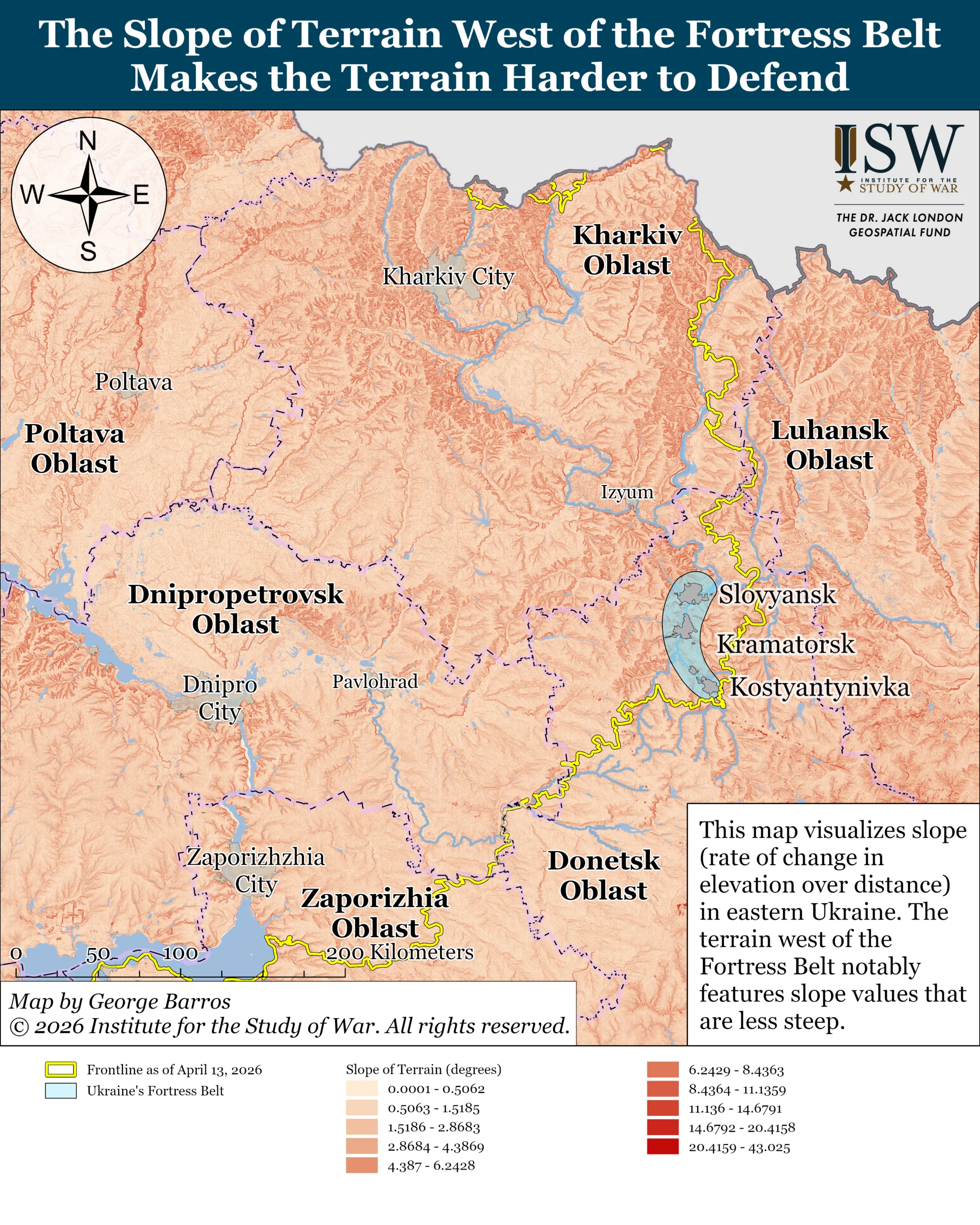
Eastern Ukraine, in general, is very flat, but there are micro terrain characteristics related to elevation and slope that optimize the Fortress Belt’s terrain for defense. The Fortress Belt notably sits atop terrain with steeper elevation slopes. These micro terrain details force Russian forces to navigate uneven terrain and provide Ukrainian defenders with various tactical high ground positions, which lend themselves to defense. High ground is additionally important for modern drone warfare, as radio-controlled drones rely on communication equipment placed on high terrain to maximize signal projection.
In contrast, the terrain west of the Fortress Belt has comparatively shallow slopes. Furthermore, this terrain leads into Ukraine’s Dnipro lowlands – a flat open steppe and floodplain ideal for rapid movement of large forces. If Russian forces controlled the Fortress Belt, Russian forces moving west would be attacking into this lowland. For Ukraine, defending in the lowland is sub-optimal, as Russian attackers would hold an elevation advantage.
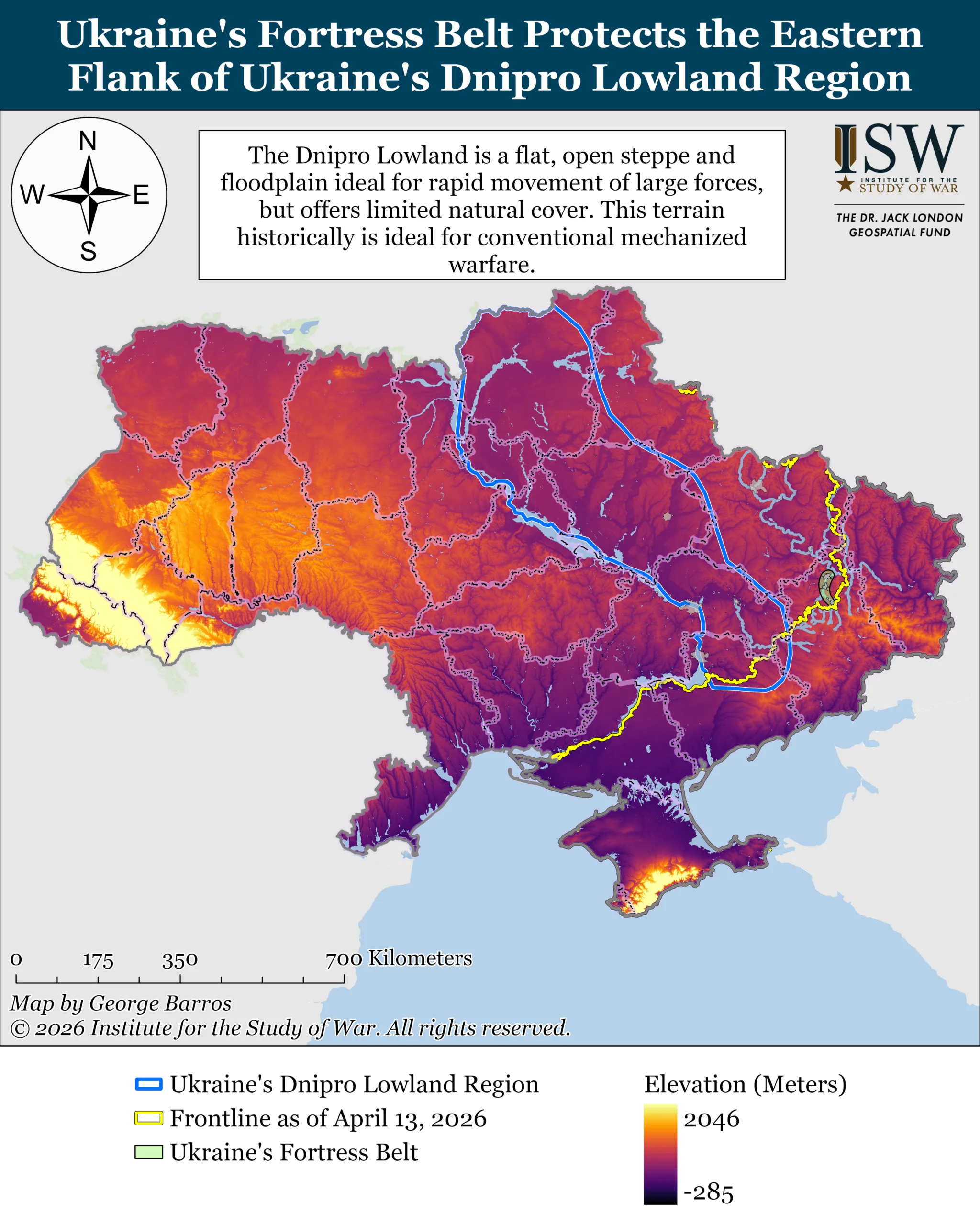
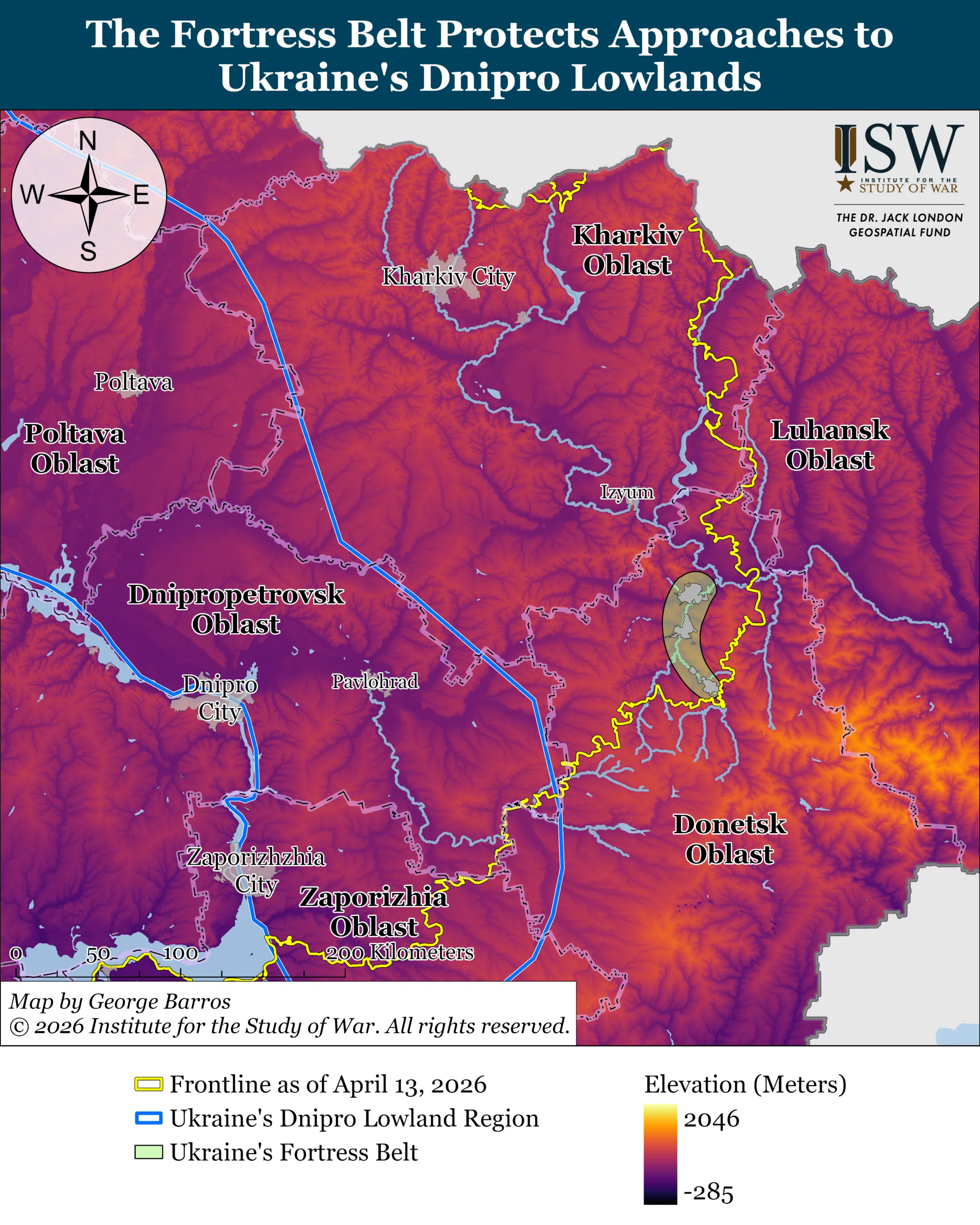
Ukraine’s field fortifications. Ukrainian engineers have built an extensive network of field fortifications over the past 11 years, including multiple miles of fighting positions, anti-vehicle ditches, rows of dragon’s teeth, barbed wire, and minefields to synergize with and amplify the naturally defensible terrain features mentioned above.[2] The loss of the Fortress Belt would require Ukraine to dig new fortifications in southern Kharkiv and eastern Dnipropetrovsk oblasts, but the physical characteristics of this terrain and its human geography are simply poorly suited for defense.
Conclusion
The Fortress Belt is optimized for defense across nearly every topographical and geographical characteristic relevant for military terrain analysis. The human geography and natural terrain present a unique confluence of factors favoring defense, which is why Ukraine has picked this land to build elaborate fortifications for a pitched battle. If Russia were to gain control over the Fortress Belt, Moscow would occupy favorable lines for launching drives into vulnerable terrain that significantly favors attacking forces over defenders. It is for these reasons that the Kremlin’s negotiation strategy seeks to secure a political settlement in which Ukraine would surrender the Fortress Belt’s critical terrain without a fight.
The battlefield reality is that Russia remains unlikely to seize the Fortress Belt anytime soon. Ukraine’s lines are holding and will likely continue to hold. The situation on the battlefield is difficult but not critical for Ukraine. While Russian offensives remain dangerous, a collapse of Ukraine’s defenses is increasingly unlikely.[3] Russian forces’ best prospects for 2026 are continued marginal gains. Russia will not seize the remainder of Donetsk Oblast this year. Under optimized assumptions that benefit Moscow, Russian forces may be able to seize Donetsk in late 2027 or early 2028, assuming Ukraine’s international partners continue to support Ukraine. But even this forecast, with assumptions favoring Russian performance, is not certain. In February of this year, Ukraine liberated more territory than Russia seized for the first time since 2023 – a trend that, if continued and reinforced, can deny Russia’s ability to seize the Fortress Belt at all. In 2025, Russian forces gained on average 15sqkm per day.[4] Russian forces advanced at an average of 5.5 square kilometers per day in the first three months of 2026, compared to an average rate of 11.06 square kilometers per day in the first three months of 2025.[5]
Ukraine’s Fortress Belt must continue to serve as the cornerstone of a future Ukrainian battlefield geometry that is militarily defensible. The reasonable starting point for conflict termination is the current de facto lines of control, including a Ukrainian-controlled Fortress Belt. Ukraine’s preemptive surrender of swaths of strategically vital fortified terrain would be a strategic mistake and undermine the Trump Administration’s goal of achieving a robust and lasting peace. It is not inevitable that Russian forces will seize the Fortress Belt, and it is unclear whether Russia’s economy, defense industrial base, and force generation system can sustain several years of additional campaigning needed to seize it.
9 Likes
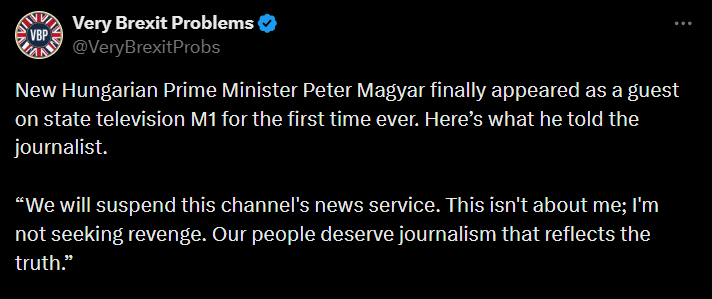
“We will nationalize the assets given to businesspeople and foundations during the Orbán era.”
“The Mathias Corvinus Collegium Foundation, close to Orbán, was transferred 10% of MOL (oil company) and Gedeon Richter (pharmaceutical company) for free. We will take back these shares.”
“After 16 years of the Orbán era, 400,000 Hungarian children in this country are living in deep poverty.”
“President Sulyok is no longer the president of this country in my eyes or in the eyes of the people.”
(In response to the host asking about his meeting with Zelensky as a counterpoint) “I get your joke, and I even like it. But your references no longer carry any meaning.”
“According to you, Germany has collapsed, there’s no internet there, people aren’t even having sex. The Hungarian people were laughing at you.”
“It was said on this channel that even my young children won’t talk to me, when in fact my children live with me.”
(When the host interrupted him) “No host in this studio ever dared to interrupt Hungary’s most corrupt and most lying prime minister.”
(When asked about the legal basis for closing the news service) “For someone on this channel to accuse me of breaking the law looks like a thief accusing the police.”

25 Likes
That pen sketch of the Russian methodvis hilarious and l suspect very accurate.
1 Like
The Fortress Blet hold the strategic key to this entire conflict. Holding on to it means RU cannot win.
3 Likes
Hungary’s incoming Prime Minister Peter Magyar has made a significant foreign policy statement following his election victory, describing Ukraine as “the victim in this war” and rejecting any proposals that would force it to give up territory as part of a peace deal.
In comments made during a press conference in Budapest on April 13, 2026, Magyar said no country should be pressured into surrendering land after years of conflict, emphasizing that peace terms must not be imposed externally. He also drew historical comparisons to Hungary’s 1956 uprising against Soviet rule, framing his position as one rooted in national sovereignty and resistance to external pressure.
His remarks represent a clear shift from the previous government led by Viktor Orbán, which maintained close ties with Russia and often took a more cautious stance on support for Ukraine within the European Union.
Magyar also indicated willingness to engage diplomatically with Russian President Vladimir Putin if necessary, while stating his preference for ending the war quickly. At the same time, he confirmed that Hungary would no longer block EU financial support for Ukraine, though he ruled out sending weapons or troops and emphasized the importance of protecting Hungarian minority rights in Ukraine.
Ukrainian President Volodymyr Zelensky has welcomed the political change, expressing readiness for dialogue and future cooperation. The statements signal a potential realignment in Hungary’s approach to the ongoing conflict and its role within the European Union.
21 Likes
That’s so fantastic to hear that coming from the Hungarian PM. Good on him and good on the Hungarian people for forcing that change.
5 Likes
Understatement of the century…
6 Likes
Sounds like he means business. Hope he doesn’t accept any tea offered by strangers.
2 Likes

4 Likes
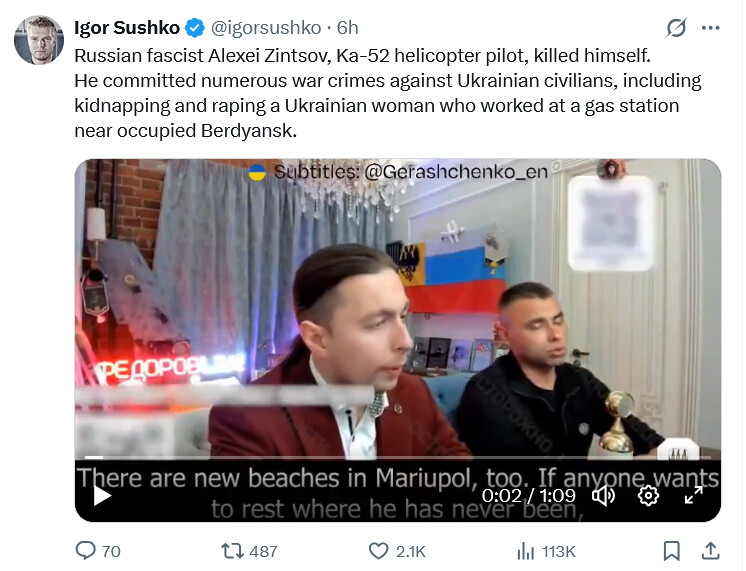
Lol, she admits she’s a cockroach at the 6 min mark. Her and her dead husband.
2 Likes
Morning everyone
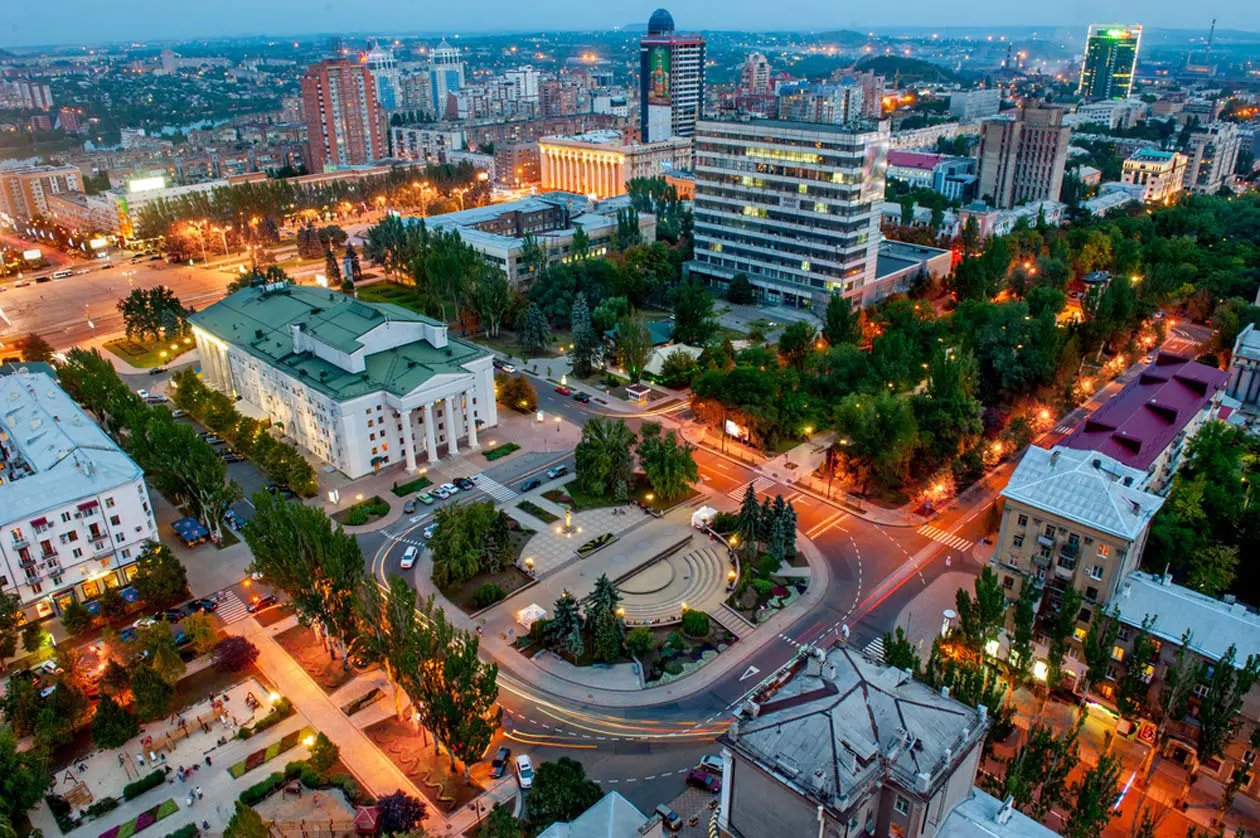
Donetsk city before the war.
Donetsk, situated in eastern Ukraine on the River Kalmius, is the largest city of the Donets Basin, a tributary of the River Don from which the city took its name. It was founded in 1869 by a Welsh businessman John Hughes, who built a steel works and several coal mines near Olexandrivka, a Cossack village.
5 Likes
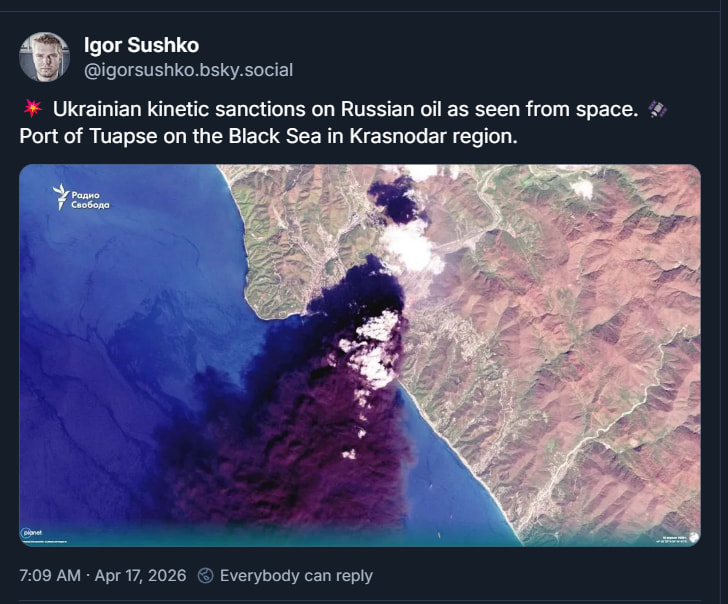
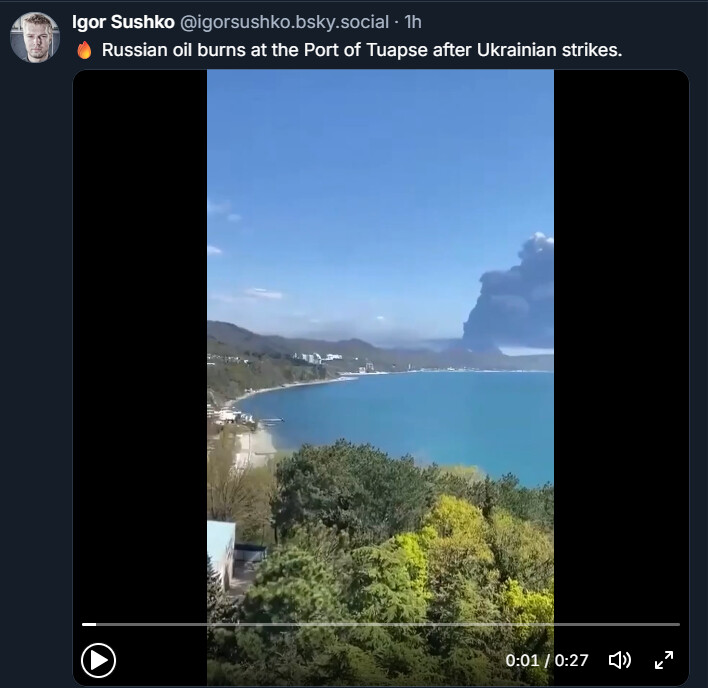
1 Like
You know, the thing I just can’t get my head around in this whole illegal invasion is this.
I was living in Christchurch during the earthquakes. Buildings crumbled, debris everywhere, no power, no sewage, no water, fatalities, military. A sense of emergency. A once beautiful city in ruins.
It was like a war zone. Except it wasn’t. It was a natural disaster and there were people there, people from different countries helping out with the rescue. And in that moment - watching foreigners assisting us in that time of need - I thought people are beautiful.
And then there’s Ukraine and the above photo of that beautiful area of the city, which is no doubt no longer looking like that. It’s probably destroyed - a war zone.
But it’s not a natural disaster- it’s a man made deliberate act of destruction.
And it just doesn’t make sense that on the one hand, we do everything to reduce the impact of destruction from natural disasters and the devastation they have on a city and its people, yet on the other - we actively and deliberately set out to create it - to inflict massive suffering on a city and it’s people.
It’s just sad - and people are not beautiful.
Fark Russia, Fark Putin, Fark Trump.
3 Likes