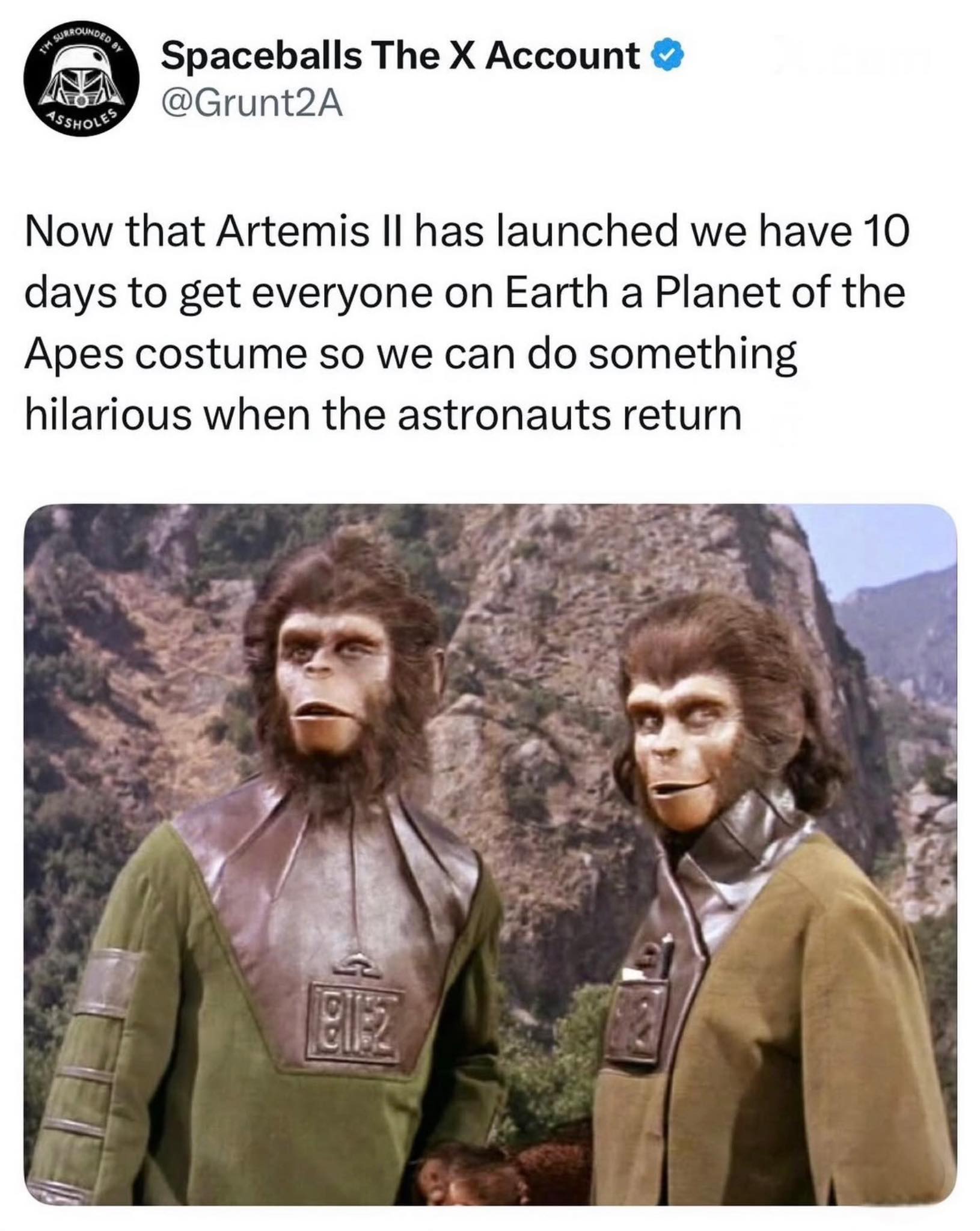
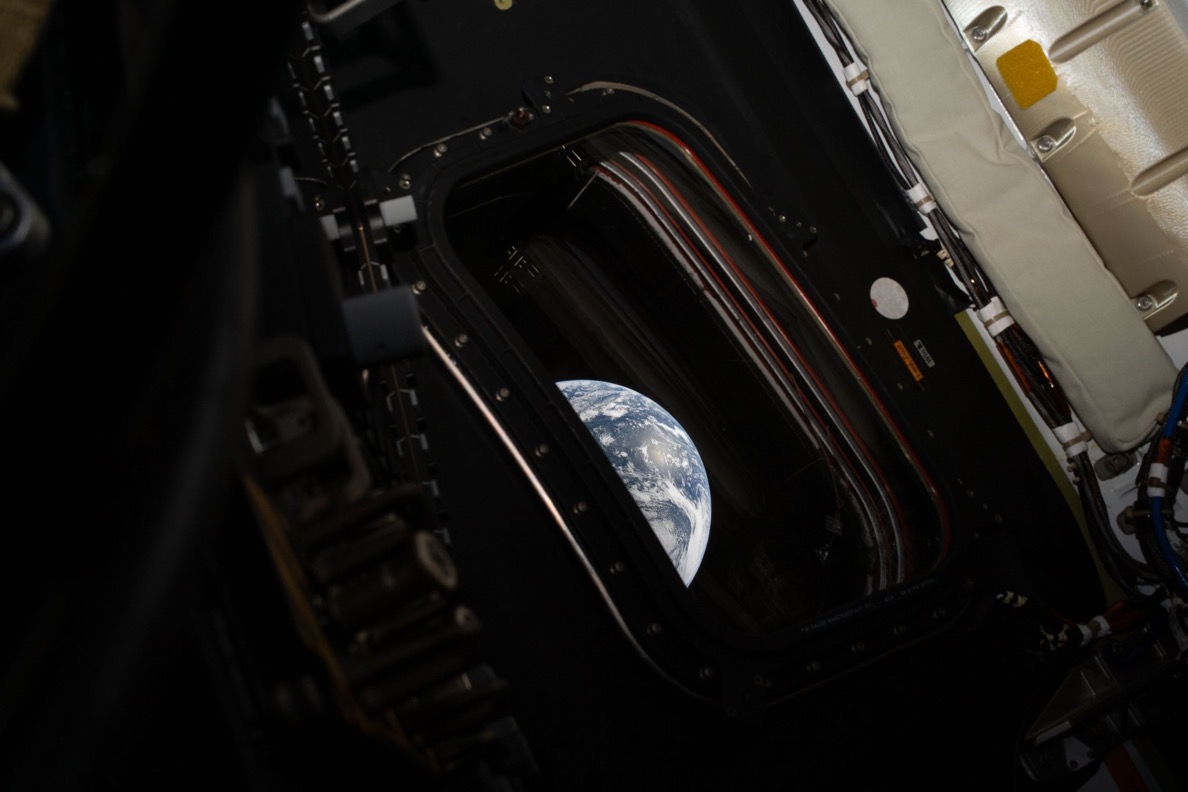
I did yesterday in the lead up to launch. Just know what and who to follow to keep up to date. I do have an iPad always on.
Space and rockets are my passion so loving life.
Are you able to see anything with a telescope? Dumb question I know but if you could I would go and buy one.
You can see the moon. Will be very nice.
Will this same crew be the ones who will land on the moon in 2028?
Doubtful any of these astronauts will be chosen for Artemis 4 in 28.
Maybe some on a later flight.
Lovell flew Apollo 8 which is the same profile as this flight going around the moon. His next flight was Apollo 13. They didn’t land because the issues they had.
Forget who said it but Artemis II program is basically to scout the moon on where they can park when we land on the moon in 2028
It’s more about testing the life support and how humans can operate it with it being the first time astronauts have been in the Orion capsule.
NASA has 9 sites shortlisted near the South Pole. They have the lunar reconnaissance orbiter scanning the surface to help them decide between the sites.
Man cant wait till we actually land on the Moon
And come back safely.
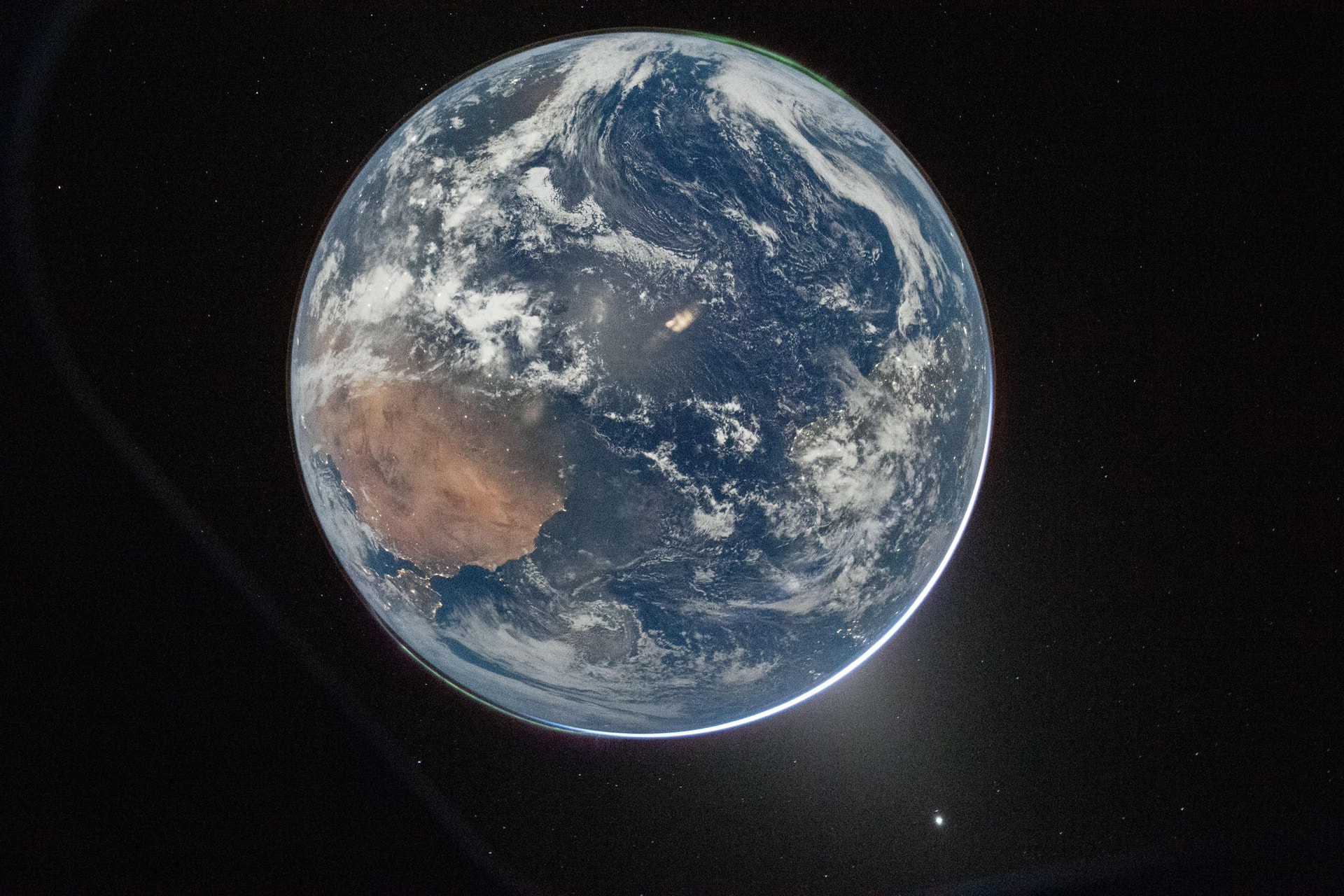
That’s us. That’s it. I like the aurora up top. Clearly shows how small our atmosphere is. That tiny bubble we rely on for life.
AI and machine learning being used for good and not stupid memes and wrong answering of basic questions.
ML review of TESS data results has found 100’s of new exoplanets and 1000’s of new candidates that were not discovered by astronomer review of the data.
“It’s fLAT! SeEE I tolD yOU!”
Our entire existence and history as we know it sits alone in the vast emptiness of space
Look again at that dot. That’s here. That’s home. That’s us. On it everyone you love, everyone you know, everyone you ever heard of, every human being who ever was, lived out their lives. The aggregate of our joy and suffering, thousands of confident religions, ideologies, and economic doctrines, every hunter and forager, every hero and coward, every creator and destroyer of civilization, every king and peasant, every young couple in love, every mother and father, hopeful child, inventor and explorer, every teacher of morals, every corrupt politician, every “superstar,” every “supreme leader,” every saint and sinner in the history of our species lived there–on a mote of dust suspended in a sunbeam.
The Earth is a very small stage in a vast cosmic arena. Think of the rivers of blood spilled by all those generals and emperors so that, in glory and triumph, they could become the momentary masters of a fraction of a dot. Think of the endless cruelties visited by the inhabitants of one corner of this pixel on the scarcely distinguishable inhabitants of some other corner, how frequent their misunderstandings, how eager they are to kill one another, how fervent their hatreds.
Our posturings, our imagined self-importance, the delusion that we have some privileged position in the Universe, are challenged by this point of pale light. Our planet is a lonely speck in the great enveloping cosmic dark. In our obscurity, in all this vastness, there is no hint that help will come from elsewhere to save us from ourselves.
The Earth is the only world known so far to harbor life. There is nowhere else, at least in the near future, to which our species could migrate. Visit, yes. Settle, not yet. Like it or not, for the moment the Earth is where we make our stand.
It has been said that astronomy is a humbling and character-building experience. There is perhaps no better demonstration of the folly of human conceits than this distant image of our tiny world. To me, it underscores our responsibility to deal more kindly with one another, and to preserve and cherish the pale blue dot, the only home we’ve ever known.
— Carl Sagan, Pale Blue Dot, 1994
I am convinced that just like a cell is a tiny part of something huge which it will never understand, so are we.
Must feel like an out of body experience for those four astronauts floating in space seeing Earth from the outside.
William Shatner when he went up to space and saw Earth for the first time it got him emotional said he never felt anything like it said it’s change him on how we view life etc.
William “Bill” Anders, was the lunar module pilot on NASA’s Apollo 8 mission.
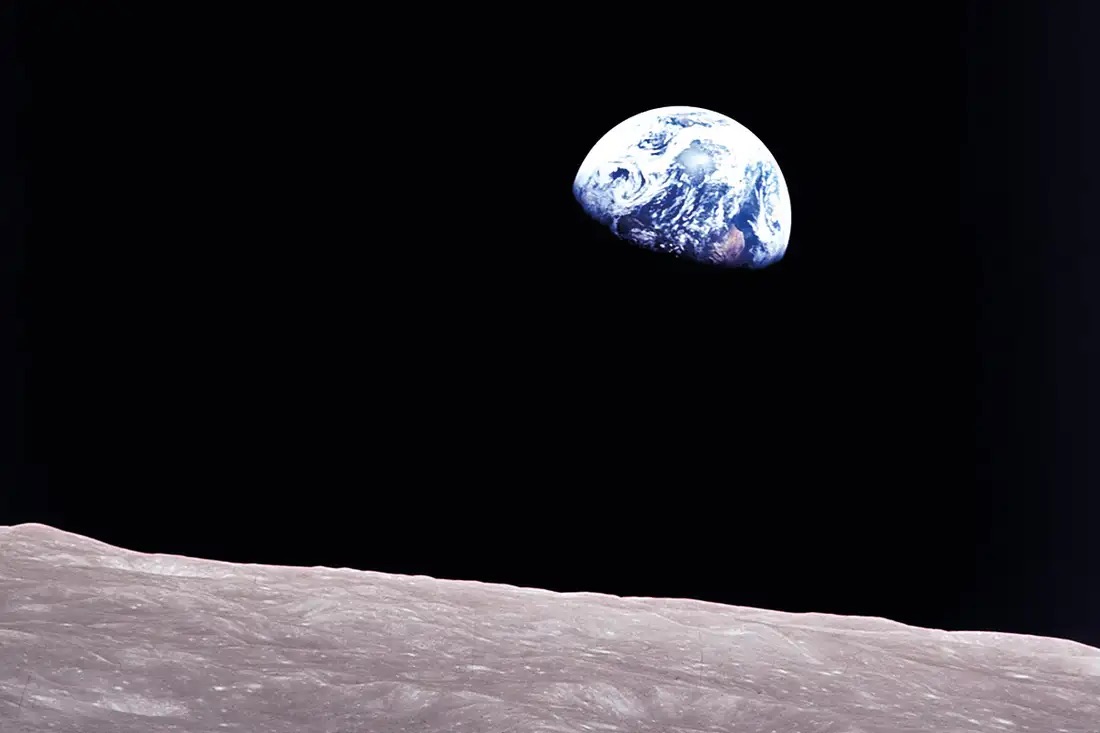
On December 24, 1968 (Christmas Eve), Anders, along with crewmates Frank Borman (commander) and Jim Lovell (command module pilot), became the first humans to orbit the Moon. As their spacecraft emerged from the Moon’s far side, Earth dramatically rose over the lunar horizon. Anders spotted it first and captured the famous color image using a Hasselblad camera with color film.
Here is the Earthrise photo he took:
“Oh my God, look at that picture over there! There’s the Earth comin’ up. Wow, is that pretty!”
(He then urgently asked for color film: “You got a color film, Jim? Hand me a roll of color, quick…”)
“We came all this way to explore the Moon, and the most important thing is that we discovered the Earth.”
This quote beautifully captures the spirit of the Overview Effect—realizing Earth’s beauty, fragility, and preciousness from a new perspective, rather than focusing solely on the Moon.
Bill Anders passed away in 2024 at age 90.
This single unplanned photograph, taken while focused on lunar science, became one of the most influential images of the 20th century. It helped spark the modern environmental movement by showing Earth as a small, isolated oasis in space with no visible borders.
2 of my favorite Carl Sagan speeches including the one you posted.