I once worked with a Lloyds Broker in London. The floor traders doing the shipping and reinsurance led such exciting lives. We were located within the sound of the Lutine Bell but I never heard it.
My wife is feeling really down, in a large mother WeChat group there was talk that 3 children under the age of 12 had killed them selves this week due to pressure from study. 2 were In Primary school and that is just this week and in Nanjing and nothing will be done
1 Like
Is this driven by Parents or the Chinese Education system ?
JFC that’s awful. My thoughts to the families. Singapore has similar pressures. We are insulated somewhat by sending our kids to an Australian International School but we see our kids Singaporen parents sending their kids for tutoring after 8 hour days.
2 Likes
I have the same question as Bacchus.
From my experience in China the pressure on students to perform came from (all of these drivers overlap)
- parents
- very competitive job market
- culture of hard work
Within the Chinese university system, I found the academics very supportive of and caring towards their students. Actually, to my surprise they put us in the Australian system to shame as we have little care for the individual student.
The Australian tertiary system is all about deriving income from international students.
2 Likes
When l worked at an international school in Bangkok l would regularly see grade 1 & 2 students struggling under the load of 3 - 5 heavy textbooks to take home each night. I had a grade 3 at the time, and would set a maximum of one piece of homework each night. When asked why l didn’t set more, l said l wanted the kids to have a chance to be kids. I also worried about the effect on the kids’ spines from lugging a pack full of heavy texts, it couldn’t be good for their health.
Because of the density of Bangkok traffic, we started classes at 7.30 in the morning. Since many kids arrived in vans from across the other side of the city, it meant many were being picked up before 6.30, which also meant many were getting up before 6.00, in some cases way before 6, even kindergarten students. Most fell asleep in the vans. We finished the school day at 3.30 and l am sure many of the kids also slept in the vans on the way home.
3 Likes
Want a politically-correct life partner? There’s an app for that
China’s “social credit score” system has taken a dark new twist with a bizarre plan to turn around collapsing marriage and birth rates.
China’s “social credit score” system has taken a dark new twist. What you do, drink, buy and say could now determine whom you are allowed to date.
The Chinese Communist Party commissars of Jinan city in Shandong province are pulling everything they know about the 650,000 citizens under their control into one State-controlled singles dating app.
It’s called Palm Guixi.
And it’s the regional response to Chairman Xi Jinping’s order to turn around the nation’s collapsing marriage and birth rates.
The idea is simple.
Build comprehensive profiles about eligible young men and women’s personalities, habits, preferences, behaviours - and affiliations. Boil these down to scores. Run them through an AI. Then organise a blind date for the resulting ideal match.
Put simply, the Communist Party of China has got a math problem.
There were 7.6 million first-time marriages in 2021. That’s 500,000 fewer than the year before and 5 million less than in 2013.
And marriages are needed to produce future party members.
That’s not happening.
Since abandoning a long-standing one-child policy in 2016, national birth rates have plummeted. Only 6.8 children were born for every 1000 people in 2022.
And that’s despite Beijing having mandated three children for every household.
While demographers believe recent birth declines are a statistical anomaly brought about by Beijing’s draconian COVID-19 lockdown policies, it underscores long-standing fears for the nation’s future.
Now the Party has renewed its efforts to bring more of the right kinds of people together to generate more marriages and, therefore, more babies.
But it doesn’t think young unmarried Party members can work it out for themselves.
Let’s get this party started
Chairman Xi Jinping’s tenure as chief of the Chinese Communist Party wants the role of women within Chinese society revisited.
The idea of the People’s Revolution was for gender equality in all things.
But Xi wants to bring back elements of traditional Confucian philosophy.
In 2013, during one of his first speeches as a national leader, Xi proclaimed it was crucial for women to be “good wives and mothers” to ensure the “healthy growth of the next generation”.
Ten years later, that idea is being turned into law.
As of January, the updated Women’s Rights and Interests Protection Law formally demands “women should respect and obey national laws, respect social morals, professional ethics and family values.”
And Xi has repeated his expectation that Chinese society must “give full play to the unique role of women in promoting the family virtues of the Chinese nation.”
Those virtues and values have yet to be clearly defined. But the message comes amid loud calls to “pass on the red gene from generation to generation”.
That means young women focused on their studies and careers are now officially out of step with Communist Party policy.
‘Leftover women’
Marriage in China has traditionally been a community affair.
Parents, village elders and business leaders regularly gather to identify suitable pairings. Then the full weight of peer pressure would be brought to bear.
But an emphasis on advanced education in the 1990s and the arrival of internet dating in the 2000s have pushed this practice aside.
Young men and women have become used to finding partners that suit their tastes, needs and styles. And women have chosen careers ahead of children.
The Ministry of Education now considers these to be “leftover women”.
It has instructed schools to teach girl students that not marrying was “self-serving and oblivious to family morality and imperatives of national development”.
“Leftover women” have since embraced the label in ironic protest.
Women, however, aren’t the only target.
Beijing is raging against “foreign influences”. It has formally banned men from appearing “too effeminate” in an effort to reinforce what it calls China’s “revolutionary culture.”
The Chinese Communist Party can’t afford such loose ends.
The one-child policy of 1979 resulted in parents choosing boys over girls.
While the central government-enforced quota was abandoned in 2016, up to 16 per cent of the Chinese population now has little hope of finding a marriage partner.
And most of them are now of marriageable age.
Sex, lies and spies
Beijing has been cracking down hard on China’s digital culture.
Access to online video games has been restricted. Digital tutors are out of favour. Even online shopping has begun attracting strict new regulations.
But the dating app industry has exploded.
And Beijing’s been turning a blind eye.
Last year there were 275 different online dating services. In 2017, there were 81.
Some estimates now say the industry is worth $7 billion annually.
But that may all soon come to an end.
The Supreme People’s Procuratorate (SPC) has declared social media and dating websites “a hotbed for the infiltration of foreign hostile forces”.
It warned students and lonely singles were becoming “the prey of foreign criminals”.
But it’s also an opportunity to address “the marriage problem” and impose a “correct attitude” on younger generations.
So what can China’s dating scene expect from this hot new dating scene?
In 2017, the Nanchang Communist Party branch issued - and then retracted - a “Blind Date Guidebook for Communist Party Members”.
It addressed questions such as whether or not it was appropriate to date someone who owned several houses and multiple cars. It was okay, the guidebook said, though it advised against giving extravagant gifts to a desired date partner. “Excessive extravagance will convince the society and the masses (you are) no longer a real Communist Party member,” it warned.
Read related topics:China
My daughter in Grade 2 and at an International school, i also asked her teacher so little homework. Her answer was that they know most children are doing additional / external classes every night and weekends so they did not want to add more.
It’s ■■■■■■ and sad how much Asian parents load up their kids with study. Our daughter spends her time at swimming lessons, tennis lessons, art and piano. ALL things she enjoys.
2 Likes
In reply to you and Bacchus.
For my 20 years here the pressure from schools / parents etc is the due to the fact that if you do not complete high school and further education your future is very bleak.
My wife and i were talking about this the other night when she told me about the children killing themselves. If you do not finish high school and some form of tertiary education your options are limited. Unlike Australia and UK - without higher education you can go and do a trade / further education later in life and can actually have a good and respected job. Sadly here you are classes as a ‘worker’ which is low class (Mao and Xi not happy about this).
There is also very very little opportunities to do further education later in life. There is not TAFE type education. I have a number of staff that have worked way up to middle / senior management and i would love them to do further education to polish their skills in areas required but there is no opportunity. It’s either a full on MBA or nothing.
The current system here comes down to one last exam the Gaokou
Explainer: Everything You Need to Know About the Gaokao
The Explainer is where we explain an aspect of Chinese life. Simple. So now you know.
The roadblocks are being set up, the police dispatched and the drones are hovering in the sky to catch cheaters. This year, China’s annual college entrance exam season will run from June 7 to 9. You can almost smell the pressure in the air as more than 10 million students across the country prepare to take the National College Entrance Examination, aka the ‘gaokao,’ a high-stakes exam on which students’ entire future depends.
But what exactly is the gaokao?
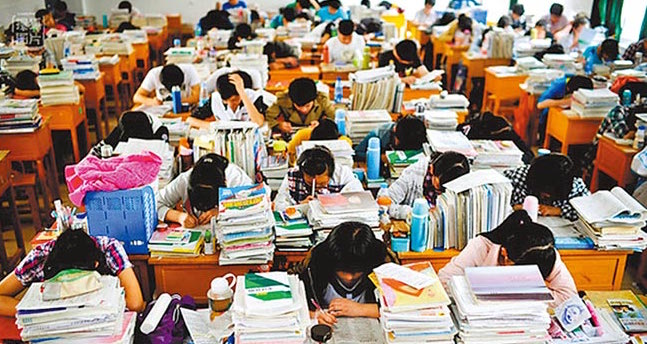 Students bury their heads in “paper seas.” Image via Quora
The gaokao (高考) is an examination that is taken by Chinese students in their third and final year of high school typically from June 7 to June 8 or 9. It is also the lone criterion for admission into Chinese universities. One Chinese saying aptly compares the exam to a stampede of “thousands of soldiers and tens of thousands of horses across a single log bridge.”
Though varying from province to province, the gaokao generally includes tests of Chinese literature, mathematics and a foreign language (in most cases English). If students choose liberal arts as specialty in high school, they need to take additional tests related to history, politics and geography. If they choose science, they’ll take physics, chemistry and biology tests.
READ MORE: Students throw gaokao papers from school to relieve exam stress
Before or after students take the gaokao, they need to fill in a form listing the colleges they want to get into (the timing of which varies by region). Every college will have a lowest intake score which varies by province, and if students meet that requirement, they can be admitted. Otherwise, they will be rejected and passed on to another nominated school to see if the score meets their requirements.
If a student does not meet any school requirements, he or she completely loses the chance of getting into college for the upcoming academic year (which has driven some to suicide in the past). But as the gaokao has no official age limit, students often redo the entire final year gaokao preparations to take the test again… and again, and again. One grandpa farmer went viral in 2014 for taking his 14th gaokao. Another brave 49-year-old man in Sichuan made headlines last year after announcing that he was on his 20th attempt at taking the exam in order get into his dream school.
How do Chinese students and parents prepare for the gaokao?
A student burns the midnight oil before the big day. Image via 新华网/Weibo
As you can imagine, the preparation for such a high-stakes make-or-break exam is a long and grueling process. The final year of high school is often devoted to preparations where students do practice exams almost every day while books and exam papers can be seen piled up on their desks.
Maotanchang High School, a famous ‘cram school’ in Anhui province, came under fire when its drill-like 16-hour daily study schedule was exposed to the public. In an interview with the New York Times, a student in Maotanchang said, “If you connected all of the practice tests I’ve taken over the past three years, they would wrap all the way around the world.”
The exam also came under further scrutiny in 2012 after images of students using intraveneous injections while studying were widely circulated online.
Parents are also known to not sit idle while their children are up to their ears in “exam paper seas.” Some parents quit their jobs to accompany their children, while full-time gaokao nannies and hired exam-takers are also not uncommon. Some desperate parents even resort to burning incense and praying to Buddha to wish their children good scores.
When the big day comes…
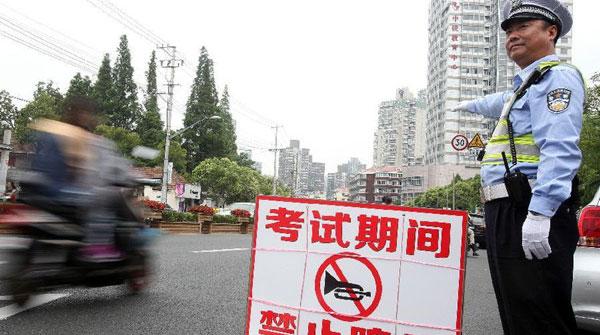 Image via Sina
From priority access to noise control, the whole country tiptoes around during the exams. To ensure students get to their exams in on time, many different measures are taken by authorities. For example, transportation officials in Shanghai have allowed test takers to get priority access to all metro stations, and students holding admission cards can be waved through metro stations, free of charge. Volunteers and police are also deployed to help give directions, with more than 1,700 taxi drivers offering free rides to exam-takers in Beijing in 2014. With the recent COVID-19 outbreak in Guangzhou, 1,200 taxi drivers are volunteering to help students make the test on time.
While often criticized for prompting a culture of cramming, the gaokao is also regarded as the fairest way of screening talent in a country with such a large population. For students coming from rural places, the gaokao can be their ticket to big cities and more promising futures.
For all its importance, one thing that should be noted is that the gaokao weighs more in less developed areas, as students in first-tier cities like Shanghai are more likely to choose to study overseas. Also, the intake scores in those cities are relatively lower than those in less developed regions.
3 Likes
Internationally, it’s be nice to China week.
UNSG warns against isolating China; Biden says no evidence that China is supplying weapons to Russia; China states that no strings attached to Honduras shift in recognition of West Taiwan.
I wonder what the tensions around Taiwan would be like if China hadn’t crushed the democracy in Hong Kong with an iron fist. That precedent has made clear the brutal consequences of a forced unification with Taiwan. It has turned what could be a grey issue into very black and white.
2 Likes
Good analysis of what AUKUS does in total, well beyond the sub purchase.
If China and the US come to blows, then most likely both sides will come to an agreement to fight it out in solely in Australia - we’ll be the expendable collateral damage.
“Most likely” is a pretty large exaggeration, but our air and naval bases are now targets if China can work out a way to reach them. The distance to get to Australia is a huge obstacle. There just aren’t many weapons that can travel 1000s of kms.
US has a Bill, China is not a developing country.
This would result in China being locked out of the trade preferences for developing countries.
No surprise that Biden has been unable to arrange talks with Xi.
Does surprise me that China is still classified as a developing country.
It’s pretty much self selective on the part of the country granting the DC preference, some basis in World Bank data.
Some do it by graduation of competitiveness in sectors.
PS If you are in Nanjing, Dictator Dan will be visiting tomorrow, trying to drum up more students for Victoria, including post grad. And he’s a Bomber supporter. He’s going to miss the Saints game.
1 Like