Just finished the S R White offering, and I’m not going to give it many out of 10. It’s set during Covid and it appears the author had a very healthy(?) scepticism about government policies.
It’s another Dana Russo story and this time she’s been called to where a body has been found in a sinkhole. I’m afraid I could never get that interested, but waded through, and in my opinion, you couldn’t possibly work out whodunnit until the last two or three chapters. There’s a side story about the father of one of Dana’s colleagues slowly dying but it didn’t contribute anything except an opportunity to take a shot at the rules about funeral sizes.
Hopefully that’s all the ■■■■ out of the author’s liver, but no, I won’t recommend it, and if @OBITV wants to read it, I’ll drop it in next coffee.
Just finished, The Witness, the latest Kalgoorlie novel by Fleur McDonald. Molly Walker is a midwife in Kalgoorlie who’s notified that her adoptive parents have died in a car crash coming back from Perth, where they travelled for an unknown reason.
Angie Sullivan is on maternity leave and busting to get back to work at Kalgoorlie. Molly’s policewoman mother was murdered 20 years ago in Newcastle and she was adopted by another policeman in Kalgoorlie. The car crash is suspicious and Angie and her colleague Jack track it all down.
Pretty well-written. Fleur has a long series before this, but it must be near 20 books.
My sister is in Vietnam for a short tour and texted me yesterday to say she thought Christian White’s The Long Night was crap. I can’t find my review of it but @OBITV loved it.
Anyhow, just finished Dave Warner’s latest, a major variance from his recent stuff set in Broome. Warner, Dave, not David or Davey, was a rock singer from the 80s with his band From The Suburbs, and talks about how his time on the road with his band, including gigs at The Espy, brought about his love of the English Golden Age of crime fiction, like Agatha Christie and Dorothy Sayers, inspired this new book Sound Mind Dead Body.
Fred Willetts is a WA gold fields detective in the years after WW1. He’s brought to England to participate in the reading of a will, 5 years after the death of Sir Thomas whose son had been saved by Fred in the last year of WW1 when been shot down. Fred had seen it and despite being under German fire, had landed his plane and picked up the pilot and returned him to England. The pilot died shortly after but told Sir Thomas of Fred’s bravery, who then determined that Fred should be awarded a plane in his own will. The distribution was to be made 5 years after his own death after his widow, Lady Julia, determined whether the legatee deserved it.
Of course, Lady Julia dies and Fred looks into it. Very Christie-like and Warner promises that Fred will figure in future stories. A very enjoyable who dunnit.
I said: Knocked this over in one sitting, given how deeply the plot sucked me in and how great was my desire to see what happened next. The book has a much greater element of horror than White’s previous work and is peppered with suspense, intrigue, surprises and a killer twist to top it all off. Excellent. 9/10
You said: Just finished the Christian White…the last third was a bit hard to follow and I’m not sure I grasped it all, but that’s the sort of writer her is. His major plot twist is reminiscent of one of his previous novels.
White does novellas with his wife…Summer La Roche…available on Audible (AFAIK)…and there was one about a yuppie couple going down to their rental property to check out why their rent isn’t coming through….not, that’s horror in the modern sense.
And I got the latest Dervla McTiernan at Target today…Three Reasons for Revenge.
Dumped my previous book purchase after 3 pages. Could not be stuffed reading it.
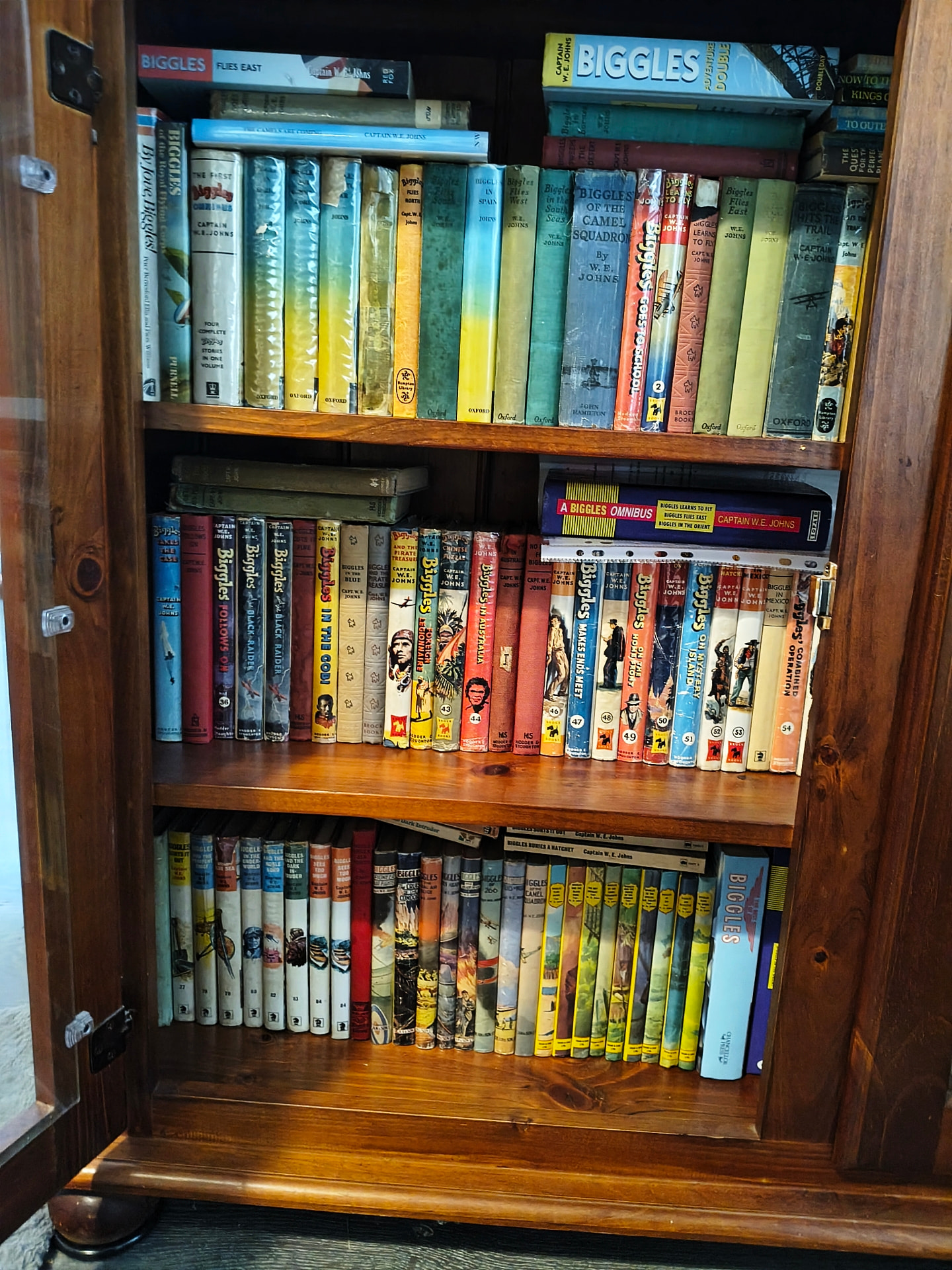
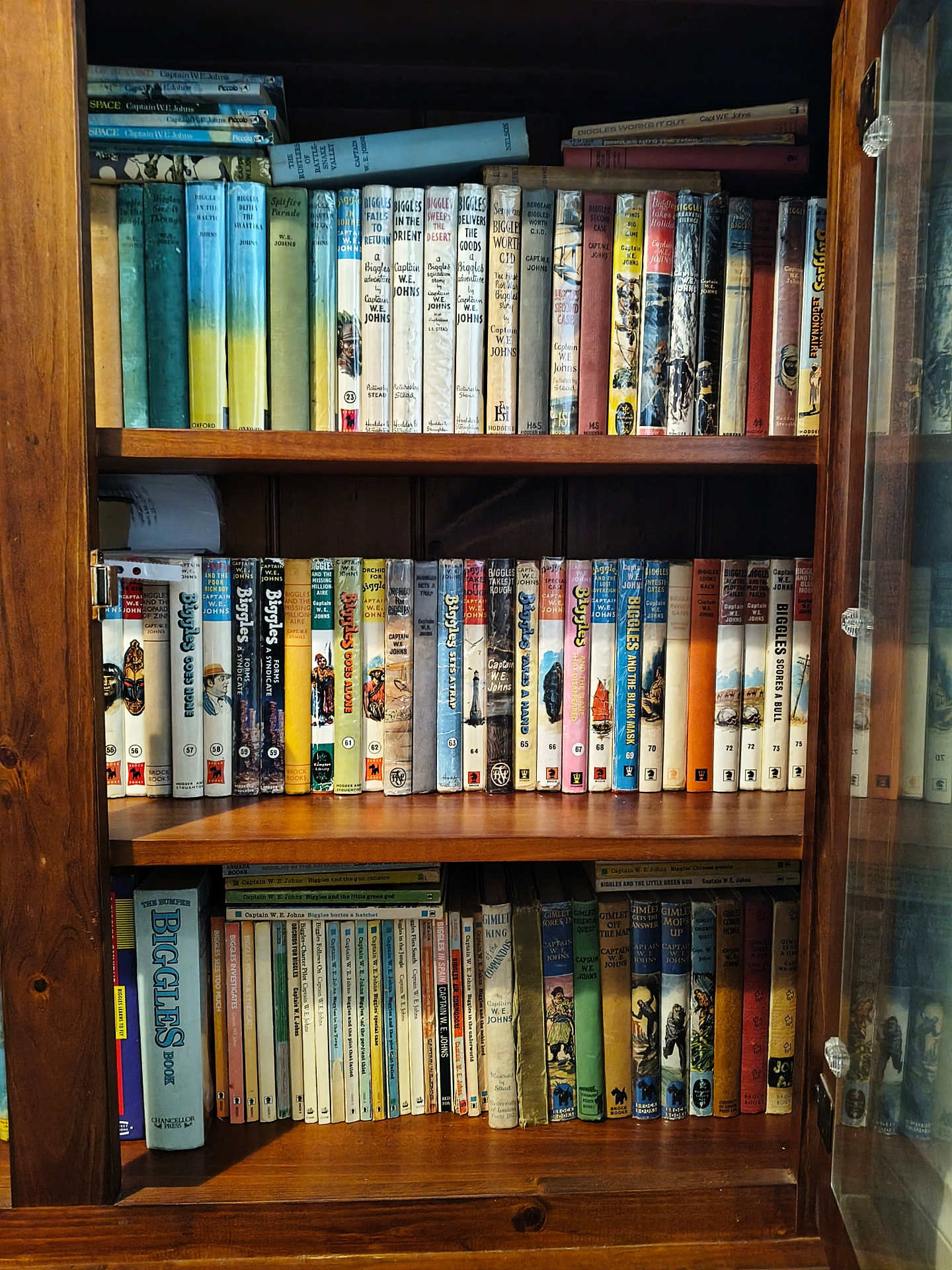
I just came across a John Hamilton Publisher 1933-ish edition of The Cruise of The Condor by WE Johns ( Biggles) . On the bookshop website, they wanted 850 quid. On their eBay page, 80 quid. I didn’t muck about… I’ve warned a family member in Cambridge that there’s a delivery inbound. I’ll worry about how to get it to Australia later.
This will be of absolutely no import or of note to 99 percent of the people on this site.
It ain’t a mint condition collection, by any stretch. And not quite complete for hard cover titles. But it’s almost 40 years ( and the bulk of it done over the first 15 years) of wandering into pretty much any second hand bookshops encountered around the country.
I cleared out a few dozen several years back, you invariably end up with all manner of double ups , slightly differing editions etc and space was getting tight. Plus, hopefully some other people got some additions to their collections.
I loved reading the Biggles books when I was a kid…mainly the ones set during WW1 but I do remember reading one called “Biggles Defies the Swastika” which was (obviously) set in WW2.
I think there were a few Biggles books set in WWII, but they had a mixed reception at the time because the author was a wwi pilot and kept forgetting that by the 40s, pilots could actually use radio to talk to each other.
I devoured as many as I could find when I was a kid, and I have a vague recollection of that title, but I don’t think I ever read it. Very few of them stick in my mind now. One that I do remember a bit was called Rescue Flight (I think), but it may not have actually been a Biggles book. It was set partly in a school.
Do you ever read them? I had a look at one a while ago and it seemed very much a book for kids. I read them between the ages of about 9 and 13.
I re read them occasionally. Some stand up well even today, some …errr…do not.
The World War 1 stories remain an excellent, authentic recording of the early days of air combat. Especially if you find the non sanitised 1930’s editions. The 1950’s reprints saw nanny state revisions to the texts.
And a few books - Flies East in particular - are surprisingly adult and dark examples of Spy novels , including early references to the racial dangers faced by Jewish people in central europe pre-war.
Johns was ahead of the game in some ways in the early 30’s , constantly warning of the threat that Hitler and his militaristic build up was about to pose.
Oh, and he’s also the guy in the recruitment office who declared TE Lawrence to unstable, unsuitable and suspicious a character to join the RAF when he tried to join up following world war 1 under the assumed name John Hume Ross . Lawrence then went above his head to Churchill to be allowed to join.
Yeah, the War Ministry asked Johns to pump out a book or two to inspire young men to want to join the RAF as a priority during the Battle of Britain ( they also asked for a female character for the Wrens which produced Worrals and a commando character series “Gimlet”) , and in his haste he largely just rewrote his WW1 stories and published them as “Spitfire Parade” . Other than introducing a few lasting characters , it’s not a good book. The War Ministry actually then assigned him a liaison officer to bring him up to date on the tech and methods such as radio. Radar, of course, was a protected secret in the first year or two of the war. But by then, he had shifted the idea to one where Biggles squadron undertook specialised missions around the globe rather than general combat duties ,which suited his writing and ideas far better.
There was an Australian sort of equivalent, Captain Mettle VC, written by J E Macdonnell. I can only remember one of the books, Mettle at Woomera, where the villain was an Italian whose principal fault was that he wasn’t English or Australian. I don’t remember much about it except that there was a race between the nasty Italian in his flashy Maserati and the heroic Mettle in his noble Jaguar, which the Italian won by cheating. I also recall that the villain got his comeuppance in the end, but that was probably foreseeable from page 1 onwards.
I remember reading a Dornford Yates novel where Berry and his pals were in Spain, and they came upon a Spanish chap whose hair was parted the wrong way or he had a flowing moustache, so they strung him up from the nearest tree.
Yates was one of Richard Usborne’s Clubland Heroes whose three authors were of the more esteemed classes between the wars. John Buchan (39 Steps) was more the Scottish gentleman whose characters weren’t arseholes, and he ended his career as Baron Tweedsmuir, Governor General of Canada, the first such who visited the frozen north-west territories. Dornford Yates and Sapper (Hector Hugh Munro whose “hero” was Bulldog Drummond), gentlemen who never met a dashed foreigner who didn’t need shooting nor a woman who didn’t warrant a smack across the chops if she didn’t “behave herself”.
The Yanks had Mickey Spillane’s Mike Hammer who could spot a damn commie from 100 yards and put a bullet between his eyes.
Mickey Spillane was something else. I find his novels quite hard to read because of the relish with which he describes violence; it’s as if he gets an almost sexual kick out of writing about it.