I’m on the side of people who want to protect their country, and to respect the residents.
2 Likes
Supporting any locals who would dislike nuclear in their backyard, then?
1 Like
Yep, who wants nuclear in their backyard, not me.
1 Like
Better let Littleproud know!
This is where Australia is heading,
The amount of battery power in California rose from 500 megawatts (MW) in 2018 to nearly 16,000 in 2025.At their daily peak, around 8pm, batteries can provide as much as 30% of the state’s electricity.
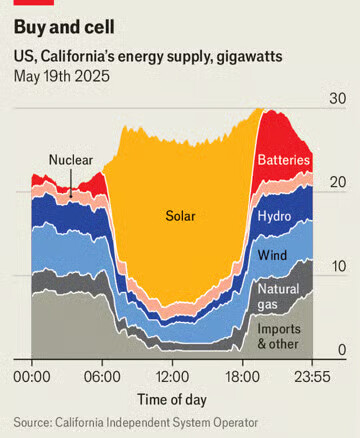
The sun doesn’t always shine and the wind doesn’t always blow. Batteries help plug the gap. Mark Jacobson, an engineering professor at Stanford University, found that most days this year contained periods when solar, hydropower and wind, helped by batteries, met 100% of California’s demand—even though just 54% of the state’s electricity generation comes from renewables. Because most lithium-ion batteries provide just four hours of power, they cannot yet replace baseload generation from gas, nuclear  or geothermal.
3 Likes
Don’t disagree with that at all.
I actually thought that Wind Energy approval was the realm of the Feds. In any case, I like the approach of the Bungaban Wind Farm project who is offering compensation payments for virtually the whole community.
If 82% of the local community do not want this project then it should be questioned.
1 Like
2 Likes
That 82% (quoted as 88%) constitutes about 100 people in the middle of nowhere. Yes, they should be heard, but their arguments as reported appear hardly convincing.
“The main concerns in the objections were strain on the accommodation supply from the 300 construction workers, lack of community consultation, and environmental and bushfire hazard impacts”.
I’d suggest this is more a case of LNP rejection on ideological, anti-renewable grounds. Prefer to dig more massive holes in the ground and burn stuff.
4 Likes
Was able to find the article you didn’t link, but don’t have visibility past the paywall.
I’m not sure that a gas salesman saying that gas is the cheapest option around is necessarily the best source of accurate information in this sector.
Gas is absolutely critical for the transition and we will need more of it to provide stability to the grid, but it is expensive and we just won’t have the supply to run everything on gas. Renewables are cheaper and their deployment needs to be sped up to keep costs under control. That’s not a net zero pathway I’m describing, it’s a sensible low cost pathway.
I think the point is pragmatism must overcome ideology when perusing the energy agenda.
I think ideology comes before pragmatism in lots of current thinking and that’s risky as it creates an unnecessary adverse outcome that ultimately won’t move the dial materially in addressing climate change.
How bout some dollars in royalties
Like maybe just a few instead of zero
1 Like
Pollies don’t like this.
Will lose their parties / own kickbacks and future job opportunities.
1 Like
I completely agree but for the opposite reason.
4 Likes
Are renewables really cheaper than gas?
I have seen no real trustworthy comparison but would like to be corrected.
I’m all for the transition from fossil fuels but it seems that cost is not a real reason.
Reducing the impact of climate change is the real reason and it seems like a false selling point referring to renewables as being cheaper to garner support.
Just say the reason is to limit the damage to the climate.
1 Like
The righteous indignation of mega wealthy fossil fuel planet rapists. Take that gen z
2 Likes
Pragmatism and ideology…
I say this as an engineer working in the hydrocarbon sector. It is fair to call me a hypocrite, but take my position as purely pragmatic and contrary to my own narrowly selfish interests.
Before I jump into this, pricing in the energy grid is set by the final 1% of supply. If 99% of the supply cost 1c and the final 1% cost $250, then the entire market price is $250. The headache to solve is the periods where there’s no competition for the final 1%, where a single source of energy holds monopoly power over setting the price for a period of the day.
Our energy grid is currently driven by coal. These plants are ageing and there are very real signals to the owners that capital investment isn’t justified due to global moves away from coal. That’s leading to coal reliability collapsing in recent years, made worse by the shrinking fleet making each existing generator more critical to the grid. The remaining coal plants aren’t economical during the day, so are setting high evening prices in order to increase their average revenue for the 24hr block. While coal was once the cheap and reliable backbone of the grid, it is now the driver of high overall pricing. Much of the coal fleet is scheduled to depart the grid in the next 4 years, driven by the owners. Eraring cost the NSW government $2B to extend operation by a couple of years, so drawing out the inevitable is mega costly. Coal isn’t viable in the current reality where bulk solar has been built out and that’s making owners chase earliest possible closure dates.
Next is gas. Gas is expensive, so you burn it when there’s no alternative. We will get new fields opening in the coming years, but that won’t drastically bring gas prices down enough to change the business case of gas fired generation. When GFG is operating, it will be setting the energy price and set it HIGH. We critically need gas and we will need more of it to fill in the gaps, but it is neither practical nor affordable to operate the grid purely off gas.
Nuclear… I have not found a single engineer with experience in large scale oil and gas projects that thinks a reactor build in Australia will be anything other than an absolute clusterfark of thermonuclear proportions. It ain’t happening any time soon and any attempts to make it happen will just pull funding and focus away from resolving the imminent headache of coal dropping off.
So now we are left with solar, wind and random minor technologies.
Solar is currently following the same cost/production curve as the computer microchips that they closely resemble. Doubling in annual production every 3 years, the fastest scale up of any energy source in human history. Costs are collapsing year on year and will continue to do so. The only headwind on solar is the lack of demand during daylight hours, market saturation. This has driven a strong growth in battery construction, with costs similarly collapsing over recent years. Solar and battery storage is now following a manufacturing curve rather than an infrastructure curve, so by all metrics this is an extraordinarily attractive technology to invest in. Australia has one of the strongest solar natural resources in the world, so pursuing this aligns with our natural advantage.
Wind is more expensive than solar, but generates at different times. This reduces the variability of a pure solar system, with fewer lulls. It requires more maintenance, construction and planning is more difficult and social licence a real challenge to manage. We have a lot of good wind resources in Australia, but they are less plentiful than solar and often lay in regions without existing transmission. It’s more expensive than solar, cheaper than gas, so drives down pricing by reducing the windows where gas generation sets the price.
Offshore wind is like onshore, but the costs are higher. Social licence issues are reduced and transmission less of an issue, so it is politically easier to build. It has a different generation profile to onshore and wind, so can further reduce the amount of time that expensive gas sets the pricing, but I’m not convinced it’s overly cost effective.
And then we’ve got storage. Pumped hydro, short and medium term batteries, compressed air, you name it. This is going to have a substantial impact on the total cost of energy as it starts to compete with the expensive monopolies of the last 1%. You are effectively time shifting the negligible pricing solar energy to the evening peak, so even with capital costs and profit covered, batteries have a huge advantage over coal and gas. It’s going to have a huge positive impact in the coming years, reducing the usage of gas to periods where sun or wind aren’t fully delivering.
That’s my take. I don’t see any other viable path forward. Everything offered by the conservative energy movement just doesn’t stack up with the realities of the current market. We are in an awkward period where transmission and storage are lagging demand, but looking ahead by even a couple of years, the speed of growth is going to make very large positive changes to the supply situation. Not looking at these easily forecast developments is what is leading to the pessimism about what renewables will deliver.
16 Likes
Great post Benny!
2 Likes
Wasted on its recipient but much appreciated
1 Like
At the very least it was an excuse to express it and let the energy nerd side of my brain have a bit of a play.
2 Likes