Yikes. I thought they had a chance of sneaking home by a couple of percent, but that’s a proper thumping. Starmer is looking more and more like Labour’s Teresa May, he’ll be out of a job and flogging Gazan beachfront property next to Tony Blair in the not too distant future you’d think.
5 Likes
A bishop arrested and Mandleson.
2 Likes
The Runaway Runway. The Economist.
Here is one suggestion to claw back costs…(I was wondering if the Vic Government could have done something similar with its big build blowouts): A bolder approach would be to let an independent body define what needs to be built, rather than HAL (the owner of Heathrow). That body could commission HAL—or a rival—to construct different parts. Separating design from delivery would curb the misaligned incentives that encourage gold-plating.
Heathrow’s expansion is on track to be eye-wateringly expensive
This is not inevitable

Illustration: Simon Bailly
Feb 24th 2026|5 min read
When George Osborne was Britain’s chancellor in the 2010s, he knew that the economy would not grow on a diet of spending cuts alone. It needed some pudding to go with the spinach: a totemic infrastructure project to show that the state was investing in the country’s future. For Mr Osborne, championing High Speed 2 (HS2) was the perfect choice for a sweet treat. The proposed railway line between London, Birmingham and the north would “change the economic geography” of Britain, providing an “engine for growth”.
Rachel Reeves, the current Labour chancellor, also inherited a tricky fiscal situation in 2024. Never knowingly original, she responded by following Mr Osborne’s recipe. The greens this time were indigestible tax rises and the dessert was to be a third runway at London Heathrow airport. Both chancellors were right to prioritise infrastructure. Better transport means ideas, people and goods reach each other more quickly, boosting productivity.
The third runway, even more than HS2, seemed a no-brainer. For an open economy that trades in services and talent, every new flight path widens Britain’s reach. Yet efforts to build it have repeatedly failed, beaten back by furious opposition from west Londoners on noise and air-quality grounds. The airport is highly congested, with over twice as many flights per runway as competitors like Amsterdam Schiphol (which has six runways). Inaction threatens Heathrow’s status as a global hub. Any serious growth policy would deal with this.
But HS2 is also a cautionary tale for what can go wrong with infrastructure projects. The government’s proposals from 2012 said that the railway would open in 2026 and cost £33bn in 2011 prices (or $53bn). Since then, two of its three legs have been cancelled on cost grounds and the remaining London–Birmingham segment has been delayed to the late 2030s. Costs are now set to exceed £100bn.
There are early signs at Heathrow of the problems that plagued HS2. The project’s deadlines look fanciful. The government wants to grant planning approval by 2029, with the runway operational by 2035. But legal challenges are inevitable—both after the government publishes its Airports National Policy Statement this summer and once a planning decision is taken. Labour has tried to speed things up by limiting opportunities for judicial review, but it has stopped short of more radical steps—such as Heathrow-specific legislation—that could prevent challenges altogether.

Chart: The Economist
More worrying is cost. Heathrow Airport Limited (HAL), the site’s operator, intends to privately fund the project, recouping costs through charges on airlines. (Lord Deighton, who chairs The Economist Group, until recently also chaired HAL.) It estimates that the airport’s expansion and modernisation will cost £49bn in 2024 prices. That’s enough to build about 40 hospitals, making it one of the costliest airport expansions ever. It’s already the second-most expensive major airport in the world for passengers (see chart). International Airlines Group, which owns British Airways and operates 60% of Heathrow’s flights, backs the runway only if it costs £30bn or less. Jonathan Sullivan, from IAG, warns that the current plan could double landing fees (already £26 per person, versus Gatwick’s £13). Heathrow’s CEO recently claimed the extra fee would be £15, though was unclear about its scope.
The obvious question is why laying just over two miles of asphalt costs billions. For answers, look to HS2, which faced many of the same cost pressures. Both projects involve building in dense London. The airport is boxed in by homes and roads, with less than half the space of its main European rivals. Land acquisition was estimated in 2014 to cost at least £4bn. It’s now probably more. The runway must also be built over one of the busiest parts of the M25, London’s ring road, which carries more than 200,000 vehicles a day.
Further costs arise from Britain’s sclerotic planning system, where the least relevant stakeholder can block proceedings to get their pound of flesh. HS2 has been riddled with such pay-offs, including a £100m tunnel to protect bats. Heathrow is at risk of following a similar path. Paperwork costs associated with planning applications alone are on track to exceed £1bn. Over £700m was previously earmarked for noise insulation in neighbouring homes.

Map: The Economist
But the biggest reason for both projects’ high costs lies in their tendency to gold-plate requirements, a curiously British disease when it comes to big infrastructure projects. HS2 was primarily intended to boost capacity, but a desire for speed led to unnecessarily expensive viaducts and tunnels. HAL’s plans are similarly bloated. The marmalade-dropper is £1.3bn for two car parks, but the biggest example of lavishness comes from the proposal to build new terminal buildings and revamp existing ones, which accounts for £27bn of the £49bn total. Andrew Light, an aviation finance consultant, singles out the plan to build multiple new terminals—linked by shuttles—as particularly expensive.
The deeper problem is that both projects are structured to discourage cost control. Contractors on HS2 are paid a share of total costs, incentivising them to spend more, while officials lack the expertise to challenge them. Heathrow has similar flaws. As a privately owned company with considerable market power, HAL is regulated by the Civil Aviation Authority (CAA), which determines how much the airport can charge. HAL is currently allowed to earn a regulated return on its investment—so the more it spends, the higher its profits. As Mr Sullivan puts it, “HAL’s incentive is to make this as expensive as possible.”
The CAA is consulting on whether to change its approach for the third runway, with a decision due in summer. Airlines are eager for more competition. Surinder Arora, the billionaire owner of several surrounding hotels, has pitched himself as an alternative developer. HAL argues that introducing a rival operator would mean years of delay. While they may be right, change is needed. A start would be to beef up the CAA, bringing in top commercial talent to scrutinise costs.
A bolder approach would be to let an independent body define what needs to be built, rather than HAL. That body could commission HAL—or a rival—to construct different parts. Separating design from delivery would curb the misaligned incentives that encourage gold-plating. Establishing such a body might take a few months, but it would be worthwhile. Without it, costs will spiral further. Even if airlines could make the economics work, passengers would face decades of overcharging. The country has suffered one pricey pudding in HS2. It can ill afford another.■
3 Likes
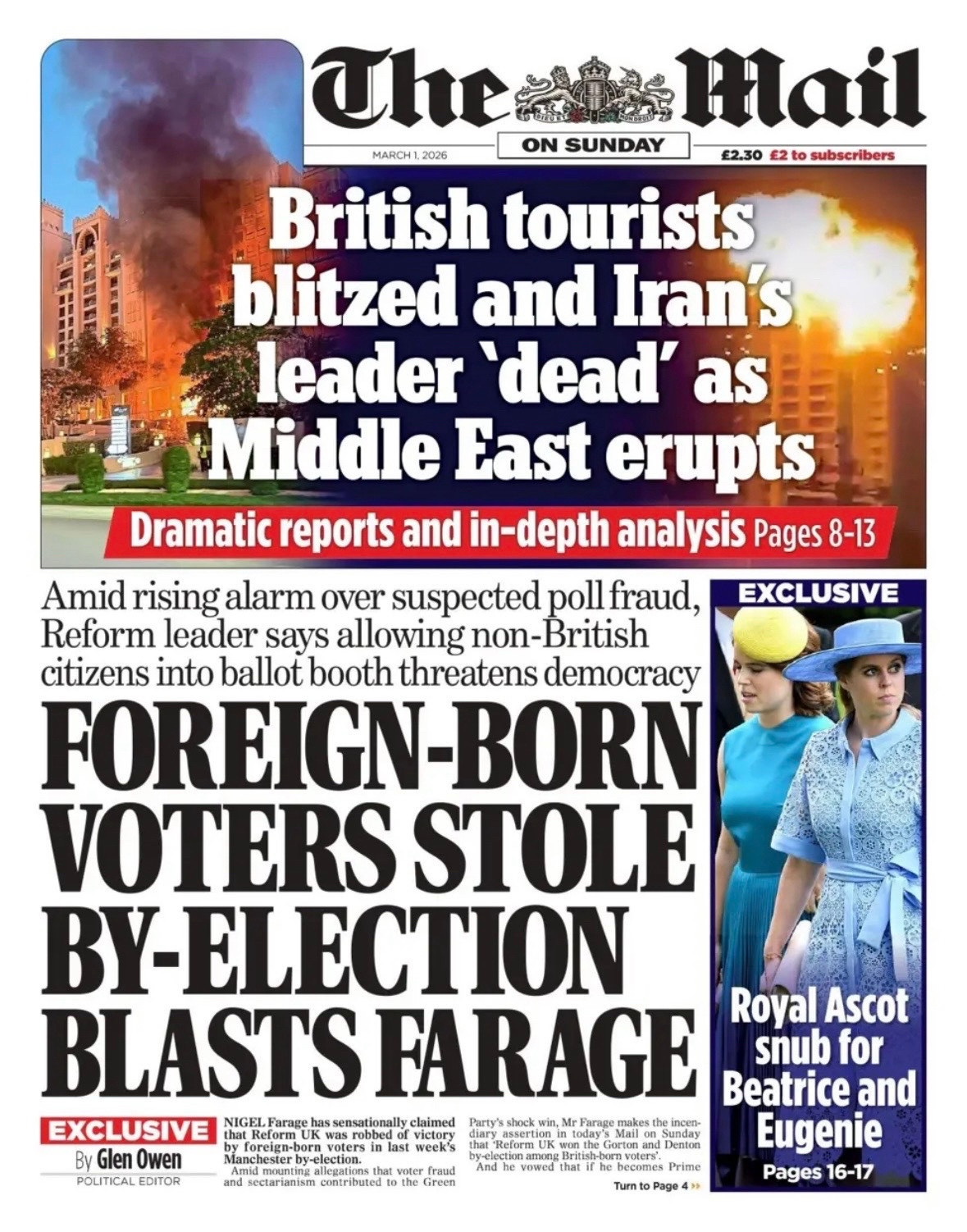
He is correct that you don’t have to be a British citizen to vote. Think you just have to be a commonwealth citizen. I was always surprised I could vote as an Aussie.
Edit: I can’t imagine Reform would be too popular with South Asian resident voters so I suppose that’s what he is dog whistling about.
Right wing rags crying over Hannah Spencer and the Greens winning. They’re not happy now are they
1 Like
We WANT gold plating for safety.
What you mean is price-gouging to direct millions of $$$ into pockets of Rsole rentiers.
1 Like
When I lived in UK in 1992, I registered to vote and voted in the General Election which returned John Major in a Conservative Government. I lived in Bath and the Liberal Democrat won this seat which they still hold. I met him once and he was a scientist and a very nice bloke. I voted Labour who got about 7% of the vote. UK elections are very civilised, especially in Bath, no snags on the BBQ though on election day.
the economy of post-manufacturing countries is built on ticket-clipping
an “independent body” deciding what to build just means different ticket-clippers. won’t save any money or time.
2 Likes
The melts about a female Green winning a little election are breathtaking to watch.
Apparently it was rigged so that all the Muslim men made their three wives vote for a party led by a gay Jew.
You can hear the cogs grinding to a state of seizure inside the heads of the lunatic right trying to explain it.
5 Likes

Good to see the Monster Raving Loony party are still hanging in there. Screaming Lord Sutch, what a legend. I would vote for the cat that lead them instead of most of our current politicians.
3 Likes
They’re no “Party Party Party” party, but I’d still preference them above Labour.
2 Likes

6 Likes
I suspect we will see more and more anti-labour memes etc now that both Russia and USA don’t like the UK.
2 Likes
10 I pledge to build at least one affordable house
Progressive!
1 Like
jeez they must be working off some budget these days
Basically .. we’re broke.
And the limited military these days reflects that.
Public services struggling yadda yada. HMRC UK target the decent SMEs, the just barely coping and our younger gens who are only helping pay off the legacy borrowings interest. Meanwhile the kissed Corporations, captains and their minions fill their boots.
Life goes on. The British spirit is still there, the mainly great multiculturalism and accommodating nature tbh (with definte exceptions). Not all gone to pot …
But who knows for how long.
1 Like
Sounds like they could have made the same report from the Fifth century. Or Ninth. Or etc…
1 Like
Nothing like some prison justice.
Good riddance
One of the UK’s most notorious child killers has died, days after he was attacked by a fellow inmate in the workshop of a maximum-security prison.
Ian Huntley, a 52-year-old former school caretaker convicted in 2003 for the murder of two 10-year-old girls, had been on life support after being hit repeatedly over the head with a metal bar at Frankland prison in northeast England on February 26.
The murders of Holly Wells and Jessica Chapman had transfixed the United Kingdom for two weeks after the best friends vanished from the village of Soham in eastern England on August 4, 2002 after leaving a barbecue to buy sweets.
5 Likes