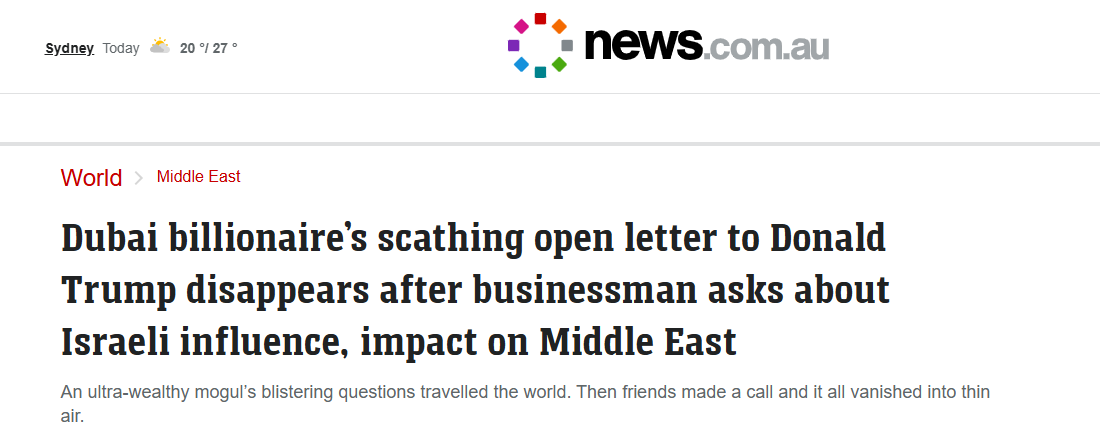
For a brief moment, Emirati billionaire Khalaf Ahmad Al Habtoor was the talk of the Middle East.
The ultra-wealthy business magnate had published — and then deleted — a direct and scathing critique of the war around Iran aimed squarely at the White House.
His lengthy spray travelled around the world through multiple media channels. It was laced with uncomfortable questions that are rarely asked so plainly in the mainstream press.
“Who gave you the authority to drag our region into a war with Iran? And on what basis did you make such a dangerous decision?” he wrote, addressing Trump directly.
Al Habtoor accused the US of acting without regard for the region that would ultimately bear the most dire consequences over the long term. Minus Iran, the Middle East is home to some 425 million people, many of whom are inextricably tied to the US through the oil industry.
In the months leading up to the US and Israel’s consequential decision to take out Iran’s leadership, the globe had been grappling with growing global instability. But compared to recent decades, the Persian Gulf was somewhat stable. Money was being made by the bucket, and ultra-modern cities like Dubai had shot to international acclaim.
But with missiles flying overhead hitting civilian buildings, oil tankers and crucial energy sites, the allure of safety throughout the more developed nations has now been shattered.
Millions are fuming and want answers.
“Did you calculate the collateral damage before pulling the trigger?” Khalaf Ahmad Al Habtoor asked. “Did you consider that the first to suffer from this escalation would be the countries of the region?”
“Was this your decision alone? Or was it the result of pressure from Netanyahu and his government?” he asked.
Al Habtoor said that while the immediate economic impacts were being felt around the globe, the region will ultimately be the one that is hit hardest in the years to come, be it through a loss in tourism, migration and general investment.
Speaking to the Washington Post this week, Al Habtoor said he ultimately decided to delete the post at the request of “friends” from the UAE and the US, claiming they had told him it was not the right time “to upset the Americans”.
“On my principles, I do not like to offend anyone in my life,” Al Habtoor said, also admitting that the damage had already been done.