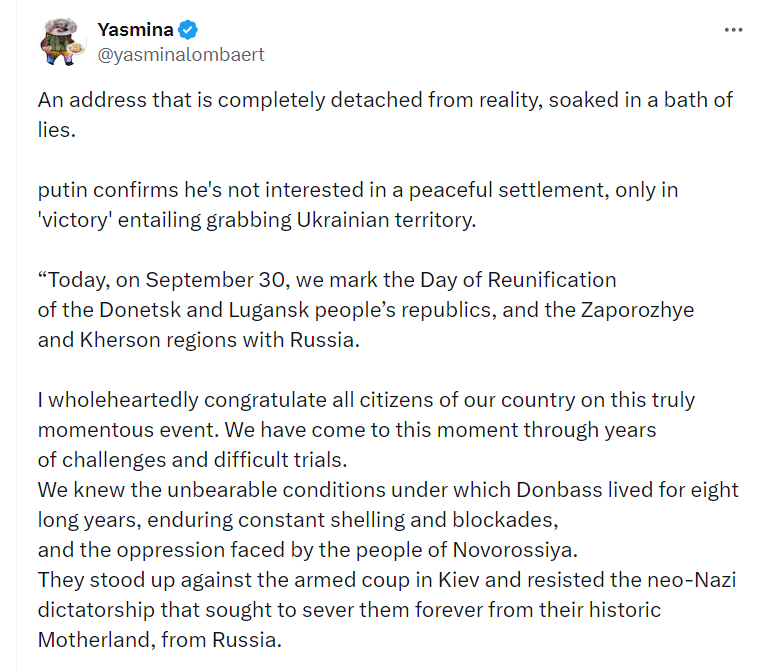
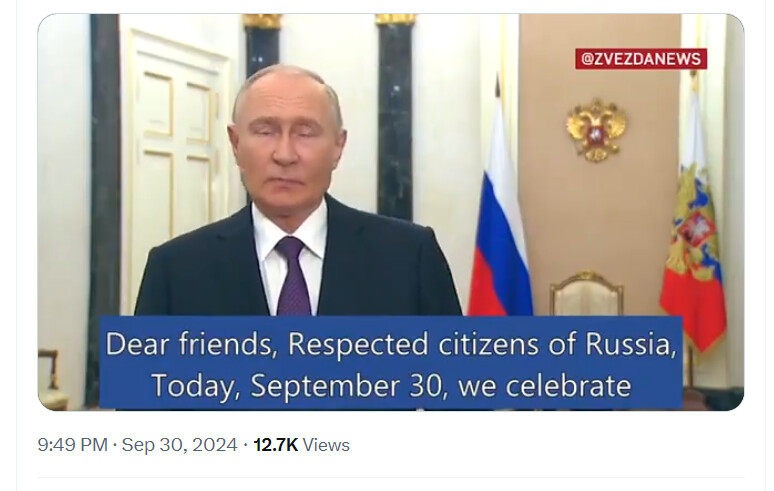
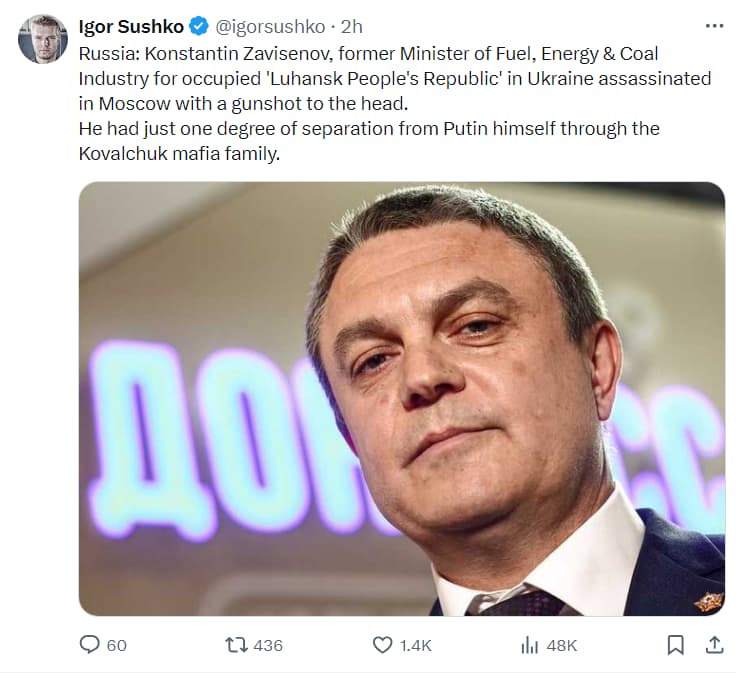
So I clicked on this link, and found x.com’s self promo placement… interesting:

3 Likes

4 Likes
The committee or the Tasmanian thread? 
1 Like
" Where the fark did he come from Goose?"
" Sorry Mav, I was looking at my phone."
3 Likes
I expect Rutte to warmonger even harder
9 Likes
This is awesome mate. Well done for taking the time to do it. I dont think we need to worry about ASIO since we took down the Middle East thread!
7 Likes
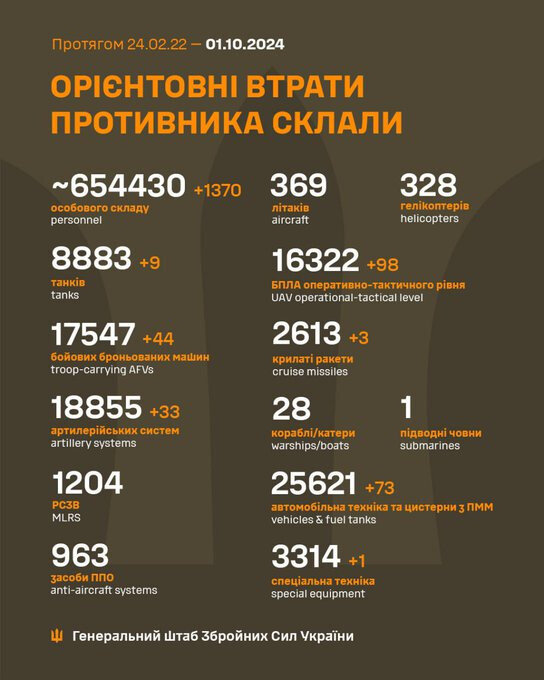
Russian losses per 01/10/24 reported by the Ukrainian general staff
+1370 men
+9 tanks
+44 AFVs
+33 artillery pieces
+98 UAVs
+3 cruise missiles
10 Likes
1 Like
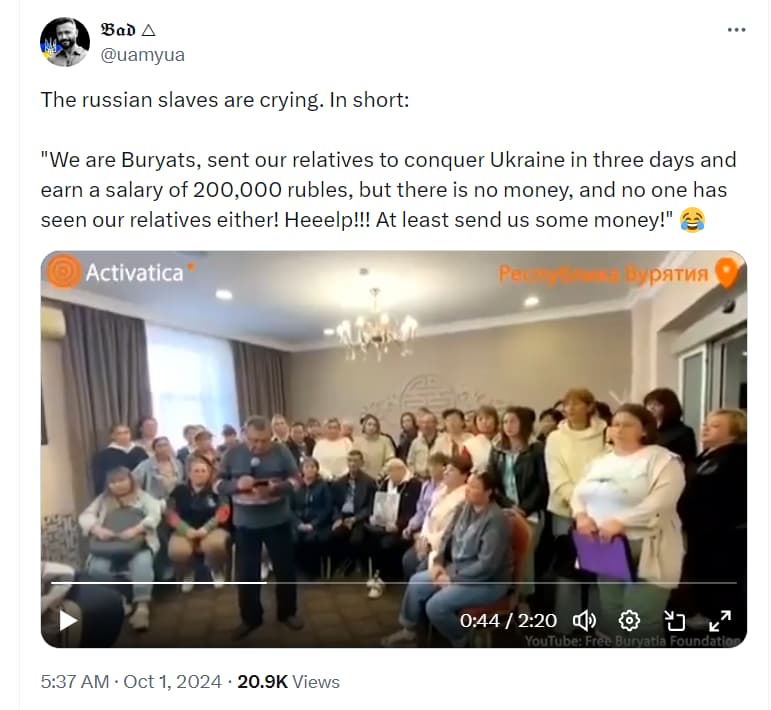
Despite “there is no money”, it looks like most of them are not suffering from calorie deprivation.
4 Likes
Russian press, “Mr Putin, zee peasants are revolting”.
Mr Putin, “Yah, I’ve known ziz for years”.
Record number of Russians want end of war with Ukraine – Russian media
TUESDAY, 1 OCTOBER 2024, 11:05

On the second anniversary of the announcement of mobilisation in Russia, a record number of Russians are in favour of compromise and an end to Russia’s unprovoked war against Ukraine, according to the results of polls conducted by two projects, Chronicle and ExtremeScan.
Source: Russian media outlet Holod
Quote: “The number of supporters of a truce with Ukraine among Russians has reached an absolute maximum - 49% of respondents expressed their readiness to support a peace agreement, even if the goals of the special military operation [as Russians substitute the term war - ed.] remain unfulfilled. 33% of respondents are against such a decision, and 18% cannot answer this question.”
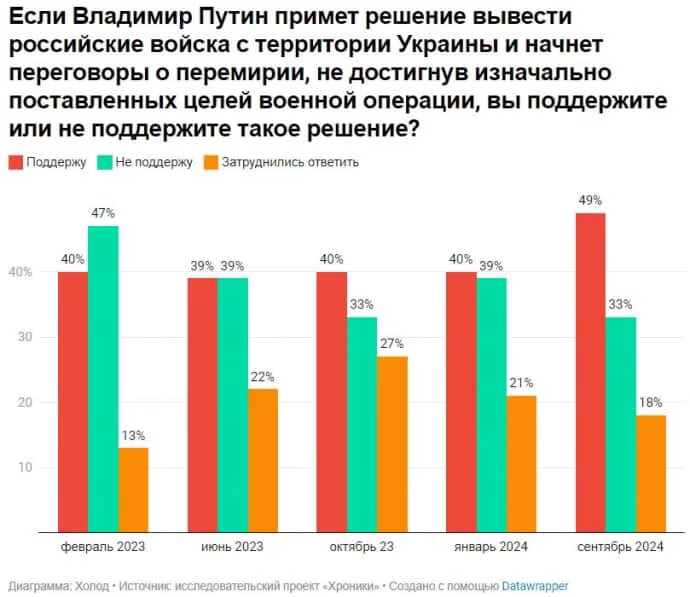
Results of the poll: If Vladimir Putin decides to withdraw Russian troops from the territory of Ukraine and starts ceasefire negotiations without achieving the original goals of the military operation, would you support or not support such a decision?
Details: It is also reported that 63% of respondents would like to reach peace within a year.
The ExtremeScan study reports some regions are even more in favour of ending the war than the traditional “protest centres” of Moscow and St Petersburg.
Results of the poll: Would you support Vladimir Putin’s decision to withdraw troops from Ukraine?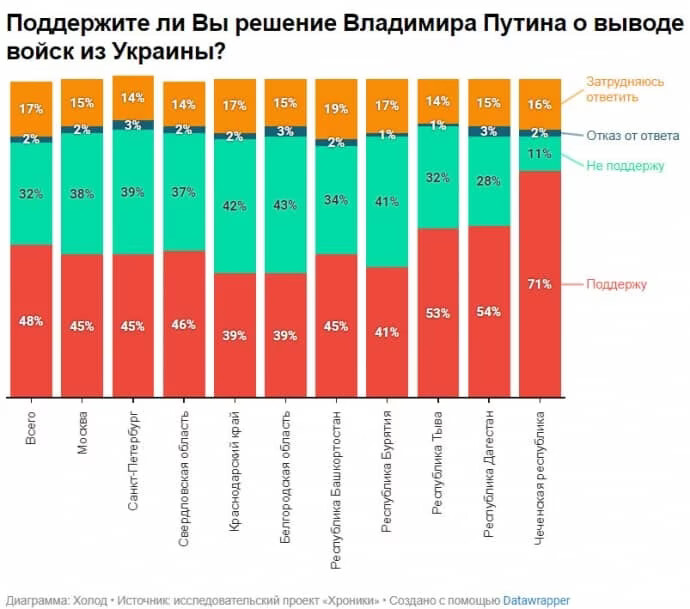
INFOGRAPHIC: HOLOD
Among the regions studied, the lowest support for the war is in the Chechen Republic - only 39% of respondents said they supported the special military operation, followed by the Tuvan People’s Republic (48%), and a slightly higher level of support in St Petersburg - 50%.
The sociologists emphasise that the same regions (Chechen Republic, Tuvan People’s Republic and St Petersburg) have the largest number of respondents who refused to answer this question. The media outlet points out that this may indicate that the level of support for the war in these regions is even lower.
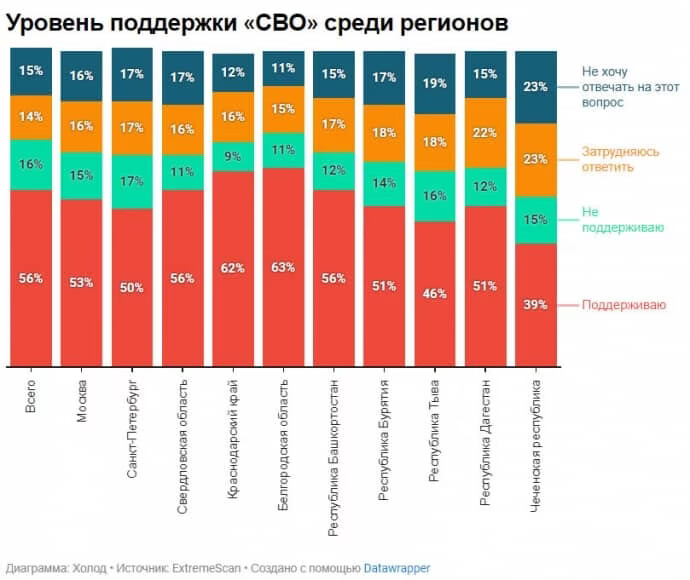
Results of the poll: Level of support for the special military operation among regions.
INFOGRAPHIC: HOLOD
ExtremeScan reports that the strongest support for the war is in the oblasts closest to the war zone - Belgorod Oblast (63%) and Krasnodar Krai (62%).
It is also reported that fewer and fewer Russians are ready to fight. In particular, from February 2023 to September 2024, the number of those who are not ready to go to war, either voluntarily or by order of the Russian Ministry of Defence, increased by 9%. Also, the share of those who were ready to go to war a year and a half ago, if mobilised, decreased by 10 percentage points.
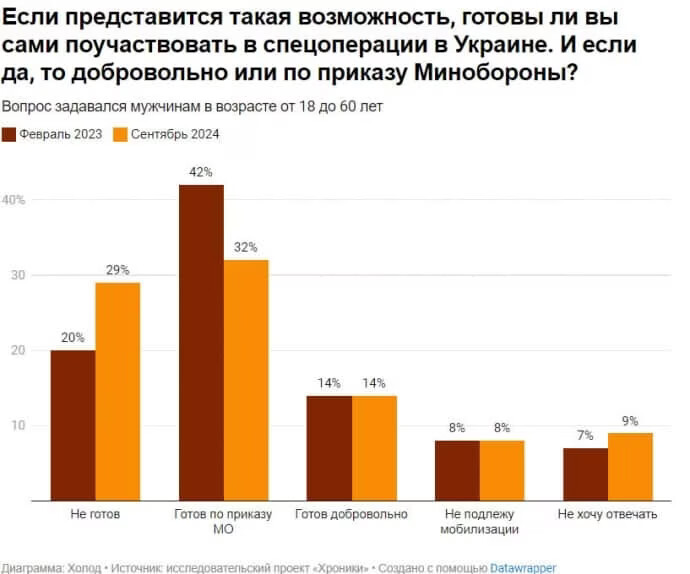
Results of the poll: Would you like to participate in a special operation in Ukraine yourself if such an opportunity arises? And if so, voluntarily or on the orders of the Russian Ministry of Defence?
INFOGRAPHIC: HOLOD
The sociologists report that the most outstanding readiness for mobilisation among men is expressed by citizens aged 50 to 60, i.e. those who are least likely to be mobilised, as under Russian law, the age limit for regular soldiers is 50.
Only 6.6% of Russians aged 18-24, who are more likely to be mobilised, are ready to go to war if ordered to do so.
Most Russians are also not ready to condemn anyone for refusing to participate in military operations: 51% of respondents said they would treat such people with understanding, 27% would condemn them, and 22% could not answer the question.
After the operation of the Armed Forces in Russiaʼs Kursk Oblast, 57% of Russians surveyed assessed the possibility of a new mobilisation as high, while 28% considered it low. Against this backdrop, 53% of respondents say that the primary task of the Russian army is to liberate Kursk Oblast, not to advance deeper into Ukraine.
Answering the question, “Which of the following events would you like to see happen in the next year?” (several options were available), only 22% named a new wave mobilisation.
50% of Russians said they would like to see relations with Western countries restored, 54% would like to see an increase in budget spending on the army, 63% would like to see a peace treaty with Ukraine with mutual concessions, and 65% would like to see sanctions against Russia lifted. 85% of respondents hope that the government will focus on solving internal social and economic problems in the coming year.
Quote: “However, the most desirable option is still the completion of the New Strategic Arms Agreement upon achievement of its goals - 86% of respondents supported this option. Sociologists attribute such a high level of support for this option to the unwillingness of some Russians to lose, even if they are wrong, and to the fact that approximately 20% of Russians are still pro-war, and victory without any concessions is important to them. However, 63% of respondents are ready for peace with mutual concessions, which is the maximum since the beginning of the war.”
The Chronicle project’s research was conducted by telephone survey from 10 to 17 September. The sample size was 800 people over the age of 18. The study’s confidence interval (the interval that most likely contains the truth) is 95%, with a maximum measurement error of 3.45%.
From 29 July to 6 September, ExtremeScan Group conducted 11 surveys: one all-Russian survey and ten within the country’s oblasts - Moscow, St Petersburg, Sverdlovsk Oblast, Krasnodar Krai, Belgorod Oblast, the Republics of Bashkortostan, Dagestan, Chechnya, Tuvan People’s Republic and Buryatia. The sample size of each survey was 500 people (a total of 5,500 respondents). The maximum measurement error in comparing oblasts is 4.38%, with a confidence interval of 95%.
It is noted that due to rounding, the sum of the percentages may slightly differ from 100%.
Holod emphasises that in times of war, it is impossible to trust the results of public opinion polls fully, as “Russians may be afraid to oppose the position dictated by the state and propaganda”.
Why it matters: The goals of the Russian war in Ukraine have been constantly changing. The Russian authorities have used the word “goals” many times, but no one has clearly stated them. At various times, Kremlin leader Vladimir Putin and his henchmen have claimed the alleged need to “demilitarise” and “denazify” Ukraine, as well as to “protect the people of Donbas”. They have also repeatedly invented some imaginary threats from NATO and the alleged need to defend Russia. It is likely that even in the third year of the war, the Russians do not understand the “main goals of the special military operation”.
Russian-controlled Russian Public Opinion Research Center reports that 43% of Russians believe that the war started to protect Russia from NATO, one in five thinks that Russia is defending the so-called “republics” [Russian-occupied territories - ed.] of Donbas, and another 15% believe that Russia wants to cleanse Ukraine of Nazis.
3 Likes
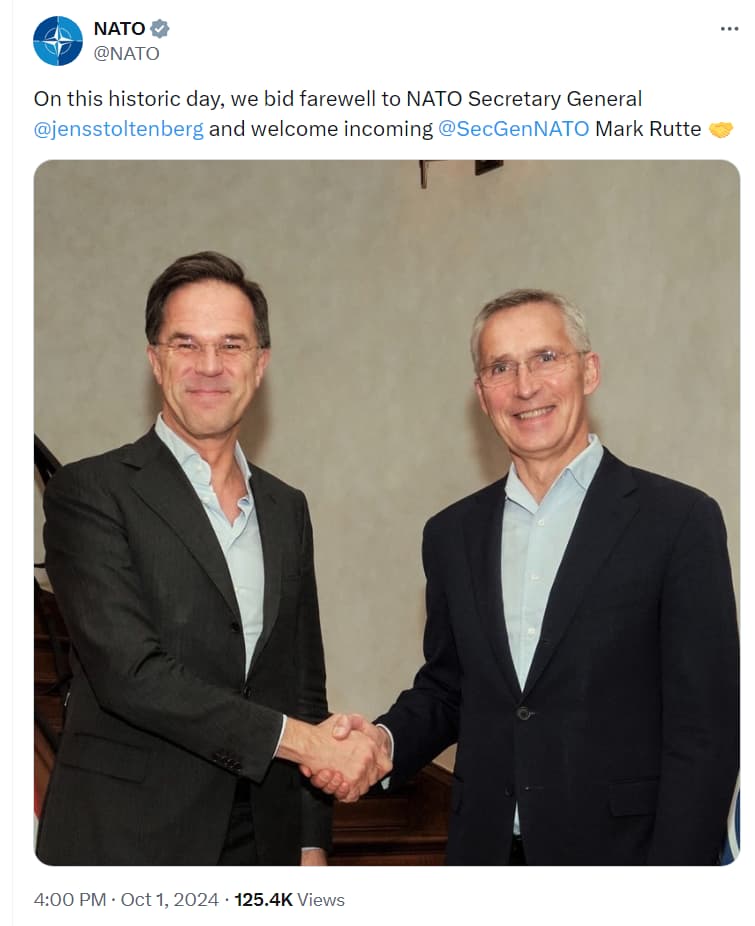
“Ukraine belongs in Nato” says Rutte as he takes over the helm
October 1, 2024
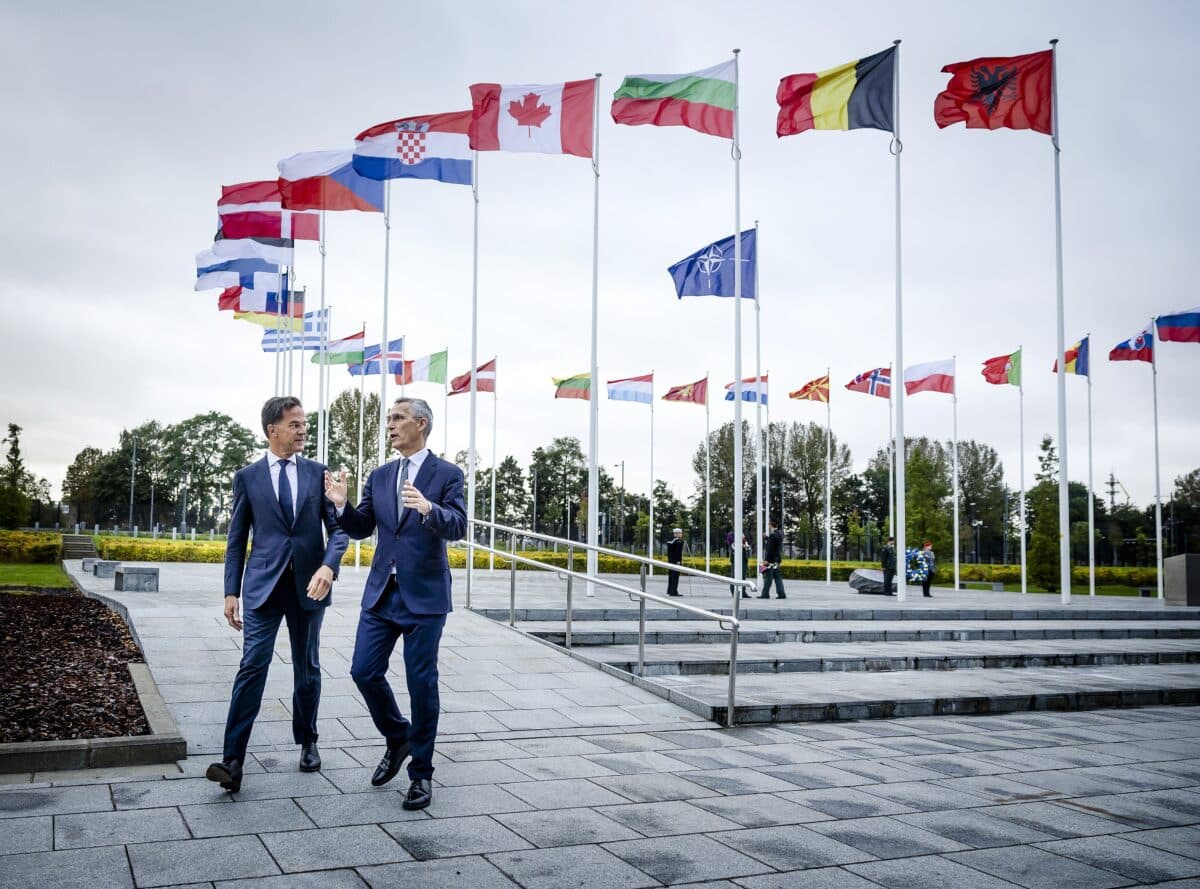
Mark Rutte (left) in conversation with outgoing secertary-general Jens Stoltenberg before being sworn in. Photo: ANP/Remko de Waal
Former prime minister Mark Rutte has been sworn in as secretary-general of Nato as the military alliance faces some of the biggest challenges in its 75-year history.
Rutte will need all his skills as a coalition builder to hold together a transatlantic partnership that swelled to 32 nations with the accession of Finland and Sweden in the last 18 months.
He will also marshal efforts to persuade all European member states to raise their spending to the alliance’s baseline of 2% of GDP – a standard the Netherlands never achieved during his 14 years in charge.
Rutte will also be responsible for ensuring the alliance remains firm in its support for Ukraine, despite the reservations of leaders such as Hungarian prime minister Viktor Orban, who recently said his country would be a member but “not a participant” in operations beyond its borders.
In a short installation ceremony in Brussels on Tuesday, Rutte said his three priorities would be to keep Nato strong, sustain support for Ukraine and reinforce its partnerships with other countries and regional powers such as the European Union.
Rutte said investment and innovation were needed to “ensure our defences remain effective and credible”. “There is no cost-free alternative if we are to rise to the challenges ahead.”
Flight MH17
He also said bringing Ukraine closer to Nato was one of the alliance’s key priorities.
Rutte referred to the shooting down of Malaysian Airlines Flight MH17 in 2017, as proof that the war with Russia was not confined to Ukraine’s borders. The passenger plane took off from Amsterdam and two-thirds of the 298 passengers and crew who died were Dutch.
“There can be no security in Europe without a strong independent Ukraine,” he said. “Ukraine’s rightful place is in Nato.”
Rutte said global security had to be a “team effort” with nations around the world.
The 57-year-old Rutte is the 14th secretary-general of Nato and the fourth Dutchman to hold the post. He succeeds former Norwegian prime minister Jens Stoltenberg, who headed the organisation for a decade.
Home from home
Stoltenberg, 65, stressed the importance of Rutte ensuring he did not “compromise on our core values and principles” as he passed on the gavel symbolising Rutte’s role as chairman.
“You know Nato well and you are well known across the alliance. You have the perfect background and the experience to become a great secretary-general,” Stoltenberg said.
Rutte said the Nato job was the only post that could tear him away from his home city of The Hague, though he is expected to go back there for non-working weekends.
He said of his new base in Brussels: “It is a city I have got to know over the years thanks to the endless amount of EU meetings I have attended. It is now my home away from home.”
3 Likes
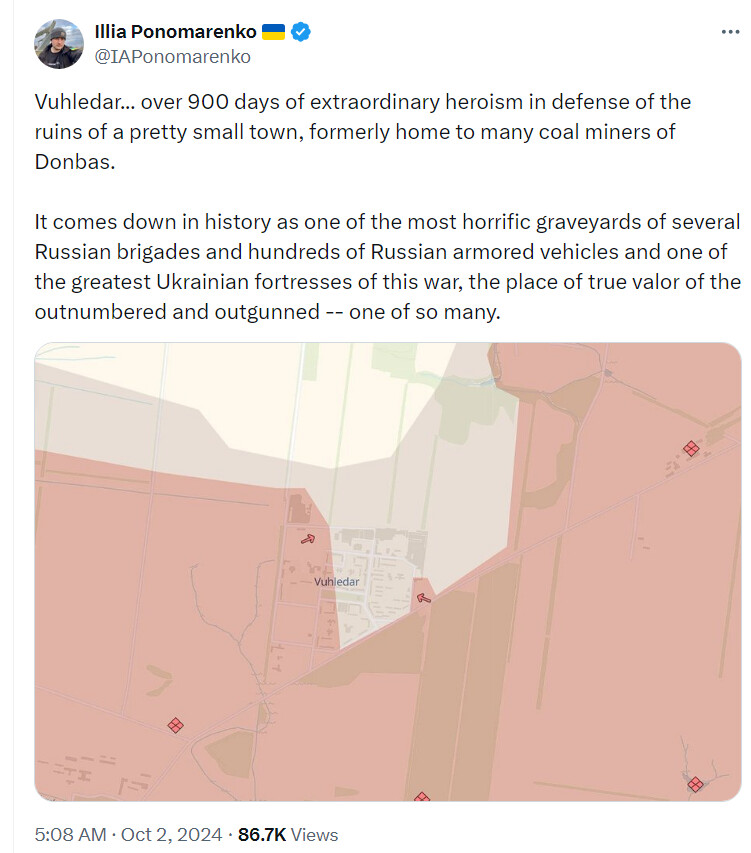
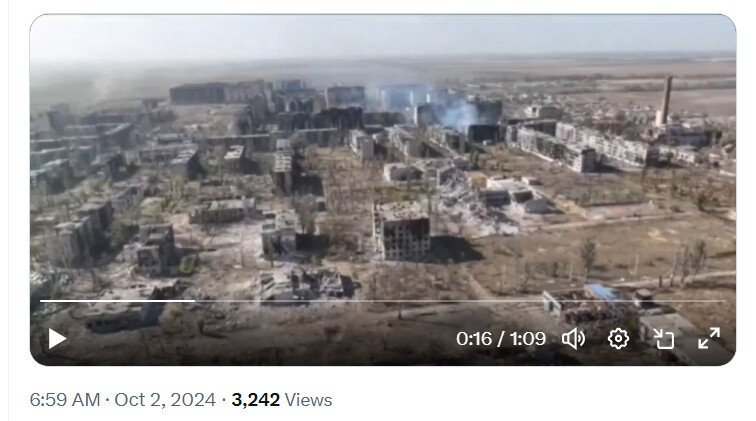
Russian forces enter Vuhledar, situation ‘extremely difficult,’ governor says
October 1, 2024 12:05 PM
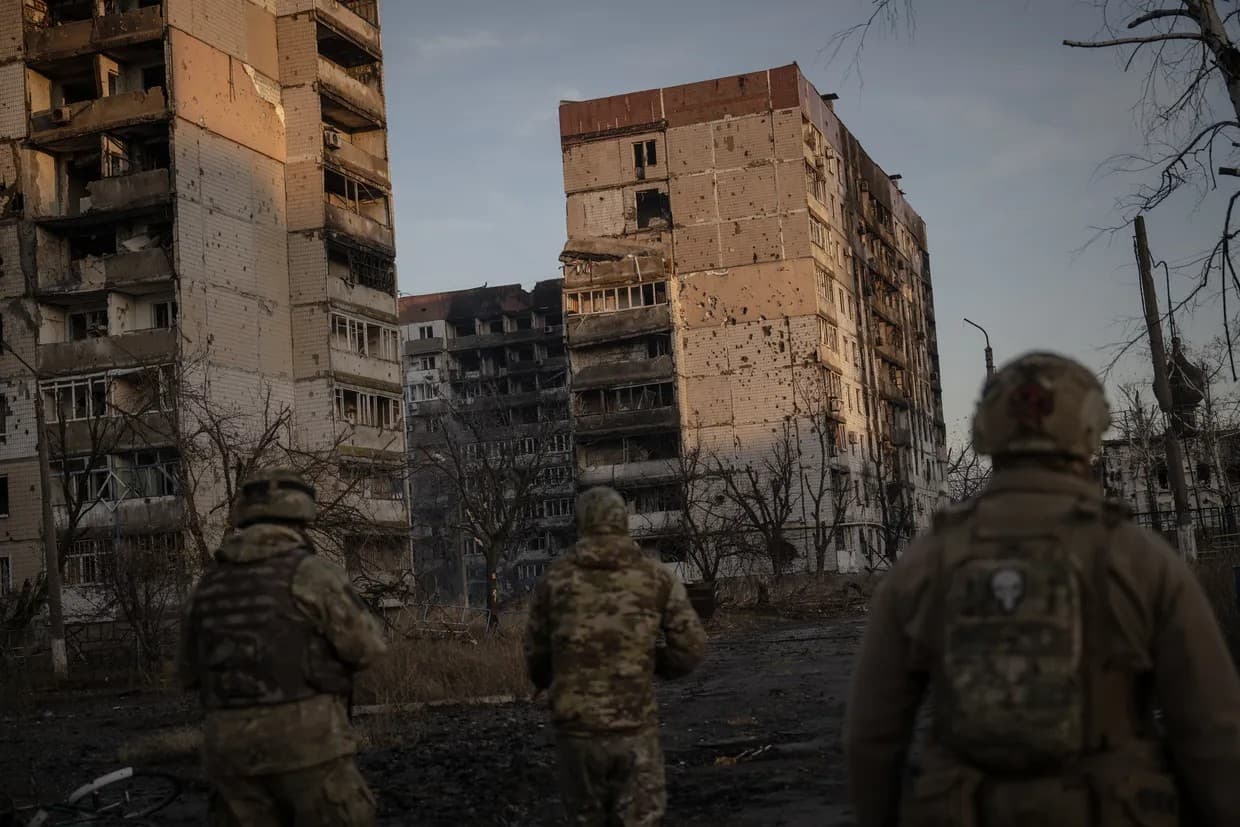
Ukrainian soldiers of the 72nd Mechanized Brigade on duty as Russian attacks on the town of Vuhledar, where a ‘tank duel’ is taking place between the two armies, continue in Donetsk Oblast, Ukraine on Nov. 15, 2023. (Ozge Elif Kizil/Anadolu via Getty Images)
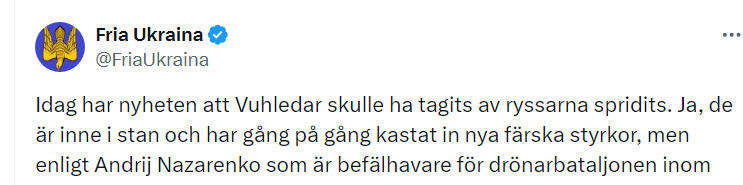
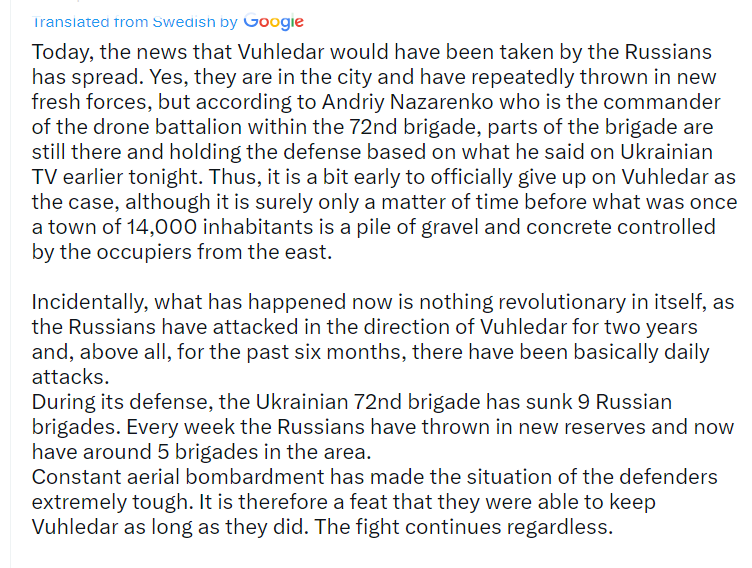
Russian troops have entered the embattled town of Vuhledar in Donetsk Oblast, Governor Vadym Filashkin said on Oct. 1, adding that fighting is ongoing.
Speaking on national television, Filashkin described the situation as “extremely difficult,” adding: “The enemy has already almost reached the center of the town.”
“The fighting is going on within the town, so it is almost impossible to bring in humanitarian aid.”
A total of 107 civilians remain in Vuhledar, though all children have been evacuated, he added.
Ukraine’s 72nd Mechanized Brigade has defended Vuhledar for nearly two years, as Russian forces have been trying to capture the town since the start of the full-scale invasion in 2022.
On Sept. 26, the brigade refuted reports that it was retreating and released a video from the town.
According to the crowd-sourced monitoring website DeepState on Oct. 1, Russian soldiers entered Vuhledar from the west and south.
In recent days, Russian forces advanced northeast of Vuhledar and on the western outskirts of the town, the Institute for the Study of War (ISW) reported on Sept. 30, citing geolocated footage.
The front-line town lies about 50 kilometers (30 miles) southwest of occupied Donetsk and roughly 40 kilometers (25 miles) east of the administrative border with Zaporizhzhia Oblast.
Vuhledar has withstood numerous attacks since the outbreak of the full-scale war in 2022 and has become key to Ukrainian defenses in the southern part of Donetsk Oblast.
“Potentially (its loss could) threaten the security of the entire southwestern portion of Donetsk Oblast not yet occupied,” Federico Borsari, a fellow at the Center for European Policy Analysis (CEPA), told the Kyiv Independent earlier in September.
Vuhledar is located north of a key intersection connecting the O-0532 road towards Vodiane and Kostiantynivka, a small paved road toward Kurakhove, and the partly occupied T-0509 highway toward Velyka Novosilka.
“It is, therefore, a key logistic point for Ukrainian forces defending the southern flank of Kurakhove,” Borsari said.
Given the Russian significant advance towards Pokrovsk from the east in recent weeks, Ukrainian forces need to avoid a similar development from the south to avoid the risk of encirclement, Borsari added.
Vuhledar is also the last fortified town before the village of Velyka Novosilka and the entire southern part of Donetsk Oblast that Ukraine controls. The occupied section of the T-0509 highway, which passes south of Vuhledar, is essential for Russian forces trying to advance westward.
2 Likes
No problems on that thread. ASIO would know the spies. Only issue would be if posters were channeling money to sanctioned individuals and organisations ( which would extend to 7 Israeli Settlers and the Hilltop Youth Group).
2 Likes
4 Likes
Bump
5 Likes
Thanks @Red_Black_Ops
10 Likes