Interview with Mike Kofman
4 Likes
2 Likes
Because of Helene and Milton, Biden has cancelled his visit to Germany to meet with Scholz and associated Rammstein meetings.
German and other European restrictions on arms sales to Israel might indirectly benefit Ukraine. There are reports of the German Government holding up approvals of export licences for commercial sales of munition shells to Israel.
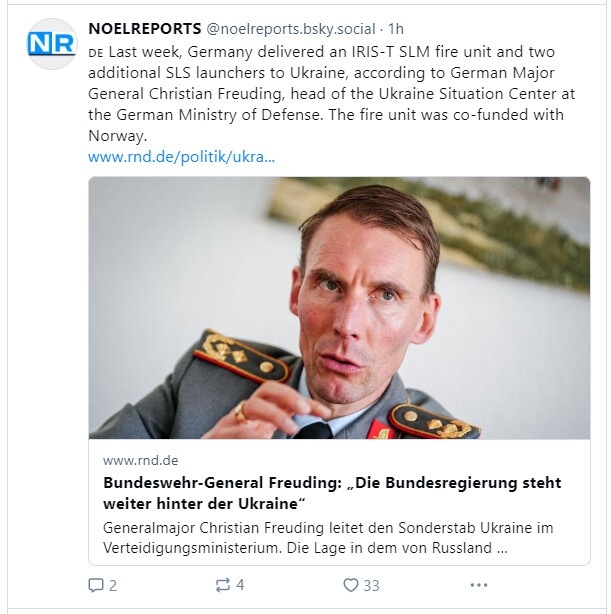
3 Likes
Although…I think the heading is misleading, I’d say it’s more troubling for Ukraine what he has to say.
1 Like
It was actually more positive than where my mind had gone. It seems like the tactical situation at the front is starting to shift in Ukraine’s favour, which is pleasing to hear.
Winter is going to be absolutely brutal without sufficient heating and there’s no clear path to making Putin come to the negotiating table. This war will have to drag on for a while yet until peace talks can begin.
1 Like
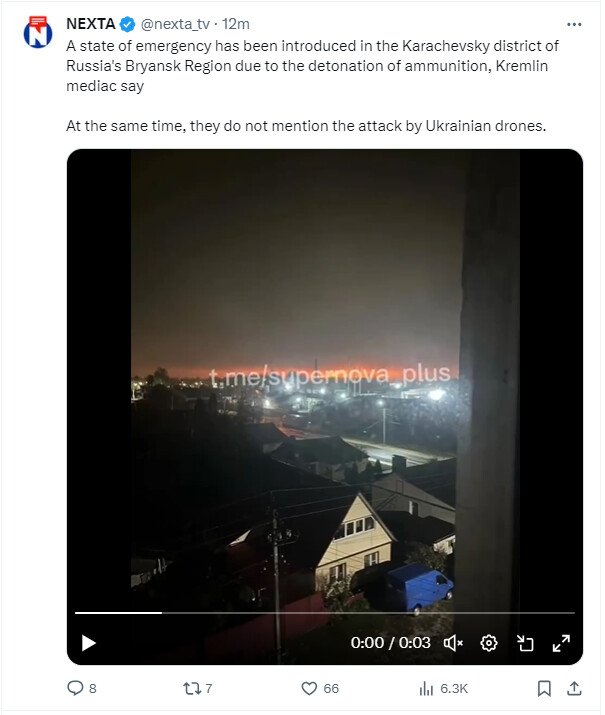
A small article on that weapons depot strike at Karachev in Bryansk Oblast.
Ukraine-Russia war latest: Blow to Putin’s forces as Kyiv destroys weapons store with North Korean missiles
26 minutes ago
Ukraine’s military says it has struck a Russian weapons depot which was holding North Korean missiles more than 60 miles from the border.
The military said the arsenal, in Karachev, Bryansk Oblast, stored ammunition for missile and artillery weapons, including those delivered from North Korea, as well as guided aerial bombs.
Footage emerged overnight of the aftermath of the attack, showing flames burning in the area as the munitions dump exploded.
A state of emergency was declared in a district of western Bryansk following the detonation, state media site Tass reported. Local residents said air raid alerts started sounding around 2am local time.
Bryansk head Aleksander Bogomaz said emergency services were working at sites where debris fell, without saying if there was damage.
The Russian ministry of defence later claimed that they had shot down 47 Ukrainian drones fired across the border overnight. They said 24 were shot down over the Bryansk region.
They said the rest of the drones were destroyed over the regions of Belgorod, Kursk, Rostov and Krasnodar, as well as the waters of the Sea of Azov.
6 Likes
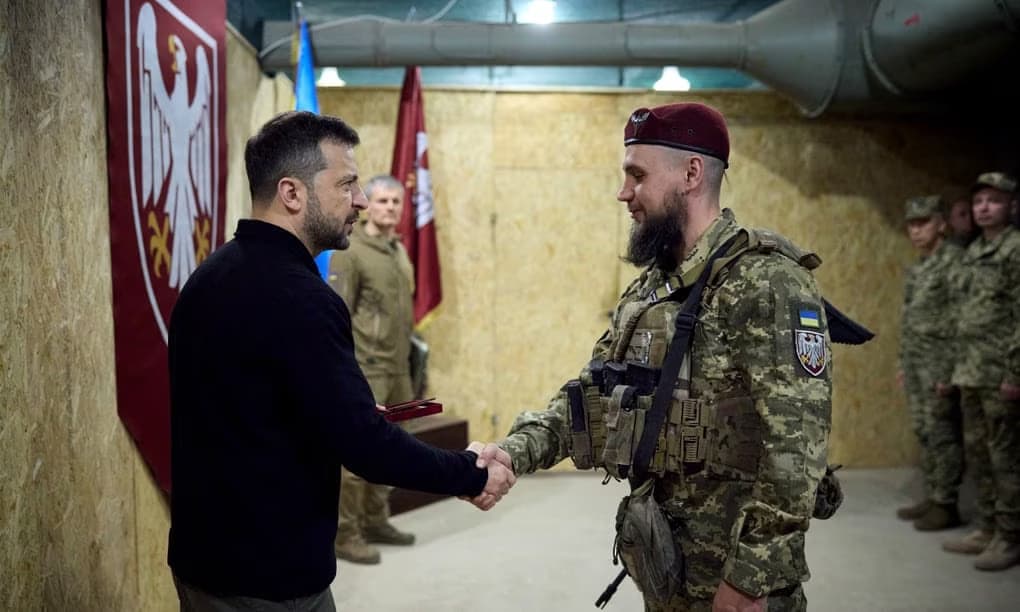
The west’s support for Ukraine is fading – and that will empower Putin for his next war
The US and Europe are failing to provide decisive military aid. A Trump victory could soon reveal the depths of this mistake
Wed 9 Oct 2024 02.00 EDT
In the corridors of Brussels, there is a sinking feeling that the political will to help Ukraine prevail over Russian aggression is ebbing – on both sides of the Atlantic. One senior western official told me it may take a “second shock” of the magnitude of Russia’s full-scale invasion of Ukraine in February 2022 to jolt western countries out of their funk, and spur Europeans to take more radical steps to boost and integrate their own defences. That shock may involve a sudden collapse of Ukrainian frontline defences, another Bucha-style massacre by Russian forces, or perhaps victory for Donald Trump on 5 November. Any of those would be a disaster for Kyiv.
For now, the US is preoccupied with its presidential election and an escalating war in the Middle East that has pushed Moscow’s grinding advance on the Donbas battlefield out of the headlines. France is distracted by a political and fiscal crisis, with Emmanuel Macron’s power at home and influence in Europe waning fast. Germany is paralysed by feuding in its moribund three-party coalition, which may or may not stagger on until a general election due in September 2025.
And the UK is struggling with its own budget woes as the new Labour government focuses on repairing health and public services amid a media furore over dodgy gifts from political donors. Meanwhile, far-right, pro-Russian parties are gaining ground in many European elections, most recently in Austria.
Russia conquered more Ukrainian territory in September than in any month since March 2022. Yet despite Volodymyr Zelenskyy’s trip to the UN general assembly and Washington to present a “victory plan”, and plead for more weapons and a freer hand to use them on Russian soil, American and European attention has drifted away. For Kyiv, these are dangerous and frustrating times.
Joe Biden, increasingly a lame duck, is avoiding any policy step that could compromise Kamala Harris’s chances of keeping Trump out of the White House. That constrains not only his ability to rein in Israel in its battle with Hamas, Hezbollah and Iran, but also his willingness to authorise Ukraine to strike deep inside Russia with US-supplied missiles or European arms containing US components. Biden remains concerned that Vladimir Putin may raise the nuclear stakes or retaliate against the west in ways that could widen the conflict and hand Trump a propaganda stick with which to beat the Democrats.
Britain and France, which supply Ukraine with Storm Shadow and Scalp air-to-ground missiles, cannot permit their unrestricted use against Russian rear bases without a US green light. The German chancellor, Olaf Scholz, continues to balk at supplying the Taurus missile system, which Kyiv has long requested to target Russian supply lines and missile launchpads. Scholz’s reluctance is a mixture of electoralism (the Alternative für Deutschland and Sahra Wagenknecht Alliance are both anti-war), historical (his SDP has always been the party of peace) and a fear of singling out Germany for Russian retribution.
In his parting speeches and interviews, the former Nato secretary general, Jens Stoltenberg, expressed public regret that western allies had not supplied Ukraine with more weapons before Russia’s 2022 full-scale invasion, arguing that it would have made Moscow’s offensive harder and may even have deterred it. This is 20-20 hindsight, especially since Stoltenberg is still unwilling to condemn US caution or press openly for releasing deep-strike capabilities.
Retired US major general Gordon “Skip” Davis lamented that “the Biden administration has delayed time and time again”. Speaking on a European Policy Centre (EPC) panel on the battleground situation in Ukraine, he said that Washington had overestimated the likelihood that Putin would escalate the conflict and hence continued to provide just enough to keep Kyiv’s head above water while withholding the means to prevail. “We want not ‘as long as it takes’ but ‘whatever it takes’,” Davis added.
EU officials see a parallel between reluctance to provide gamechanging assistance to Ukraine and the stubborn resistance among major European powers against collective borrowing and joint weapons purchases to boost Ukraine’s and their own defences. Many European countries have emptied their threadbare ammunition stocks to supply Kyiv and are struggling to expand national arms industries, or source supplies abroad.
"There was some momentum behind greater European defence integration earlier this year, when the commission published its defence industrial strategy,” a senior official told me. “But it has faded since the European elections with the political problems in key capitals.” Now, it may take an earthquake such as the return to power of Nato-sceptical Trump to renew energy and put more money behind EU defence efforts. If Harris wins, the risk is that EU capitals ease up and revert to relying on US protection, as some did after Biden defeated Trump in 2020.
Ukraine can ill afford to wait for such a “second shock” to jolt western governments as its forces are bleeding out daily in the war of attrition imposed by a bigger enemy. “You can’t expect Ukraine to sustain another 30 months when our own country is the battlefield and subjected to daily strikes,” Mykola Bielieskov, a senior analyst at Ukraine’s National Institute for Strategic Studies, told the same EPC panel. “What we don’t see is a long-term strategy of sustained support. Otherwise, the Russian victory scenario will progress.”
For European governments, regardless of their domestic predicaments, the choice ought to be clear. Support Ukraine more decisively now, including with deep-strike capabilities, or face a far worse strategic position next year, with an emboldened Putin rearming for his next war of conquest.
Paul Taylor is a senior visiting fellow at the European Policy Centre
6 Likes
So Ukraine is using Korean missiles now, going by that headline  . Little fat guy won’t like that.
1 Like
Well ****, someone hasn’t been paying attention in the last two years.
Such a shame.
4 Likes
It all seems depressing Benny! Like a slow defeat creeping up on the Ukrainians
EU approves 35-billion-euro loan for Ukraine using frozen Russian assets
October 9, 2024 11:44 PM
EU flags in front of the European Commission building in Brussels, Belgium, on Dec. 28, 2023. Photo for illustrative purposes. (Dursun Aydemir/Anadolu via Getty Im
European Union countries have approved an unprecedented plan to issue a 35-billion-euro ($37.2 billion) loan to support Ukraine’s war-torn economy, using Russia’s immobilized Central Bank assets as collateral.
The deal is part of a broader G7 initiative to provide €45 billion ($50 billion) in aid to Kyiv, struggling to counter a renewed Russian offensive that has severely damaged its power infrastructure.
Under the G7 plan, profits from Russia’s frozen assets will gradually be used to repay the multi-billion-euro loan. EU officials said that the 35 billion loan will be “undesignated” and “untargeted,” allowing Ukraine maximum flexibility in how it spends the funds. The EU expects to start distributing the money early next year.
The agreement, reached on Oct. 9 by EU ambassadors, follows Hungary’s announcement that it would block a key sanctions reform until after the U.S. presidential election on Nov. 5.
The proposed amendment will extend the renewal period for sanctions on Russia’s frozen assets—valued at around €210 billion across the EU—from six months to 36 months. Unlike the loan, which passed by a qualified majority, changes to sanctions laws require unanimous approval.
“We believe that this issue should be decided – the prolongation of the Russian sanctions – after the US elections. That was the Hungarian position,” Hungary’s finance minister Mihaly Varga said on Oct. 8 following a ministerial meeting in Luxembourg, according to Euronews.
The longer renewal period aims to make the project more predictable and address concerns raised by G7 allies, particularly the U.S., which fears that a single EU member could block sanctions, unfreeze assets, and disrupt the entire plan. These fears are mainly directed at Hungary, known for blocking sanctions in exchange for controversial concessions.
According to the G7 plan, profits generated by the frozen assets will be used to gradually repay the money loaned to Ukraine. If these profits are no longer accessible, the West will be responsible for covering the costs.
8 Likes
Meanwhile, the EU Commission is suing Hungary in the EU Court of Justice for its National Sovereignty laws, which criminalises those who have received any funds from foreign sources.
You would like to think that banks would have taken this action willingly rather than under the duress of sanctions. But ‘business is business’ and has never had, nor will have, a moral compass.
Russia has lost another banking partner as more lenders turn their back on Moscow over fear of sanctions
Oct 10, 2024, 2:32 AM GMT+8
- Russia will be cut off from another bank at the end of the month.
- Oversea-Chinese Banking Corp will stop processing Russian transactions in November, Bloomberg reported.
- The Singaporean bank is following lenders in China, which have largely pulled back from Russia.
Another bank has turned its back on Russia as lenders grow worried about doing business with Moscow under threat of Western sanctions.
Oversea–Chinese Banking Corp, the second-largest lender in Singapore, told its clients it would no longer process any transactions related to Russia as of the start of November, a person familiar with the matter told Bloomberg in a report published this week.
That includes transactions revolving around the transport or sale of goods and services in Russia, the person said, attributing the pullback to “operational challenges” around compliance and regulation.
The new restrictions aren’t expected to significantly impact the bank, given that OCBC hasn’t opened new accounts for Russian clients in two years, the source added.
The bank did not immediately respond to requests for comment from Business Insider.
The changes come as more lenders grow hesitant about doing deals with Russian clients after the West threatened to impose secondary sanctions on firms doing business in the country.
A Russian state media outlet reported that nearly all Chinese banks have stopped processing payments from Russia out of fear of being targeted.
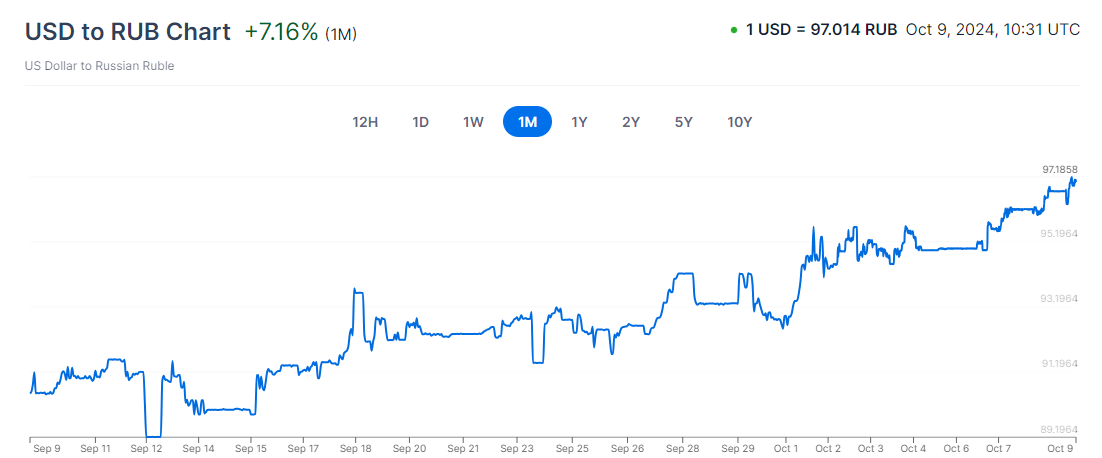
Russia, meanwhile, has nearly depleted its yuan reserves and businesses earlier this year had been locked out of billions amid payment issues abroad, according to data from Russia’s central bank.
6 Likes
But does being at war make some difference?
1 Like
Does Hungary have any present Declarations of War?
UK intel: Russia proposes 25% defense budget increase, social cuts in 2025
The draft budget has a 16% cut in social spending, prioritizing military funding amid 9% inflation and economic challenges from excess demand, per UK intelligence.
09/10/2024
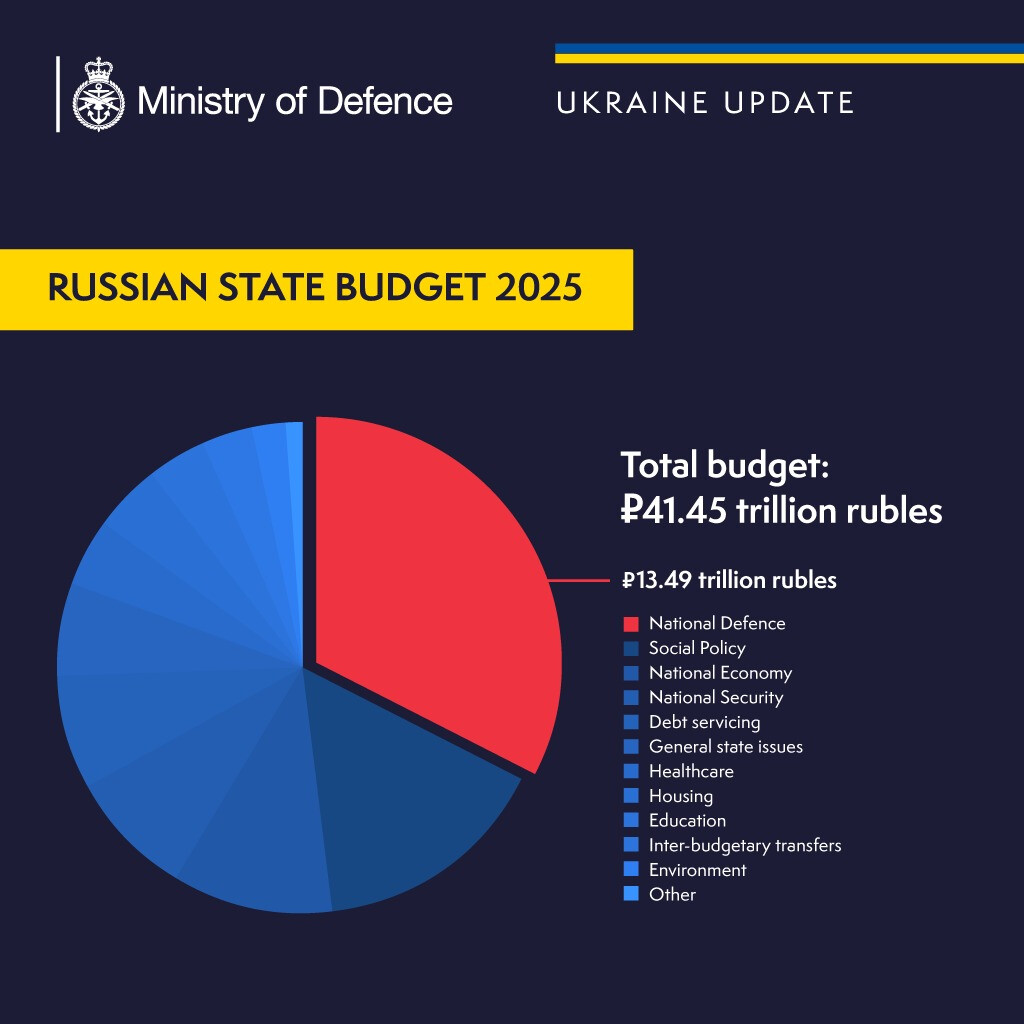
Russian budget 2025. Infographic: X/DefenceHQ
UK intel: Russia proposes 25% defense budget increase, social cuts in 2025
Russia’s proposed 2025 budget includes a 25% increase in defense spending and a 16% reduction in social spending, reflecting the government’s prioritization of military financing, according to the UK Defense Ministry’s Intelligence Update, published on 9 October.
This budget decision is set against the backdrop of rising inflation, which reached 9% in August 2024, and ongoing economic challenges caused by demand exceeding supply.
The Ministry wrote:
- On 30 September 2024, the Russian government submitted draft budget proposals for 2025 to the State Duma. The 2025 budget expects expenditure to grow by 5% (not adjusted by inflation) to 41.5 trillion rubles ($447bn).
- The proposed budget envisages an approximate 25% increase in defence spending in 2025, compared to the announced 2024 budget. Defence spending accounts for 32% of the 2025 budget, up from the pre-war share of 14.5% in 2021. The new budget demonstrates Russia’s continued prioritisation of financing the war over other domestic priorities. For example, social spending is expected to decrease by 16% in 2025.
- Demand continues to outpace supply in the Russian economy and the expanding budget for 2025 is highly likely to worsen this. This will almost certainly add to inflationary pressures which remain a key issue, due to the inflation rate being approximately 9% in August 2024.
According to ISW, despite Russian officials, including Prime Minister Mikhail Mishustin, emphasizing the importance of fulfilling social obligations, the 2025 defense budget is set to rise to $140 billion, consuming 40% of the federal budget.
ISW noted earlier that Russia plans to allocate almost $1 billion for military contract payments from 2025 to 2027, indicating a continued reliance on crypto-mobilization for Ukraine war manpower.
2 Likes
Ukraine getting the promise of a loan while at war, but you come across as asking why Hungary are being investigated. Just wondered if being at war made a difference. I wouldn’t have a scooby why Hungary are mentioned.
3 Likes
Hmm Hungary. Here’s some selected news articles about Hungary in just the last 8 hour period.
https://www.washingtonpost.com/world/2024/10/09/hungary-viktor-orban-donald-trump-europe-ally/
https://www.nytimes.com/2024/10/09/world/europe/eu-hungary-orban-ukraine-russia-china.html
4 Likes