Ex-Google CEO contributing to space with first private space telescope. Not really the first, but the first with this level of capability. Similar to Hubble.
1 Like
Crew-11 undocking 9:05am Thursday morning and landing Thursday 7:51pm.
Login earlier on NASA live or SpaceX on X if you are interested in seeing the re-entry.
4 Likes
That sweet sweet moon cheese.
3 Likes
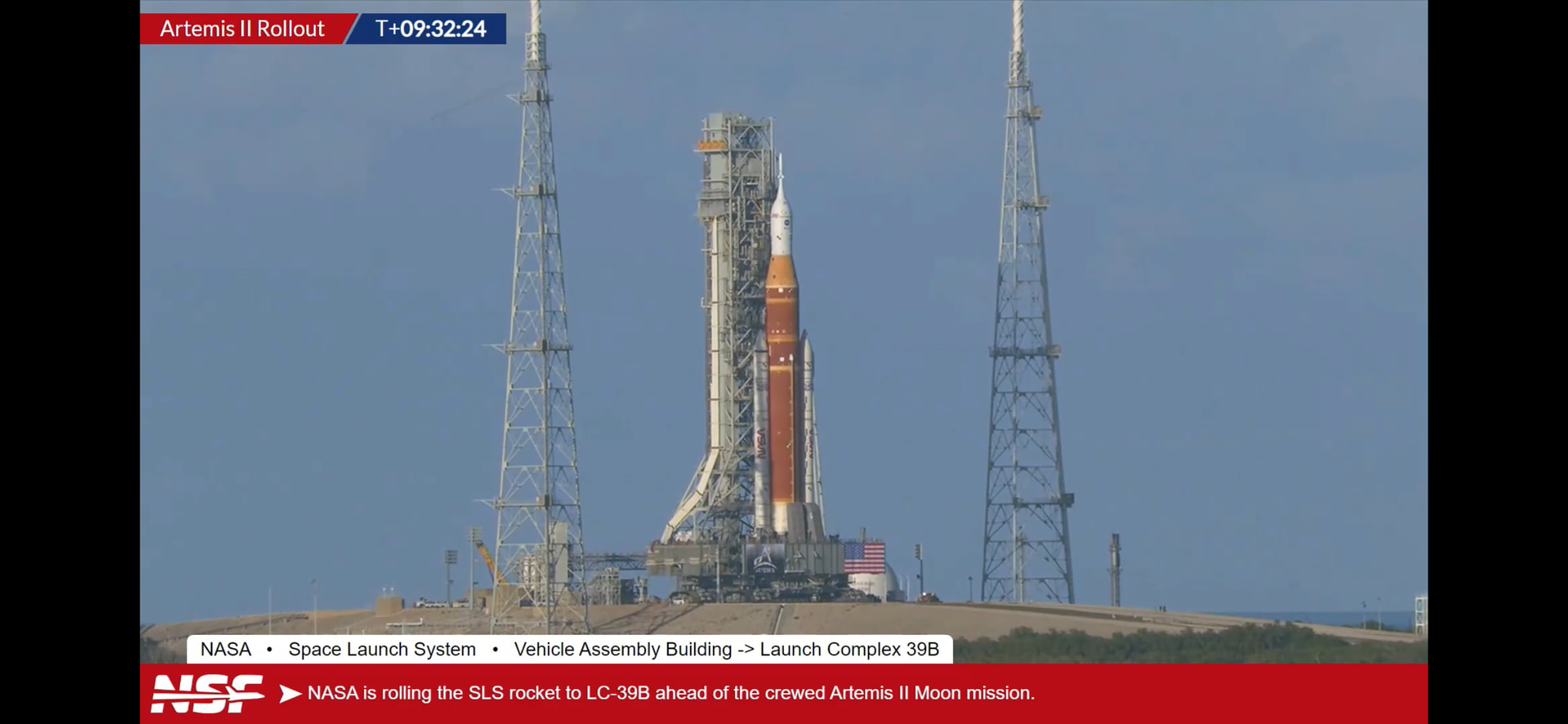
SLS rollout Saturday 17th @ 10:30pm
EDIT
Maybe…

2 Likes

Oh that’s good.
1 Like
Pretty good AI generated list…
Some links are broken, thanks AI.
Good reminder of what happened last year. Mostly last year.
Updated to include better descriptions
I deleted the post as it had too many errors.
Bloody AI is not ready for this yet.
2 Likes
Happier with this list.
If you keep prompting AI to triple check and add extra prompts it eventually gives more accurate responses.
Why not just triple check and then triple check again before giving a response.
Jeez…
Here is the updated complete list of the top 50 space launch missions and space discoveries for 2025. All external links have been removed from the entries (no URLs are included now). Summaries remain ~100 words, with consensus status noted where relevant for discoveries.
-
Tianwen-2 Asteroid Sample Return Mission (CNSA)
China’s Tianwen-2 launched on May 28, 2025, from Wenchang on a Long March 3B rocket, targeting near-Earth asteroid 469219 Kamoʻoalewa for sample collection and a flyby of comet 311P/PANSTARRS. This mission built on China’s lunar successes, using advanced robotics to gather surface materials for return by 2029. It aimed to reveal insights into asteroid composition and solar system origins. Despite geopolitical challenges, it showcased CNSA’s deep space expertise and potential for international collaboration in planetary science. -
ESCAPADE Mars Mission (NASA)
Launched November 13, 2025, from Cape Canaveral on Blue Origin’s New Glenn, NASA’s twin ESCAPADE spacecraft (Blue and Gold) studied Mars’ magnetosphere and atmospheric escape. Built by UC Berkeley and Rocket Lab for under $80 million, they arrived in 2026, providing data on solar wind interactions and why Mars lost its water. Findings challenged ion dynamic models, supporting future human missions. -
SPHEREx Observatory Launch (NASA)
NASA’s SPHEREx launched in March 2025 on a SpaceX Falcon 9, conducting a near-infrared all-sky survey to map galaxies, study cosmic inflation, and detect water/organics in protoplanetary disks. It complemented other missions, revealing new galaxy clusters and ice distributions essential for understanding universe evolution. -
PUNCH Mission Launch (NASA)
Launched alongside SPHEREx in March 2025 on Falcon 9, PUNCH’s four satellites created 3D images of the Sun’s corona, tracking solar wind origins. This improved space weather forecasts, protecting infrastructure, with early data refining coronal mass ejection models. -
IMAP Mission Launch (NASA)
Launched in 2025, NASA’s Interstellar Mapping and Acceleration Probe at L1 studied heliosphere-interstellar interactions, mapping neutral atoms and cosmic rays. It advanced knowledge of solar wind and cosmic ray origins, aiding space environment predictions. -
TRACERS Mission Launch (NASA)
Launched October 2025, NASA’s Tandem Reconnection and Cusp Electrodynamics Reconnaissance Satellites examined magnetic reconnection in Earth’s magnetosphere. Dual satellites offered stereo views, enhancing space weather forecasting accuracy. -
Fram2 Private Polar Orbit Mission (SpaceX)
Launched April 1, 2025, on Falcon 9, Fram2 achieved the first crewed polar retrograde orbit. Four astronauts performed Earth observations, aurora studies, and climate research over 8 days, expanding commercial spaceflight capabilities. -
Blue Ghost Lunar Lander (Firefly Aerospace)
Launched January 15, 2025, on Falcon 9, Blue Ghost entered lunar orbit February 13 and landed March 2 in Mare Crisium. It transmitted over 110 GB of data, including lunar horizon glow and eclipse images, supporting NASA’s CLPS resource prospecting. -
IM-2 Lunar Lander (Intuitive Machines)
Launched February 27, 2025, on Falcon 9, IM-2 inserted into lunar orbit March 3 and landed March 6 in Mons Mouton. Despite tipping over, it remained intact, drilling for ice and confirming volatiles for future bases. -
Hakuto-R Mission 2 (ispace)
Launched January 15, 2025, on Falcon 9 with Blue Ghost, Hakuto-R M2 performed a lunar flyby February 14 and orbit insertion June 5. The landing attempt in Mare Frigoris failed, resulting in a crash, but provided valuable data. -
New Glenn Maiden Flight (Blue Origin)
Debuted January 16, 2025, from Cape Canaveral, New Glenn reached orbit but failed first-stage landing. The November 13 flight succeeded in propulsive landing, marking a milestone for reusable heavy-lift rockets. -
HTV-X1 Cargo Mission (JAXA)
Launched October 26, 2025, on H3 rocket, HTV-X1 arrived at ISS October 29, delivering supplies and lunar gateway tech demos. It enhanced autonomous docking, strengthening Japan’s ISS contributions. -
Axiom Mission 4 (SpaceX)
Launched June 25, 2025, to ISS, returning July 15, with crew including Peggy Whitson, Shubhanshu Shukla (ISRO), Sławosz Uznański (ESA), and Tibor Kapu. Debuted Crew Dragon Grace, marking firsts for India, Poland, and Hungary. -
Lucy Asteroid Flyby (NASA)
NASA’s Lucy flew by main-belt asteroid 52246 Donaldjohanson on April 20, 2025, at 922 km, capturing images and spectra. This en route encounter provided data on Trojan asteroid precursors and composition. -
Solar Orbiter South Pole Images (ESA)
After Venus flyby February 18, 2025, Solar Orbiter captured first images of the Sun’s south pole outside the ecliptic, released June 11. Tilted to 17°, it advanced heliophysics understanding. -
Europa Clipper Mars Gravity Assist (NASA)
On March 1, 2025, Europa Clipper performed a Mars flyby at 950 km, adjusting trajectory for Jupiter arrival in 2030. It gathered bonus Mars data while en route. -
Hera Mars Gravity Assist (ESA)
ESA’s Hera flew by Mars on March 12, 2025, observing Deimos and adjusting path to Didymos for 2026 arrival, studying DART impact aftermath for planetary defense. -
Parker Solar Probe Perihelions (NASA)
In 2025, Parker achieved perihelions on March 22, June 19, September 15, and December 12, sending closest solar wind images from 3.8 million miles, revealing atmospheric details. -
OSIRIS-APEX Earth Gravity Assist (NASA)
On September 23, 2025, OSIRIS-APEX flew by Earth at 3442 km, redirecting toward Apophis for 2029 rendezvous, building on OSIRIS-REx’s Bennu sample return. -
Starship Block 2 Maiden (SpaceX)
SpaceX’s Starship Block 2 debuted January 16, 2025, but failed. Five launches occurred, with two successes, advancing reusability and in-orbit refueling for future missions. -
Ariane 6 Launches (ESA)
Ariane 6 completed four successful launches in 2025, deploying satellites and proving reliability after its debut, enhancing Europe’s independent space access. -
Vulcan Centaur Maiden (ULA)
United Launch Alliance’s Vulcan Centaur debuted August 13, 2025, successfully, providing a new heavy-lift option for U.S. national security and science missions. -
Long March 12A Maiden (CNSA)
Launched December 23, 2025, Long March 12A succeeded in orbit insertion but failed booster landing, advancing China’s reusable rocket technology. -
Zhuque-3 Maiden (LandSpace)
China’s Zhuque-3 debuted December 3, 2025, achieving orbit but crash-landing the first stage, marking progress in private reusable launchers. -
Record 317 Successful Orbital Launches
2025 saw 330 orbital launch attempts with 317 successes, driven by SpaceX and China, setting a new record and boosting global space economy. -
Interstellar Comet 3I/ATLAS Discovery
Discovered July 1, 2025, by ATLAS, 3I/ATLAS was the third interstellar comet. JWST and Hubble revealed organics, suggesting panspermia, and enriched models of interstellar objects. This discovery has achieved scientific consensus as an interstellar object of natural origin, confirmed by multiple observatories and peer-reviewed studies. -
Biosignatures in Mars’ Cheyava Falls Rock
A September 10, 2025, Nature paper discussed potential biosignatures in Cheyava Falls rock from Perseverance, including organics and microbial-like structures, closest evidence to ancient Martian life. This discovery has not achieved scientific consensus, as abiotic explanations are debated and require sample return for confirmation. -
Weakening Dark Energy Confirmation
In 2025, DESI and other telescopes confirmed dark energy’s decreasing strength, resolving Hubble tension and altering predictions for the universe’s fate. This discovery has not achieved full scientific consensus, as it is an emerging finding with ongoing debates and needs further data validation. -
Biosignatures on Exoplanet K2-18b
JWST detected dimethyl sulfide and methane on K2-18b in 2025, providing strongest evidence for potential life on this hycean world, sparking habitability debates. This discovery has not achieved scientific consensus, due to alternative explanations and the need for more observations. -
Early Universe Supermassive Black Hole Growth
JWST observed an actively growing SMBH in a 570 million-year-old galaxy in November 2025, challenging formation timelines and models. This discovery has achieved scientific consensus on the observation, but consensus on implications is pending further theoretical work. -
Monster Stars in Early Universe
JWST spotted massive stars from cosmic dawn in 2025, breaking formation theories and illuminating reionization processes. These “monster” stars, far larger than previously thought possible so early after the Big Bang, challenge models of stellar formation in the infant universe. This discovery has not achieved scientific consensus, as it requires additional confirmations and model revisions. -
Quipu Superstructure Discovery
Astronomers discovered the Quipu, a 1.4 billion light-year chain of 68 galaxy clusters in early 2025, the largest known structure. Its immense scale questions the cosmological principle of homogeneity on large scales. This discovery has not achieved scientific consensus, with ongoing debates about its impact on standard cosmology. -
Rogue Black Hole in Dwarf Galaxy
A wandering black hole was detected in the dwarf galaxy MaNGA 12772-12704, 230 million light-years away, in 2025. Its motion suggests it was ejected during a past galactic merger. This discovery has achieved scientific consensus on the detection itself, but formation and ejection mechanisms are still under discussion. -
Most Energetic Neutrino Detection
KM3NeT detected a 220 PeV neutrino in 2025 — 30 times more energetic than the previous record — traced back to a distant blazar. This breakthrough advances multimessenger astronomy by linking high-energy neutrinos with cosmic accelerators. The discovery has achieved scientific consensus as a valid detection. -
Gamma-Ray Burst from Early Universe
JWST observed a gamma-ray burst from an exploding star just 730 million years after the Big Bang in December 2025. The event provides insights into the first generations of massive stars and cosmic reionization. This discovery has achieved scientific consensus on the event, though broader implications are still being studied. -
Moon-Forming Disc Around Exoplanet
JWST provided the first direct measurements of a circumplanetary disc around an exoplanet in 2025, confirming the process of moon formation is occurring beyond our solar system. This milestone opens new avenues in exomoon research. The discovery has achieved scientific consensus on the observation. -
Potential Habitability of TRAPPIST-1 d
Observations in August 2025 suggested TRAPPIST-1 d could support liquid water under certain atmospheric conditions, boosting searches for life in this nearby multi-planet system. This discovery has not achieved scientific consensus, as habitability strongly depends on uncertain atmospheric models. -
Unusual Features in GN-z11 Galaxy
JWST found anomalies in the extremely distant galaxy GN-z11 in 2025, including evidence of a surprisingly dead or quiescent core. These features challenge prevailing theories of early universe galaxy formation and evolution. This discovery has not achieved scientific consensus and requires further data. -
Dead Galaxy in Early Universe
JWST discovered a fully formed quiescent (dead) galaxy in the early universe in 2025, defying standard models that expect active star formation at such early epochs. This finding prompts major revisions to cosmic galaxy evolution theories. It has not achieved scientific consensus. -
New Galactic Distance Record
JWST broke distance records in 2025 by confirming galaxies beyond 13 billion light-years, pushing back our view of the universe closer to the Big Bang. These observations refine cosmic expansion history and Big Bang timelines. This discovery has achieved scientific consensus on the distances measured. -
Paradigm-Shifting Black Hole
Physicists identified a new class or type of black hole in 2025, with properties that reshape current understanding of quantum gravity and black hole thermodynamics. This discovery has not achieved scientific consensus, as it challenges established paradigms and awaits broader theoretical acceptance. -
Earth’s Interior Connections
New 2025 research revealed stronger links between Earth’s deep interior (core and mantle) and surface processes than previously thought, with implications for plate tectonics, volcanism, and geodynamic models. This discovery has not achieved scientific consensus and is still being integrated into geophysical frameworks. -
Exoplanet BD+05 4868 Ab Discovery
Discovered in 2025, gas giant BD+05 4868 Ab orbits a cool, low-mass star, offering fresh insights into planet formation and potential habitability zones around red dwarfs. The existence of the planet has achieved scientific consensus, though its detailed properties remain under study. -
Proxima b Atmosphere Confirmation
Enhanced observations in 2025 strengthened evidence that Proxima b (the closest known exoplanet) is rocky and may retain a thin atmosphere. This advances prospects for habitability studies of the nearest extrasolar world. Consensus has not been reached on the atmosphere’s presence or composition. -
WASP-127b Exotic Clouds
JWST revealed exotic, high-altitude clouds on the ultra-hot Jupiter WASP-127b in 2025, improving our understanding of exoplanet atmospheres and weather patterns. The discovery of these unusual cloud features has achieved scientific consensus. -
Gaia-4b Rogue Planet
The Gaia mission discovered a free-floating (rogue) planet candidate Gaia-4b in 2025, adding to evidence of a large population of unbound planets in the galaxy. Detection has achieved scientific consensus, though estimates of their abundance are still under review. -
YSES-1 Multi-Planet System
Direct imaging in 2025 revealed the young YSES-1 system containing two gas giant planets, providing a rare snapshot of early planet formation and dynamical evolution in multi-planet environments. The system has achieved scientific consensus among astronomers. -
Quarks Obey Special Relativity
Confirmation in 2025 that quarks inside protons and neutrons fully obey special relativity unified aspects of quantum mechanics and relativity, marking progress toward a theory of quantum gravity. This finding has achieved scientific consensus within the physics community. -
Exoplanet Milestone: Over 6,000 Confirmed
NASA and international teams reached the milestone of over 6,000 confirmed exoplanets in 2025, showcasing the incredible diversity of worlds beyond our solar system and accelerating the search for Earth-like planets. This milestone has achieved full scientific consensus. -
Intense Solar Activity and Global Auroras
The 2025 solar maximum (peak of Solar Cycle 25) produced exceptionally intense solar storms, resulting in widespread auroral displays visible at unusually low latitudes and providing valuable data for space weather prediction models. This solar behavior has achieved scientific consensus as part of the expected solar cycle.
5 Likes
Great list. For all the Elon hype NASA is out performing them by a mile. Is SPACEX just the FEDX of space?
They mainly do very different things.
SpaceX is a rocket company and has done very little in terms of science. Mostly effects of space on humans.
NASA and other space agencies predominately allow scientific investigation and discovery via probes and space telescopes.
Anyone who believes SpaceX can replicate what NASA is doing it is nuts.
SpaceX and other commercial providers can replace NASA launch and infrastructure capability. They do it cheaper and faster. Apart from nuclear power due to security concerns.
When SpaceX sends humans to Mars, they will only be able to do it safely with knowledge and help from NASA and its scientists.
5 Likes
I think the nuclear concerns are more about what happens if the rocket blows up. SpaceX or anyone else aint sending anyone to Mars in our lifetime IMO. There is too much new technology required which is just not available yet.
It’s more about a commercial company having and developing nuclear tech and controlling nuclear material.
Nuclear in space will happen very soon. Target of 2030 on the moon which will definitely push a little later.
Government agencies should control the development and manufacture that tech. Especially given rockets are basically ICBM’s without nuclear warheads.
The risk of launching of rockets with a nuclear reactor on board is overstated given the size will be small and fuel used will not enriched as per nuclear weapons.
Flight trajectory of the rockets on liftoff is straight offshore and crashing into the ocean given the small mount of fuel is no major risk.
There will also have protection surrounding the reactor and it will be in a shutdown state. Lots of things to make it relatively safe on takeoff and until it reaches orbit.
Russia put a nuclear reactor in space decades ago and tested it.
2 Likes

1 Like
And then it crashed back to earth and landed on Chernobyl #4.
*May not be a true account.
3 Likes
I understand why SpaceX is doing this, but I don’t like it.
A listing of $1.5 trillion has been discussed, which will raise $30 billion in cash for AI satellites and result in the biggest IPO globally.
Great reward to employees as they can sell their shares employee shares.
Could just do a private raise and achieve the same amount easy.
I don’t like it as the stated goal of SpaceX is Mars. There isn’t really a profit to be made in that mission at this stage.
Shareholders might take that goal off the table if Musk loses control of a public listed company.
2 Likes
The VCs want their money. As do the employees.
You can only extend the runway so far.
We kind of have the same thing at our company.
I expect and IPO in the next two years.
2 Likes
Fixed.
2 Likes
I do understand that.
I’m concerned on what shareholders will do when there will be no profit at least initially and maybe ever from sending hundreds of starships to Mars whilst money is being made with Starlink and AI satellites.
They might want SpaceX to only pursue profit making ventures.
NASA doesn’t do space by making profit decisions. If they did there would be no NASA.
2 Likes
It will be interesting to see how the books look on any SpaceX IPO. Would make fascinating reading I reckon.
1 Like