I had heard something similar to what i have now just found online. " Altogether there are over 50,000 characters, though a comprehensive modern dictionary will rarely list over 20,000 in use. An educated Chinese person will know about 8,000 characters, but you will only need about 2-3,000 to be able to read a newspaper."
1 Like
Oh, is that all ,… 
2 Likes
I think there are people that do know more about the history, from what i have learnt here is that Mao united China in the country we now know. In the thousands of years history there was were different dynasty’s, feudal law, civil wars and lot of bloodshed. There were events through the Mao era that did result in an unknown number of deaths and suffering and his rule has had a positive and negative effect on the following generations. After Mao’s passed leaders that followed introduced some ‘checks and balances’ written into the Chinese Constitution that would in future avoid one leader having unlimited terms and unlimited power. The current leader of China has effectively over time in power removed / rewitten them in the Constitution.
2 Likes
Yup, he has now become as close as you can get to being a modern day emperor. Absolute control with pretty much no term limits.
That’s the thing I don’t understand about Chinese characters. If a new character is introduced for e.g. a new scientific concept, how do readers who do not know it get to understand what it is intended to mean?
This was in regards to Stalin.
I guess they have to look it up in a dictionary. Also, more complicated words are made up of more than one character, so sometimes the individual characters that form the entire word can give a sense of what it’s about.
Somehow…
I think sarcasm gets lost with you…
Maybe, but how was your comment sarcastic?
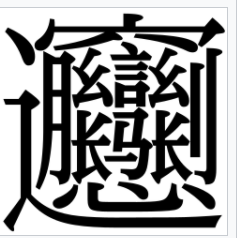
Chinese dictionaries are a science unto themselves, as pinyin might seem sensible to us, but it’s not Chinese, and one common syllable eg shi could be any one of 50+ characters each with a different meaning. Understanding is helped by the tonal variation ie the 4 different ways to pronounce ‘shi’.
@bomber001 is right, but also within one character there are clues to meaning. Supposedly the character above tells the story of making the noodle - I can see a moon, and a heart (maybe it’s a stomach in this context?), and a horse - all needed to grow rice and make a noodle…and there is much more in that character that I can’t see.
So the components of a character do give clues of meaning and verbal sound, but not as efficiently as Latin roots and our phonetic alphabet.
To answer Albert’s question, there is a lot of memorisation and need to consult technical dictionaries, so lay people may have limited capability to read scientific articles.
I know about 1000 characters which gets some instant respect when I work in China, but all it means is I can survive on social media reading and writing very short simple sentences, I’m light years away from being able to read a newspaper but I do generate a lot of laughs when I continually cokkup their beautiful language.
3 Likes
But if it is a new concept or invention it wouldn’t be in the dictionary yet. And the individual characters often represent the whole word or concept.
Maybe someone in China can answer this about how new characters are created. I wonder if they have a department, like in France, that is responsible for it.
I will ask some of my staff
Don’t worry about it…
I really can’t be bothered…
Sometimes they ‘translanguage’ and insert the technical term in English into an otherwise complete sentence in Mandarin (eg we do this with ‘deja vu’). My students sometimes send text to me in this way and the younger generations are comfortable with this.
But traditionalists in govt in China don’t like their language being westernised so they construct a new character.
They can do this via ‘transliteration’ eg if your name is Mark, they will transliterate two characters - ma and ke - and your 2 syllable name will be written in Chinese with 2 characters.
The second method would be to create a new character from existing strokes (that complicated character I posted has around 50 separate strokes).
2 Likes
This below is what i find frustrating about conducting business and also living in China, from The Rage today
"Chinese authorities have suspended timber exports from Victoria in the latest escalation of tensions between Australia and its biggest trading partner.
The trade block comes after reports of curbs being placed on Australian exports of lobster, barley, wine, copper and coal destined for China, although Chinese authorities have not officially confirmed the restrictions."
Don’t be frustrated Comrade !! Life in the Middle Kingdom.
I love the irony, how authorities have suspended imports but not confirmed it. I bet you if Twiggy was the importer then it would go right ahead.
1 Like
Yes they need iron ore … for now. They won’t need Australian iron ore - even Twiggy’s - once the Pilbara killer starts exporting.
But in the meantime Australian pollies will lie back and bask in those sweet mining royalties, making no real plans for how the future economy will be affected by this.
1 Like
Pilbara killer?
Iron ore mine in Guinea in the process.
1 Like