Hot air ballooning or kite flying?
1 Like
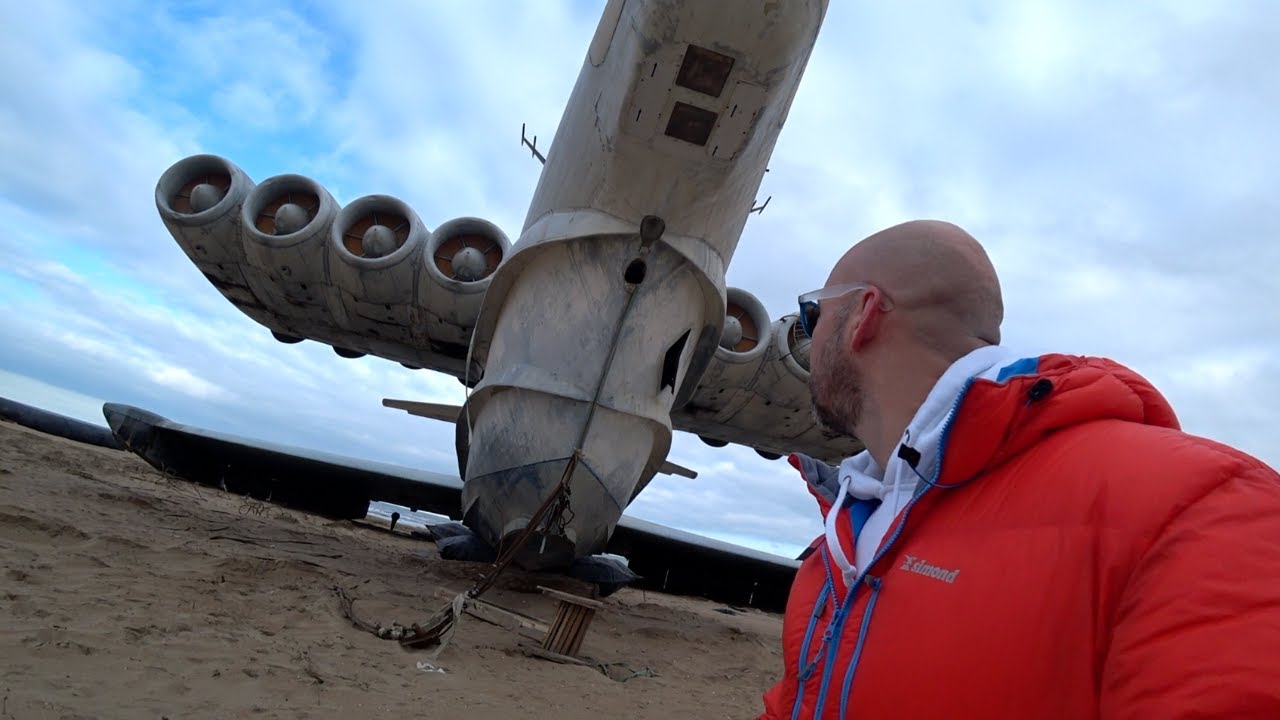
Interesting video from UK Youtube vlogger Benjamin Rich (AKA 'Mr. Bald) from the Bald and Bankrupt YT channel. He was extensively travelling Ukraine, Belarus, russia and the Stans before the outbreak of the war. Here, starting in Rostov-on-Don next to Ukraine’s border, he goes in search of the wreck of the Soviet Ekranoplan on the Caspian. He visits Gorbachev’s hometown and his travels give you some good insights into this part of russia.
Hunting The Caspian Sea Monster
1 Like
Haha listening to an international relations Fellow at the Lowy Institute.
Dissecting the China Russia relationship, he calls Russia an arsonist of the international system.
China wants Russia politically on side to erode western hegemony in the international rules based system. But it also depends on international economic stability, rules based.
So, China running with different agendas in high and low diplomacy?
Make of it what you will ( with minimal implicit bias)
1 Like
But that’s what they want you to see, surely.
1 Like
WW2 helped us to understand the power of propaganda to turn people against each other.
Western media is talking about the regime as the enemy of peace, there’s no talk about Russian people being evil or Russian people spreading a dangerous ideology.
Russians aren’t getting that message, they are being told that western PEOPLE are the enemy, that they are spreading a dangerous LGBT ideology, that they are Nazis that have to be stopped.
And they are buying it, just like the Germans did in WW2.
6 Likes
The video for this week’s FC is out on ABC.net.au for the article posted by @loyalandproud and referred to by @Esteban. Australians who haven’t been following this war and who watch foreign correspondent tonight will have their eyes opened to the batshit crazy russian propagandists and their shenanigans we are already all too familiar with. It might have an impact on broad public sentiment here about russia and this war in general…
Russia’s Info War - ABC News
2 Likes

2 Likes
Some remarkably weird assertions not connected with the reality of the R politics at all in this one
Tried using the archive but it didn’t capture the content. So here is the full article:

How long can Russia keep fighting the war in Ukraine?

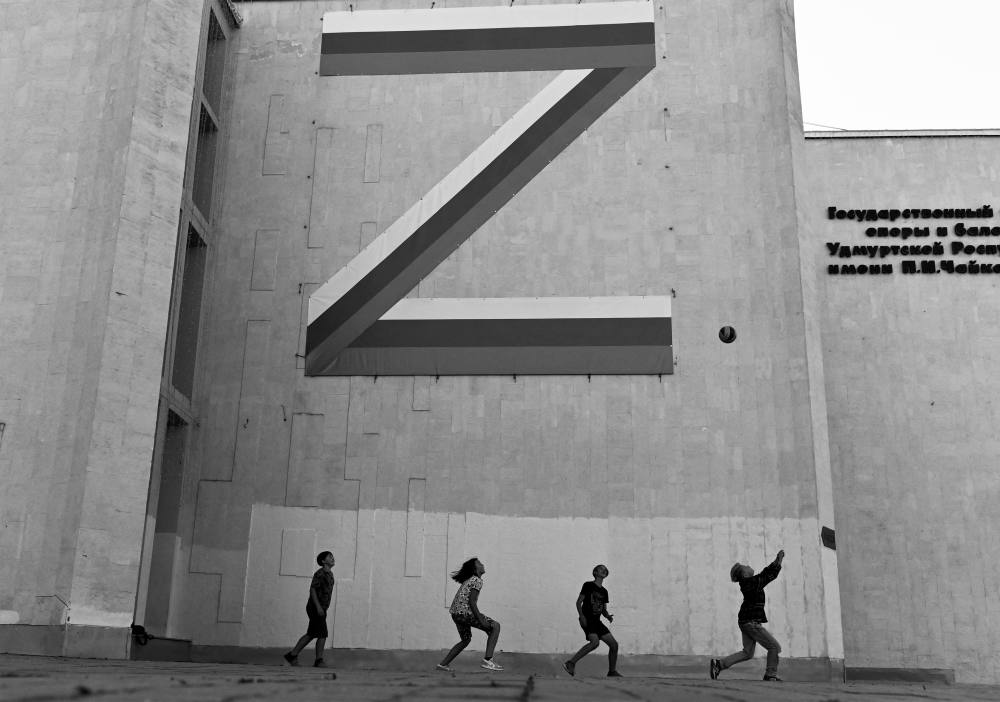


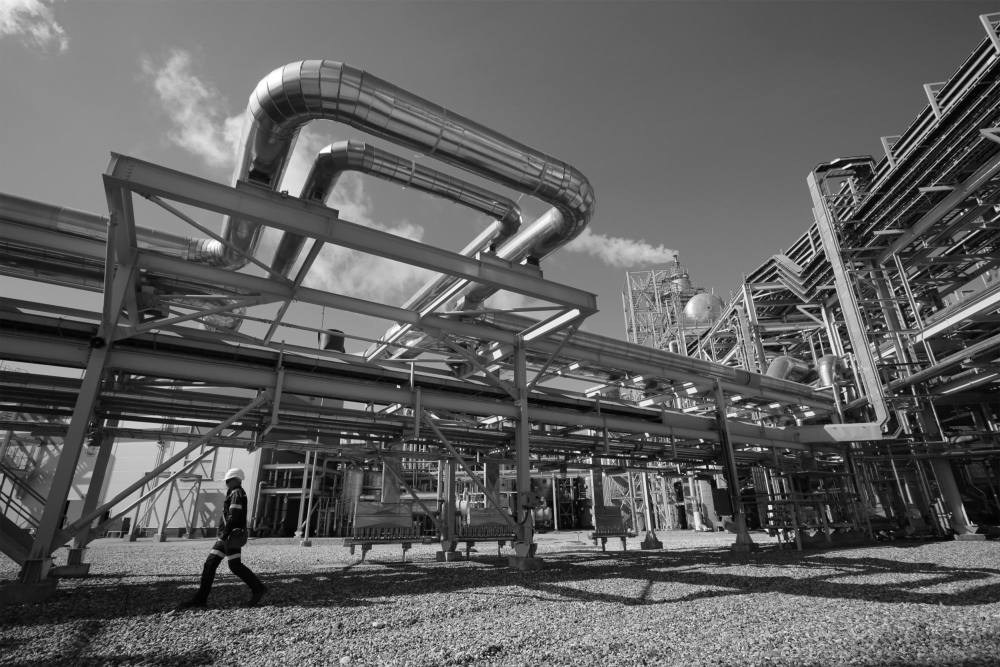
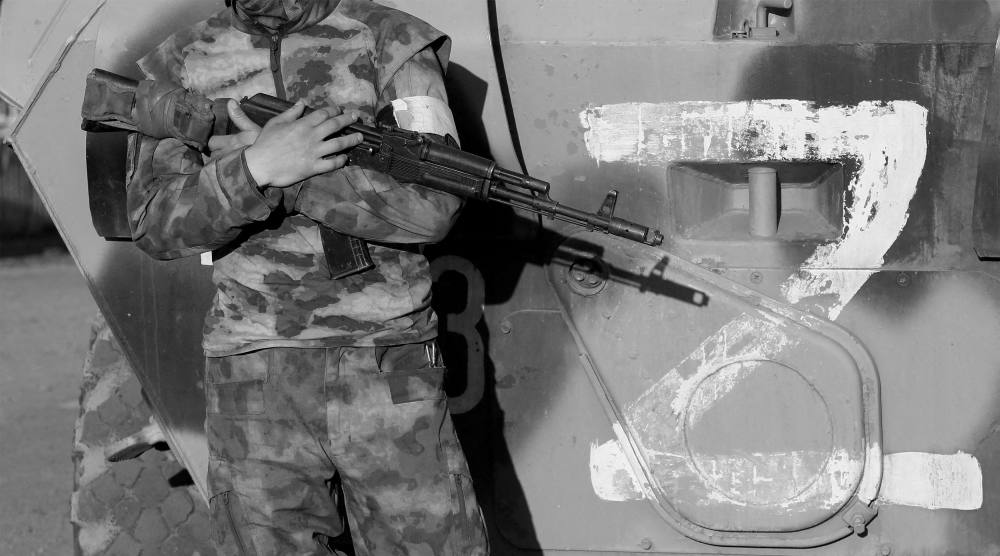
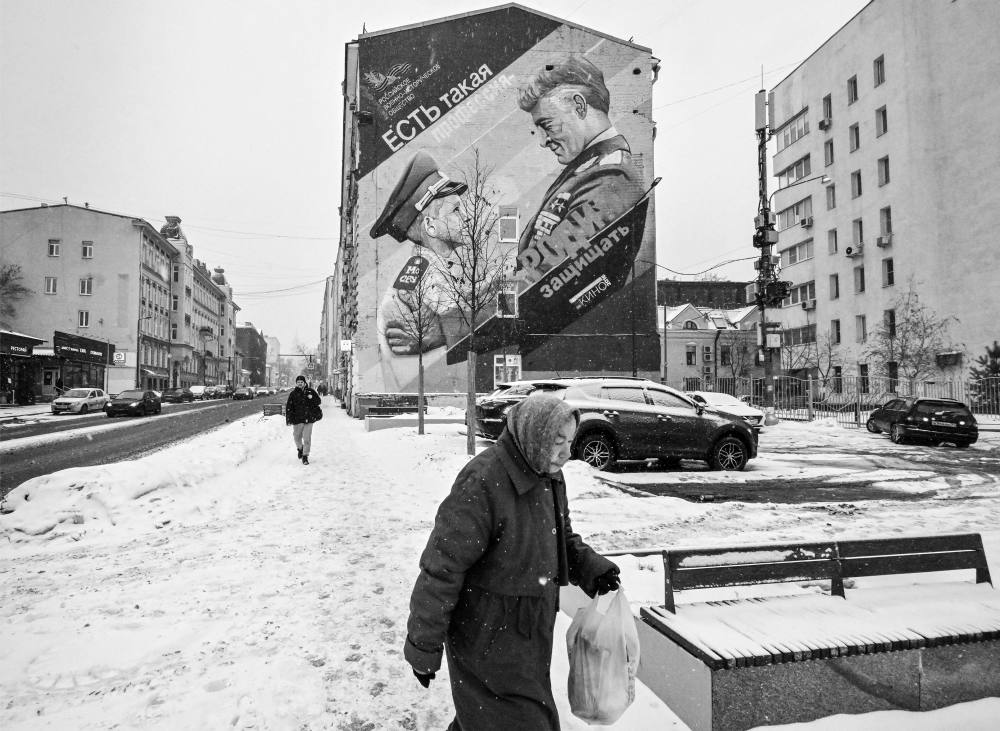

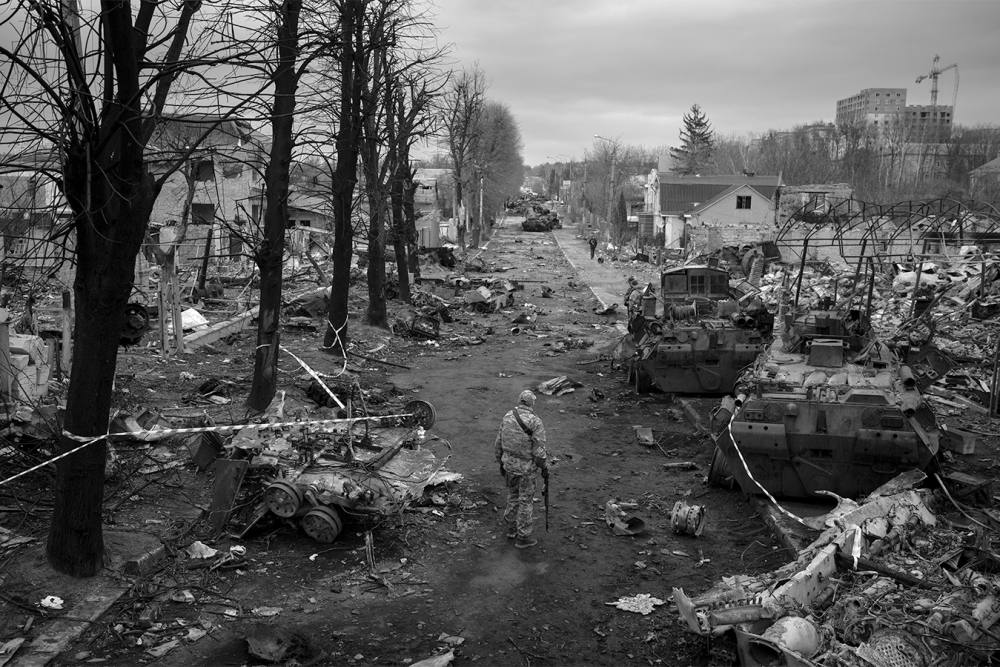
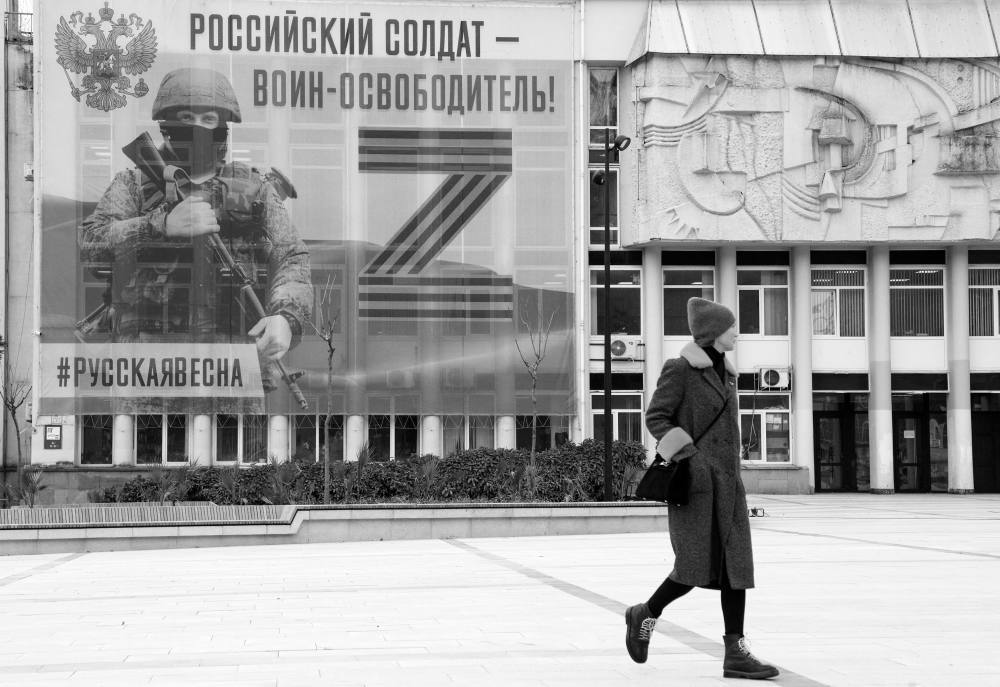


© FT montage: AP, Getty
Max Seddon, Anastasia Stognei in Riga, Polina Ivanova in Berlin, Chris Campbell, Dan Clark, Sam Joiner and Caroline Nevitt in London FEBRUARY 21 2023
- Share on Twitter. Opens in a new window.
- Share on Facebook. Opens in a new window.
- Share on LinkedIn. Opens in a new window.
When he ordered the invasion of Ukraine, Vladimir Putin’s original plan envisioned Russian forces capturing Kyiv within as little as three days.
Nearly a year later, Russia’s army is no closer to winning the war — and has even lost part of the territory that Putin attempted to annex last September.
Russia’s battlefield losses are so huge that western officials doubt it has the capacity to mount an offensive on the same scale again. Sanctions, meanwhile, have hurt Russia’s economy and have cut it off from supply chains crucial to sustaining Putin’s war machine.
But despite the dire state of Russia’s forces and the years-long quagmire its economy faces, Putin has shown no indication he intends to scale back his goals or seek a way out of the war, insisting Russia’s victory is “inevitable” and its “goals will be met in full”.
To assess how long Russia can sustain its war efforts, the FT examined four key areas Putin must draw on: the forces on the battlefield; Russia’s stock of munitions; the Kremlin’s economic war chest; and ordinary Russians’ feelings about the war.
The bottom line: Putin’s war machine is under enormous pressure and could struggle to mount the decisive, new offensives that he has promised. But Russia has the resources to keep fighting in Ukraine for some time to come.
Ammunition
At a visit to an arms factory in Siberia in February, Dmitry Medvedev, Putin’s former stand-in president, said Russia needed to build and modernise “thousands of tanks” to defeat Ukraine.
“Our enemy was begging for planes, missiles, and tanks when he was out of the country,” Medvedev said, referring to Ukrainian president Volodymyr Zelenskyy’s visits to the US, UK, and Europe. “What must we do in response? Increase production of all kinds of arms and military equipment.”
But even as those factories work around the clock in three shifts, the defence industry faces an uphill battle to make up for Russia’s astonishing losses during the war.
Since the invasion began, Russia has lost at least 4,500 armoured vehicles, 63 fixed-wing aircraft, 70 helicopters, 150 unmanned aerial vehicles, 12 naval vessels, and more than 600 artillery systems, UK defence secretary Ben Wallace said in December. Ukraine’s estimates of Russia’s losses are even higher, including 6,388 armoured vehicles, 2,215 artillery systems, 294 aircraft, 284 helicopters, and 796 cruise missiles as of early February.
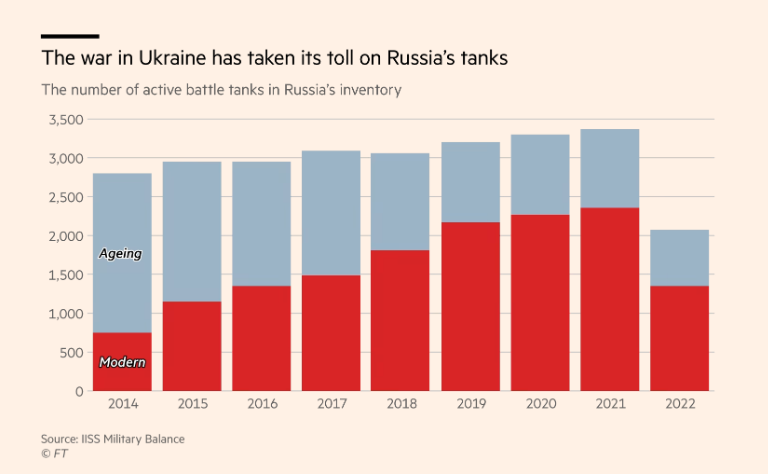
Of those, Russia has lost up to 2,300 tanks in Ukraine, including about half of its most modern battle tanks, according to a report last week by the International Institute for Strategic Studies. Though Russia is currently deploying about 1,800 tanks and has a further 5,000 in reserve, many of them are Soviet-era tanks often in poor condition, the report says.
Russia has also used most of its pre-war stock of 3,000-3,500 missiles with a range greater than 300km, according to Pavel Luzin, a visiting scholar at the Fletcher School of Law and Diplomacy at Tufts University.
In a sign of desperation, Russia has shifted to using its S-300 air defence system for long-range strikes.
On the front lines itself, the situation is equally difficult. The US said in December that Russia could only sustain its current rate of artillery and rocket fire until early 2023 as stocks of fully serviceable ammunition dwindle, leaving Moscow’s forces to switch to degraded ammunition.
The losses indicate likely difficulties in sustaining new offensives. “They thought it would be like [the annexation of] Crimea in 2014, where the Ukrainian units were ordered to stand down and no one could really contest it,” says Dara Massicot, a senior research fellow at the Rand Corporation. “And that’s obviously not what happened. There was no plan B ready so they had to figure it out on the fly.”
One source of respite could come from Beijing. At the weekend, the Biden administration said it was “deeply concerned” that China would start to supply weapons to Russia, easing some of the pressure on its depleted stocks of arms.
Despite the blow to Russia’s armed forces, Putin has shown little indication that he is willing to back down from his goals — and expects Russia’s arms industry to play a key role in winning the war.
“From the point of view of the end result and our inevitable victory, there are several things that haven’t gone anywhere and are at the foundation of our victory,” Putin said while visiting an anti-aircraft munitions factory in St Petersburg last month. “It’s the unity and cohesion of the Russian people, it’s the courage and heroism of our fighters on the front lines, and it’s the work of the military industrial complex, factories like yours and people like you.”
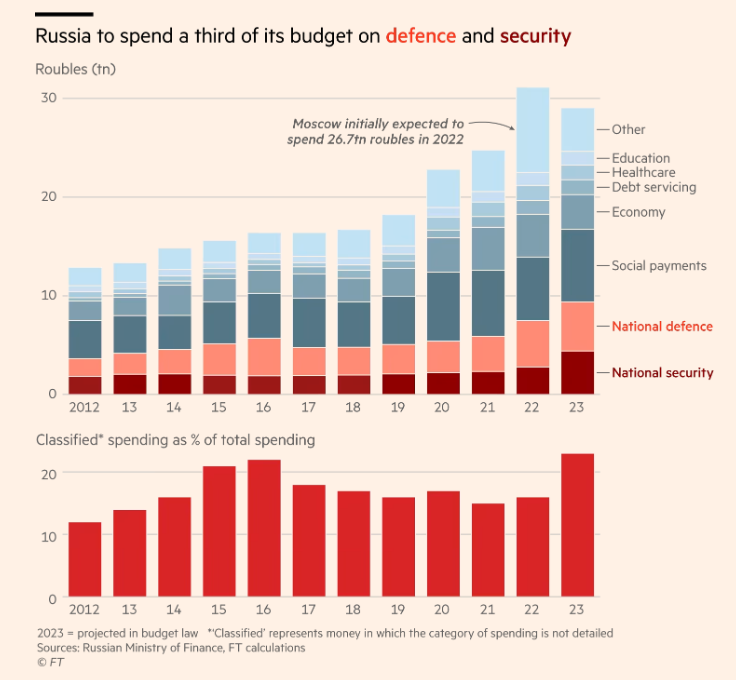
Defence spending will soar this year, but the increased funding is unlikely to compensate for deeper problems in Russia’s production cycle, Luzin says.
Like many other industries, Russia’s defence factories are reliant on advanced foreign-manufactured semiconductors, which the country is now barred from importing under western sanctions.
That has impacted everything from the production of T-72 tanks, air defence weapons like the 9K37 Buk and 9K22 Tunguzka, and Kh-101 cruise missiles, all of which were manufactured with western-made components, as detailed in a study by the German Council on Foreign Relations last week.
Inspecting downed Russian weapons and equipment, Ukraine’s armed forces have found components from household appliances such as washing machines, an indication Russia is scouring consumer items to compensate for the shortfall.
“Russia’s defence industry won’t survive in its current state in the long term,” Luzin says. “They have reserves of components up to 2025, but not for everything. Production overhead has gone up significantly already. It’s not clear how long the foreign equipment will keep working.”
He adds: “It’s a zombie industry.”
Even with a new offensive in eastern Ukraine under way and 300,000 reserves mobilised into the army, Russia’s losses mean it is likely to lack the overwhelming superiority required for a breakthrough, analysts say.
“They’re doing enough to sustain the war and they’re doing enough to make it tough for Ukraine to retake all of its territory,” says Rob Lee, a senior fellow at the Foreign Policy Research Institute. “But it comes back to the issue of: are they doing enough to provide that qualitative advantage to do offensive operations and achieve some real success?”
Finances
Last month, Putin proudly told his economic cabinet that predictions of a Russian economic collapse had proved unfounded.
“The real dynamics turned out to be better than many expert forecasts,” Putin said. “Remember, some of our experts here in the country — I’m not even talking about western experts — thought [gross domestic product] would fall by 10, 15, even 20 per cent.”
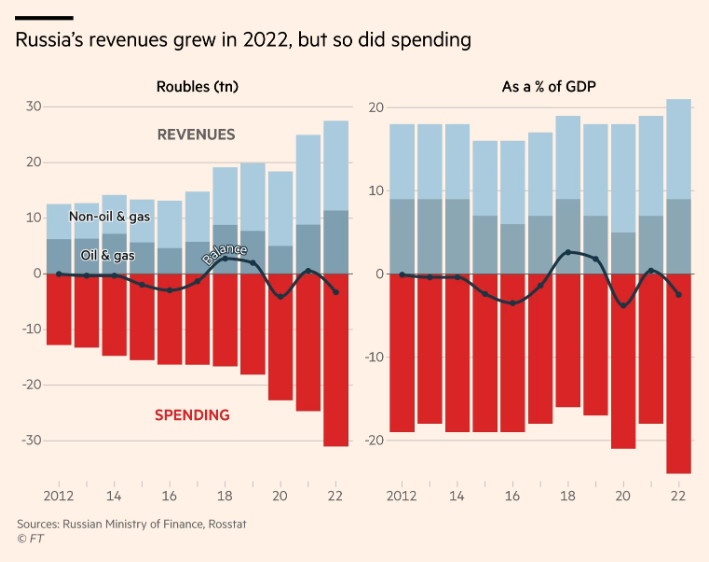
Instead, Russia’s gross domestic product fell by just 2.1 per cent, significantly less than the US contraction during the 2007-09 financial crisis, as record oil and gas profits of Rbs11.6tn ($168bn) helped the Kremlin compensate for western efforts to shut Russia out of global markets and supply chains.
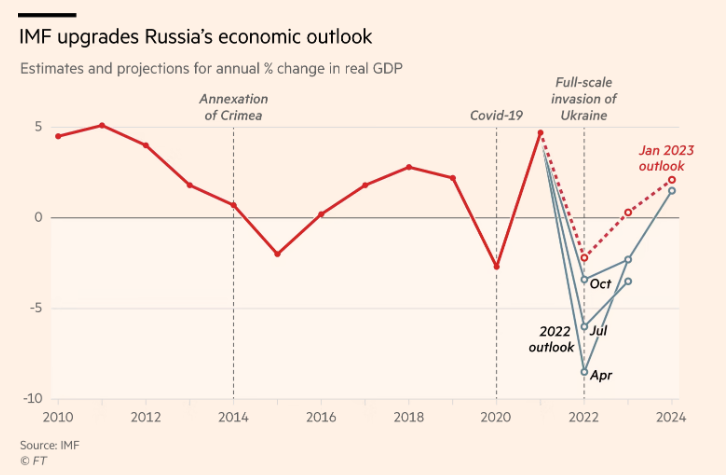
But recent figures indicate that this feat may be a one-off: in January, energy revenues fell 46 per cent year on year while military spending ballooned, sending the deficit soaring.
Russia expects its income from energy, which accounts for about 40 per cent of government revenue, to drop 23 per cent this year amid western attempts to place an embargo and price cap on its oil exports. The Kyiv School of Economics expects the fall could be as much as twice that.
Some of it is irreplaceable: Russia has lost more than half of its gas exports after Europe moved to lessen its dependence on Russian energy, and lacks the infrastructure to reroute supplies to Asia.
Though China and India have helped offset the damage by buying bigger volumes of Russia’s oil, western sanctions have begun to cut into Moscow’s profits by widening the discount between Urals, its flagship oil blend, and Brent crude.

To compensate for the increase in defence spending — which now accounts for a third of all budget spending approved for 2023 — the Kremlin has been preparing to plug the holes by dramatically cutting its fiscal expenditure and reliance on international capital markets.
The assets controlled by Russia’s National Wealth Fund (NWF) grew from 1.9 per cent of GDP in 2008 to 10.2 per cent by the beginning of the invasion. A year later, it is down to 7.2 per cent of GDP — due to currency revaluation and the state using its assets to cover the deficit. In 2023, the budget law projects a deficit of Rbs2.9tn, equivalent to 1.9 per cent of GDP, much of which the state plans to cover with NWF money.
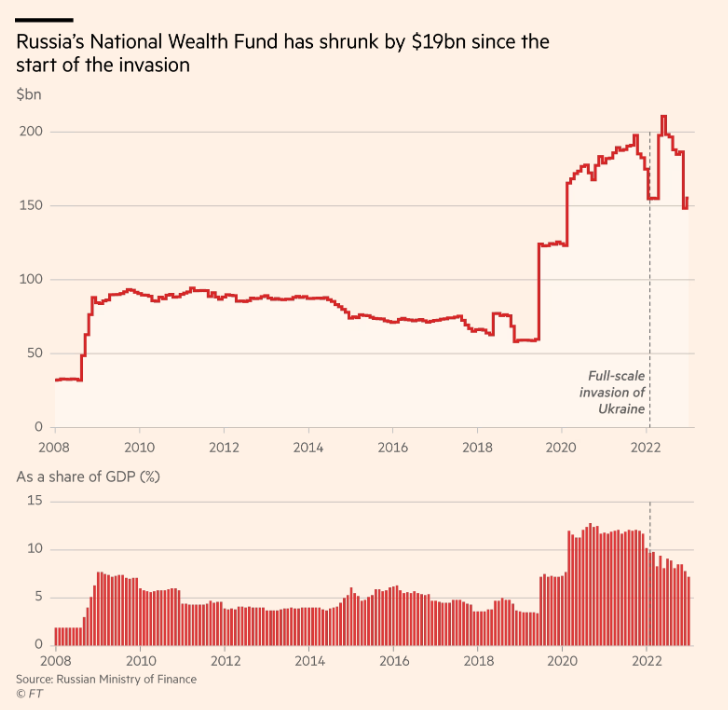
Russia is also likely to turn to debt markets rather than spend the fund completely. The war has forced Russian policymakers, previously obsessed with keeping state debt low, to increase borrowing, mainly from Russian state-owned banks. But the country’s debt still accounts for only 16 per cent of GDP and may at worst grow to 18 per cent by the end of the year, a far from critical level, estimates Natalia Lavrova, chief economist at BCS Global Markets.
In addition to the NWF and borrowing, Russia can pinch a share of companies’ profits as it did through a $20bn windfall tax on Gazprom in 2022.
The cabinet is discussing a “voluntary contribution” from major Russian companies, the first deputy prime minister, Andrei Belousov, said in February.
Another option is to cut some non-military spending. Maxim Mironov, a professor at IE Business School, says the government could decide to “not invest in infrastructure, not repair roads — like in the ’90s, given that Russians are very tolerant to changes in their quality of life”.
This is crucial for Putin, who is interested in dragging the war out, hoping that one day western support for Kyiv will wither, says Mironov. “Russia’s territory is not threatened, which allows its economy to operate, while Ukraine does not have this luxury and has to rely on external financial support,” he adds.
Mobilisation
In September last year, as he was announcing the start of a wide-ranging draft for Russia’s armed forces in Ukraine, defence minister Sergei Shoigu said Russia had a “mobilisation resource” of almost 25mn men with military experience that it could deploy.
This number, according to analysts and statisticians, is very misleading. But working out what the real figure may be — the manpower Moscow could mobilise, and what constraints are in play — can give some insight into how long Russia is able to maintain its assault on Ukraine.
Before the start of the war, Russia’s army totalled between 740,000 and 780,000 personnel according to Luzin, the military expert from Tufts University — far fewer than the official figure of 1.15mn. Moreover, only up to 168,000 troops were permanently combat ready troops in battalion tactical groups, while 100,000 or so were in units that served as their reserves, according to Luzin. The rest were support personnel.
The Russian forces deployed in Ukraine suffered heavy losses in the first weeks of the invasion, and by July, US officials were estimating that up to half — more than 50,000 troops — had been either killed or injured.
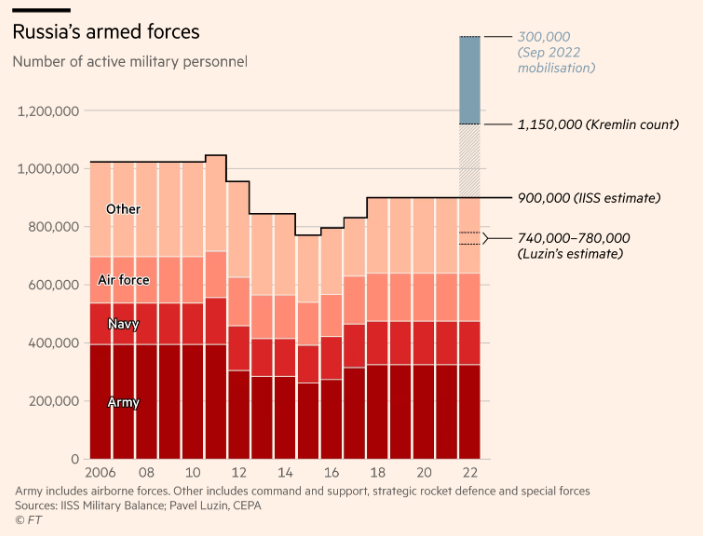
The effect was stark in elite units. By late summer, up to 50 per cent of Russia’s airborne force had been taken out of combat, according to a pro-war Russian military commentator, the former defence ministry press officer Mikhail Zvinchuk, speaking on state television.
Seeing the evident manpower shortages on the battlefield, Ukraine began preparing counter-offensives that would liberate swaths of territory that Russia had occupied just a few months earlier.
On September 21, Putin announced a draft to call up 300,000 men for the frontline.
Since the start of the year, rumours of a second mobilisation have appeared regularly in the Russian press and on social media, but analysts say that a draft of the same scale is not likely yet.
Half of all recently mobilised men are likely to still be in training, says Michael Kofman, director in the Russian studies programme at CNA, a think-tank. “Russia may not need another large mobilisation wave,” he says. Instead, it “could keep mobilisation quietly rolling at a sustainable rate”.
How many more could be called up in future isn’t straightforward.
There are indeed about 30mn men of fighting age, 18-50, in Russia, but in that group only 9mn-10mn have military experience, primarily due to conscription, according to researcher and demographics specialist Igor Efremov.
That figure, however, includes those who may be sick or disabled or who have exemptions from service, for example due to their profession. Russian demographers also agree that about 500,000 Russians have fled the country on an at least somewhat permanent basis since the start of the invasion, a majority of them men of fighting age.
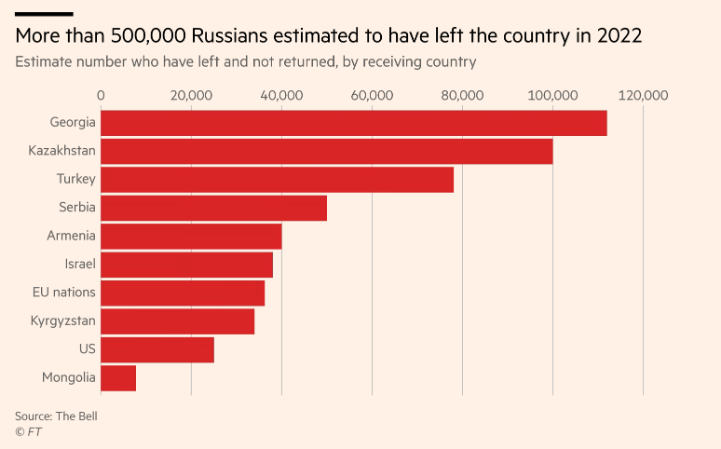
Nevertheless, in terms of numbers alone, “there is still a pool of several million people from among whom Russia can continue to recruit participants,” Efremov says. “From a demographic point of view, Russia can continue to rake in people for the fighting for quite a lot longer.”
However there are other very substantial constraints, from the capacity of the army to house, equip, train and pay new troops, to the Kremlin’s willingness to take men out of economic life and trigger new waves of panic and mass migration.
“Who will command all these mobilised men, in the context of a deficit of lower-level commanders, lieutenants and sergeants?” Luzin asks. “Who will feed and clothe them? What will they be armed with? Who will do their civilian jobs in their place?”
Russia’s economy already has a very low unemployment rate. Taking men out of the workforce could be destabilising very quickly.
Demographer Dmitry Zakotyansky says he estimates the army could theoretically recruit up to a million more men, although that “would require a lot of financial and also political strain, and would come at the cost of another shift in public opinion.”
Russia’s defence ministry announced plans at the end of last year to increase the size of the army to 1.5mn, of whom 695,000 would be contract soldiers who volunteer rather than conscripts. Luzin says these plans were unrealistic: “The real aim is to secure a huge military budget.”
The other constraint the government faces is Russia’s worsening demographic picture. The country was already suffering a demographic crisis before the start of the invasion, a hangover from the economic collapse that immediately followed the break-up of the Soviet Union.
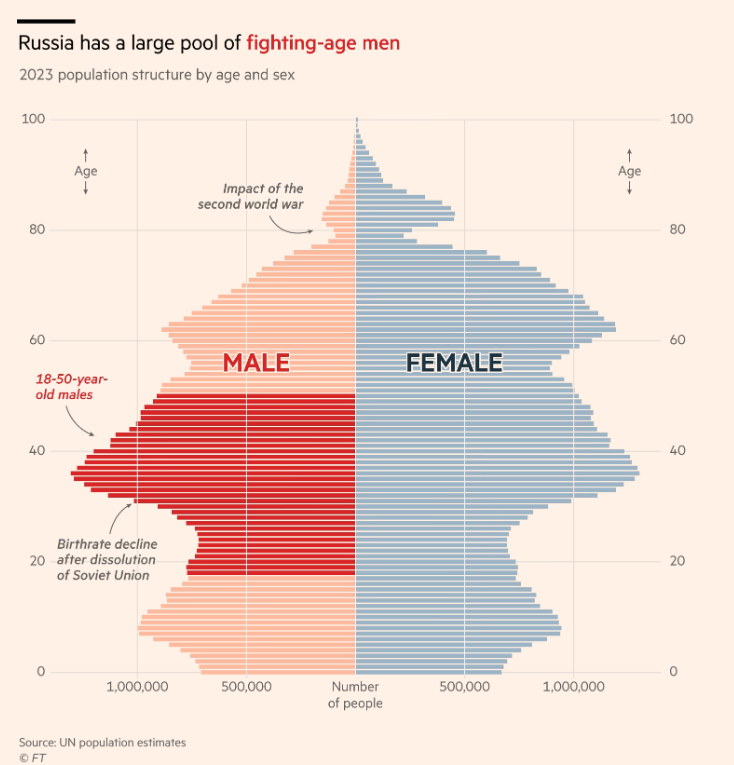
The women giving birth today were born in the 1990s and early 2000s, one of the smallest generations in Russia’s history. “And now they’re being hit over the heads with external factors which take the already low fertility rate and make it even worse,” Efremov says.
Independent statistician Aleksei Raksha estimated that the number of births would shrink by 12 to 15 per cent in the next year and a half due to factors such as the “difficult economic situation”, and “shocking news”. Raksha adds: “This is a massive drop.”
Public support
After annexing parts of four Ukrainian provinces under Russia’s control last September, a crowd of 180,000 people gathered on Red Square for a rally led by Putin and an array of nationalist pop stars.
But when the music stopped, the crowd meekly lined up to board dozens of buses waiting to take them home — a sign the rally had been a massovka, a stage-managed event where the Kremlin pays ordinary people to simulate spontaneous enthusiasm.
The lack of popular euphoria over one of the most significant developments in the war indicates that Russian society remains on edge. Though any domestic challenge to Putin and the war has been crushed, the difficulty of manufacturing displays of support for the regime is a taxing issue for the Kremlin ahead of next year’s presidential elections, when he is expected to run for his fifth term in office.
Putin has claimed the invasion enjoys overwhelming support. In polls taken in September, the state-run pollster Vtsiom claimed up to 73 per cent of Russians back the war, while the Levada Center, Russia’s only independent pollster, found a similar result — 72 per cent.
Ukraine and some of its western backers have claimed the overwhelming totals show Russians heavily back Putin’s war and have used the figures to justify measures targeting all Russians, including EU visa bans and restrictions on accessing financial services.
But analysts say Russia’s unprecedented crackdown on dissent — which prompted hundreds of thousands of people to flee after Putin signed a new law introducing prison sentences of up to 15 years for “discrediting the armed forces” by so much as calling the conflict a “war” — has made judging the true extent of public support difficult.
The censorship has effectively destroyed Russia’s independent media and all but wiped out anti-war activism, but police have used it equally against ordinary Russians for making anti-war comments at a bus stop, in a restaurant, or online.
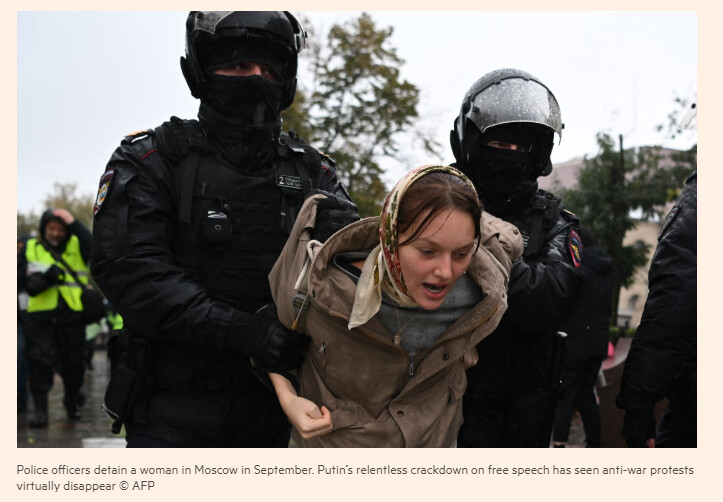
Police officers detain a woman in Moscow in September. Putin’s relentless crackdown on free speech has seen anti-war protests virtually disappear © AFP
That means the support for the war shown in the polls does not tell the full story. In a study that sociologist Philipp Chapkovsky and political scientist Max Schaub conducted in the war’s early weeks, when Levada found 81 per cent of Russians supported the war, about 15 per cent of respondents changed their answers depending on how the question was presented.
Asked if they supported “the actions of the Russian armed forces in Ukraine”, the same wording used by Levada, 68 per cent replied in the affirmative. But when presented with a list of questions on varying topics and told only to name the number of statements they agreed with, only 53 per cent backed the war.
Grigory Yudin, professor of political philosophy at the Moscow School of Social and Economic Sciences, says response rates, which most pollsters do not publish, range between 10 and 25 per cent, a figure low enough to ensure their results only represent those sections of society who trust the state. A poll this month by Chronicles, a group of independent sociologists, had only a 6 per cent response rate.
Instead of tracking Russians’ direct feelings on the war, some scholars have begun to look for broader trends indicated in their responses. Fewer than half the Levada Center’s respondents have said they “definitely support” the invasion, with almost as many expressing tepid support for it and opposition slowly increasing.
Those trends increased after Putin’s decision to mobilise 300,000 people into Russia’s army concurrent with the annexations in September, which prompted at least as many people to flee the country once again. The Levada Center found that 47 per cent of respondents felt anxiety, fear or dread, while 13 per cent felt anger — against 23 per cent who felt pride.
Russian President Vladimir Putin inspects the progress of mobilised servicemen in December. Thousands of men of fighting age have fled Russia since the start of the invasion © EPA
Other responses indicate the war is beginning to affect more Russians’ everyday lives. In a series of polls by Chronicles, more than half of Russians said price rises had forced them to limit their spending on groceries. At the end of March, 3.5 per cent of respondents said they had recently been laid off from their jobs; by February, that figure had risen to 9 per cent. Most strikingly, the number of respondents who reported anxiety or depressive episodes grew from 32 to 50 per cent during that same period.
The Kremlin is also tracking those trends closely. In a secret poll conducted by a Kremlin-controlled polling agency in November, 60 per cent of Russians said Putin had done the right thing by starting the war — a 10 per cent drop since the spring.
The poll, first reported on by the independent journalists Farida Rustamova and Maxim Tovkaylo, also pointed to a growing generation gap: only 40 per cent of Russians aged 18 to 45 thought Russia was right to start the war against 76 per cent over 45.
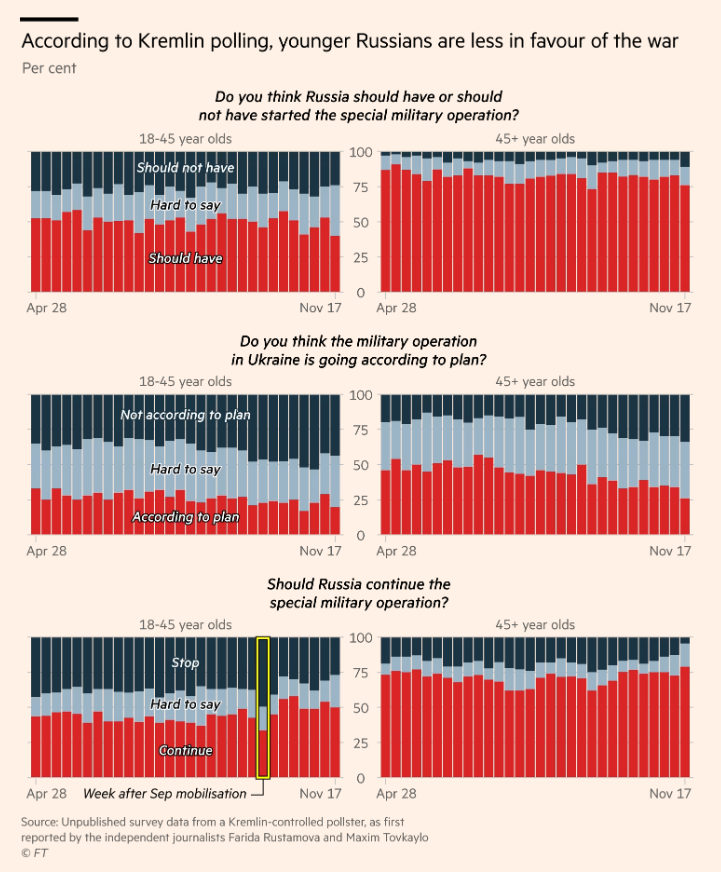
The difference appears to be in how Russians get their news: younger people favour the internet, where some dissenting content is still accessible despite growing censorship, whereas older people overwhelmingly favour state television, which provides a nonstop drumbeat backing the Kremlin’s line.
These trends appear to capture major changes in public behaviour, meaning the polls are still worth conducting despite all the necessary caveats, Levada director Denis Volkov wrote in an essay this month.
“Polls aren’t conducted with a lie detector — they only fix what people are willing to share with an interviewer. This is information about how people are prepared to behave in public,” Volkov wrote. “The main goal of pressure [to support the war] is to change people’s behaviour so they don’t want to criticise the government or protest. You can hardly argue that’s been successful. And that’s what poll results show you.”
4 Likes
The unpaywalled report from WSJ is here - excerpt:
The Chinese arms trade is shrouded in secrecy, and it is unclear what weapons Russia might receive. China is a world leader in the production of weapons that have been used heavily in the Ukraine war, including long-range artillery systems, precision multiple rocket launchers, antitank and surface-to-surface missiles and small, tactical drones and loitering munitions.
Russia’s military is suffering from a shortage of ammunition and weapons and is dogged by battlefield problems up and down the chain of command.
U.S. and European officials said Beijing wouldn’t necessarily provide advanced weapons, but would likely backfill what Russian forces have lost on the battlefield in Ukraine, such as ammunition, or have been unable to produce because of sanctions, such as electronics.
“It’s not an issue of technology,” said Vasily Kashin, a China specialist and the director of the Center for Comprehensive European and International Studies at Moscow’s Higher School of Economics. “It’s primarily an issue of production capacity. And in terms of production capacity, China, in many aspects, especially if we talk about ground-forces weapons, might be stronger than Russia and the whole of NATO combined.”
My guess is that the public warning is serious and preparation for responding to an expected Chinese decision to sell weapons after denouncing West for failure to take up an imminent Chinese “peace initiative”.
So, prepare for possibility of Russia not being short of munitions.
1 Like
Thanks for that. It is an important read.
I was confused by one of the graphs.
The graph under the para below has the description:
"Russia’s trade with China, India and Turkey has grown since the war in Ukraine.
But the actual graph for Russian imports shows substantial decline for those 3 while fairly flat for EU, UK, US, Japan, S Korea.
Exports graph shows a large decline for EU etc and corresponding initial increase for China etc, followed by China etc joining the decline. Corresponds to the explanation in this para:
Anyway, I think following paras provide a fair summary (emphasis added):
As well as being a fair summary of the article I also think it makes sense - especially if China does sell munitions.
The war ends when the fascist regime ends. Initial replacement regime could be more competent fascists than Putin so it may not be quick.
1 Like
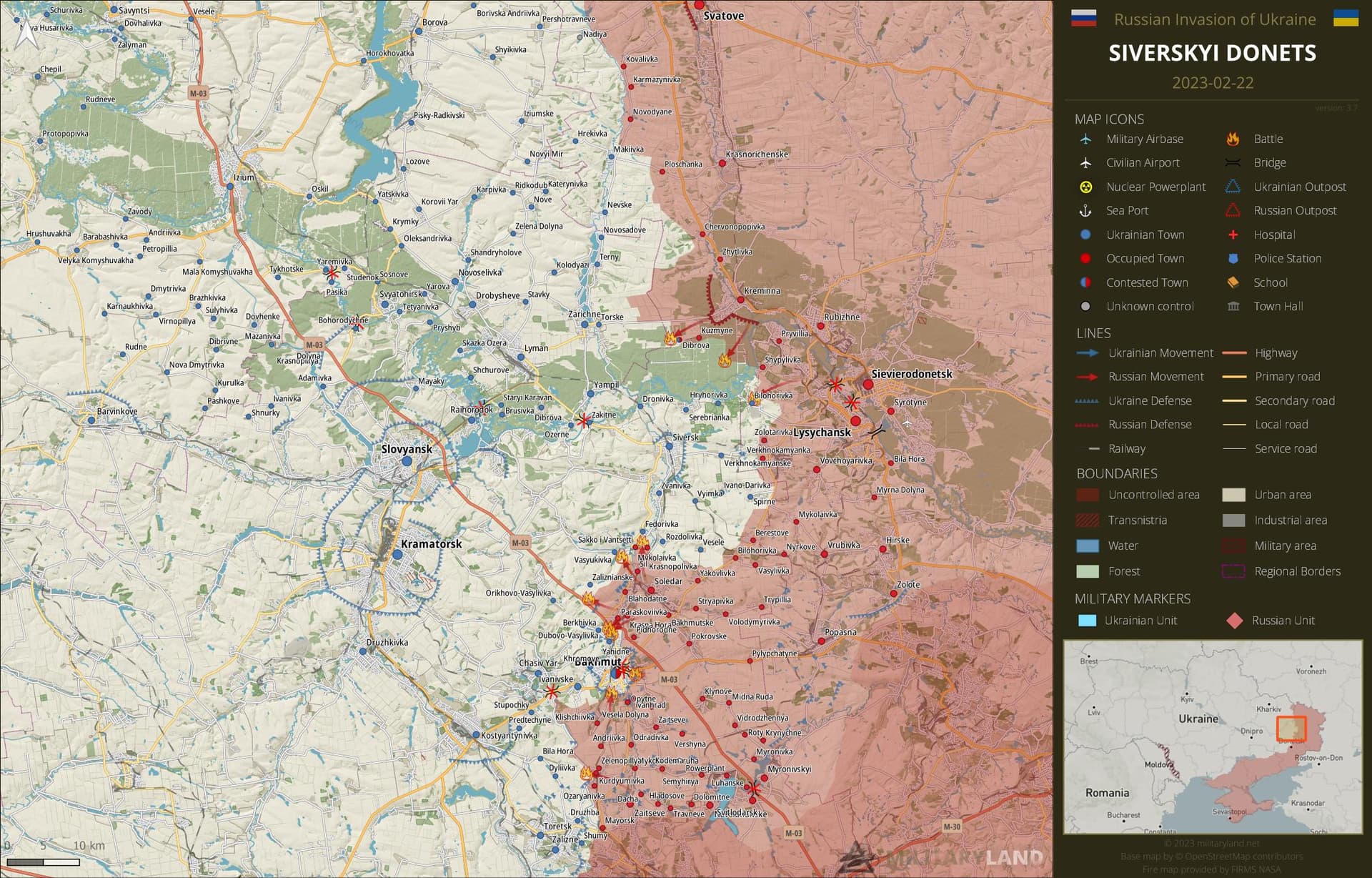
I see lots of posts here about new tanks and guns but what’s happening with them? There doesn’t seem to be any change despite the supposed increase in the Ukranians ability to counterattack. Where are all of these resources going?
1 Like
yes, it’s a confusing graph. The imports portion is inverse to the exports section above. The horizontal line down the centre of the 2 represents zero, so increasing imports corresponds to a line that drops lower. Confusing way to display it I think.
Also, the commentary is in relation to the changes since the war started. For imports, the EU/US line jumps up (ie lower imports) then sits flat. So relative to pre-war, imports are significantly lower. The China/turkey/india imports have increased (shown in the chart, looks like it is falling) since the war started, but recently reduced (but still higher than pre-war)
1 Like
I think there is a lot of training going on - I read something about 670 odd Bradley crews finishing training, which means 220 or so 3-man crews, plus another 750 just starting.
The shipping of the hardware will take a while, many countries are now also doing whatever maintenance is needed to get them up to shape after pulling out of storage. 4-6 weeks seems to be mentioned a few times.
The mud season is not far off and lots of commentators have noted how stupid it is for Russia to have started their offensive at the end of winter. April-May is when I think the mud season will be finished, crews have been trained and hardware shipped over to the front.
7 Likes
Full video of Magyar’s birds with English subtitles here:
@elfm This shows operations of Bakhmut DACC and illustrates important aspects of drones under a separate command (now formally constituted as an independent Coy) providing a “service” to other units that do not have the drones organic and how this can be done FASTER than approval and coordination at higher levels.
Only mentions one side of the “online mission command” I think is necessary:
- “Offers” of a target can be taken up by the “first cab off the rank”.
That works for the drones over Bakhmut battlespace. Mentions a target that commander thought more suitable for a drone strike than by artillery got destroyed by artillery that responded quicker.
On a larger scale there would also be similar mechanisms to rapidly respond to:
-
Requests for general ISR and ELINT tasking, responded to by the available drones
-
Requests for engagement support between artillery and drones
-
Ditto for infantry overwatch engagements
Not all could be “first cab off the rank”. Rapid prioritization and allocation mechanisms would be needed and would be evolved with experience just as has happened in Bakhmut.
My speculation is that there could be something like budgets of “combat power” currency assigned to units that can attach portions of their budget to “bids” in continuous double auction market for particular parameters of location, type of support, time window. Such “expenditures” of combat power get transferred to the budgets of units that take them up as corresponding “asks”.
That is pure speculation, but such mechanisms do in fact lie behind quite massive and complex transfers of resources between various productive (and unproductive) activities at various locations and time windows. Air power apportionment is fundamentally an “economy of force” activity closely related to other “resource management” that could work as fast as finance does in the 21st century rather than in the daily cycles of times long past.
The point of the video is simply that it shows a DACC operating substantial numbers of drones for multiple artillery and direct FPV/UCAV strike tasks (and presumably others).
Another feature of the video is the reference to USB sticks of 1TB HD video studied by the commander overnight.
I think lots more than that could be usefully captured and studied by remote image analysts etc - both for near real time use and subsequent Processing Exploitation and Dissemination. Goes together with analysis of logs, calculation of Measures of Performance MOPs and of Effectiveness MOEs, for various munitions, sensors, airframes, teams, Techniques, Tactics and Procedures (TTPs) etc.
Also “replay” of logs of engagements in simulators for training and development of TTPs.
The mechanisms for handling that and the “working from home” Geospatial Agency organization and optical fiber links from flash drive delivery points also need to be part of enhancement proposals.
2 Likes
Thanks. I did not understand that until you explained it.
Yep. Ukraine is holding the line with about 40% of their strength. The rest is currently training and preparing for an offensive after the ground dries out. Not seeing donated equipment is actually a good thing, it means Ukraine is confident they can hold it in reserve without losing the front.
We had a similar thing before the Kherson and Kharkiv offensives. Donated gear had been delivered in mass qualities, but hadn’t been seen at the front. It was only when Ukraine attacked that videos and images started to appear.
7 Likes