Two US officials & one Western official told NBC News that the US has intelligence that is leaning toward Russia as the perpetrator of the attack. US officials were working to declassify some of the intelligence and share it as early as Tuesday afternoon.
1 Like
This proves that either the RU intelligence service has no idea where the UA forces are, and shows a lack of intelligence, due to a failure of their recon drones to observe troop movements and build up. Or else that story is another lie.
2 Likes
Some good questions that I haven’t seen answered yet:
- How long will it take for the flood waters to subside?
- What state will the Russian fortifications on the left bank of the Dnipro in and around Kherson be in once the flood waters have subsided?
- What new river crossing opportunities will open further up the river?
- How long can the Crimean population go without the dam channel water source?
3 Likes
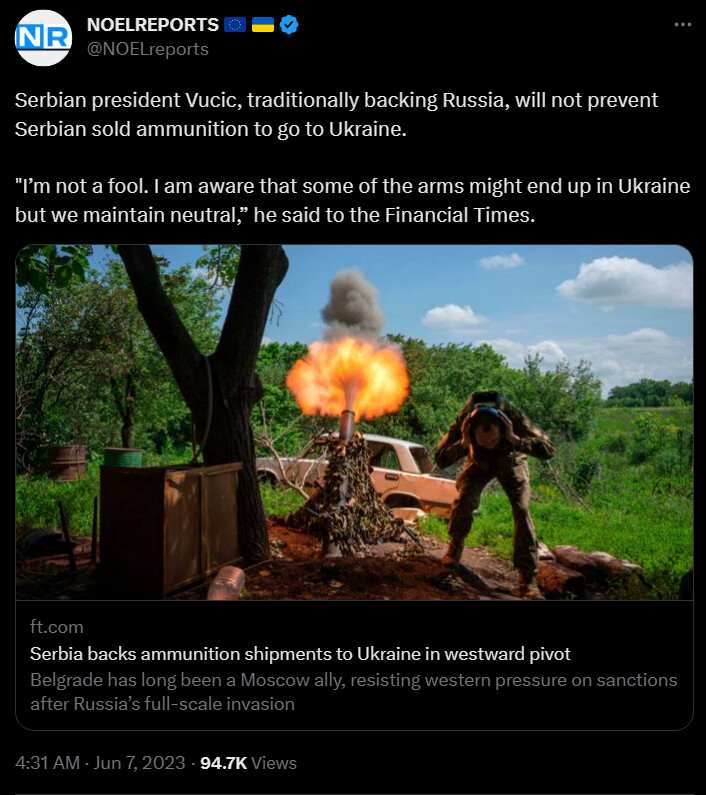
On that last part I think the answer is “no problem”.
I assume references to Crimea being dependent on water supply from rest of Ukraine and canals providing this are relevant to agriculture, not household consumption, which is enormously less than agricultural requirements.
L8R
1 Like
Kakhovka Dam Collapsed | Versions & Consequences (English subtitles)
In the early morning hours of June 6, the Nova Kakhovka HPP dam has been destroyed in the Kherson Region of Ukraine. Let’s dissect the possible explanations of the disaster.

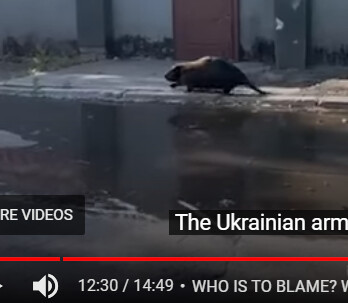
what kind of animal is this?
a chernobyl mutant rat?
1 Like
canada’s special assistance package to fix the dam
beavers
10 Likes
didn’t know beavers grew that big!

6 Likes
The Geneva Convection - 1977, Article 56 expressly states attacking / destroying a dam is a war crime.
3 Likes
Russia filled up the Crimean water storages with multiple years worth of water. Not an issue in the short-medium term.
2 Likes
Czechia is retiring the remaining Mi-24/35 attack helicopters. One might wonder where they will soon be transferred…
https://twitter.com/rebel44cz/status/1666137973346250772?s=46&t=A5S-z5IJslFoC5SVN0Jodg
3 Likes
Russia’s Ministry of Defence says that 71 Russian servicemen have been killed while repelling Ukrainian attacks during the last 3 days.
Russia’s MoD says they killed 3715 Ukrainian soldiers & destroyed 52 tanks and 207 armoured vehicles in the same timeframe
https://twitter.com/faytuks/status/1666140194070724620?s=46&t=A5S-z5IJslFoC5SVN0Jodg
2 Likes
It was a big issue at the UNSG noon briefings, confirmed that attacks on civilian buildings is a war crime.
There was badgering for the UN to engage in establishing responsibility. However, while the UN would make every effort, it was noted that the dam is under Russian control. The UN, including humanitarian agencies, have not been allowed into Russian controlled territories to date.
There was supposed to be a UNSC meeting on the issue yesterday afternoon, but I have not seen any reporting. The UNSG has a measure of authority for some actions, without having to seek UNSC approval.
In addition to water for newly planted crops, there was concern at the impact on drinking water in southern Ukraine, with contaminated rivers. Some of the flooded areas have mines floating in them
The Americans think it has started.

https://www.washingtonpost.com/opinions/2023/06/06/counteroffensive-ukraine-russia-dam-sabotage/
Non paywalled:
It was bracing that Ukraine launched its counteroffensive against Russian invaders as we celebrate the anniversary of the 1944 D-Day landings this week. This assault could turn the tide of the battle for Ukraine, just as the Allied assault on the Normandy beaches altered the trajectory of World War II.
Military campaigns are rarely all or nothing, but this one comes close. If Ukraine can drive back an already shaky Russian army, it stands a chance of forcing Moscow to bargain for an end of its failed invasion. But if Ukraine fails, it would be a bitter blow to the country’s weary population and could endanger continued support from some restless NATO members.
Biden administration officials believe the offensive began on Monday with a Ukrainian thrust south along multiple axes. A major goal is to cut the land bridge across southeastern Ukraine that connects Russia with its occupation forces in Crimea, U.S. officials believe. Part of Ukraine’s strategy appears to be an attack along several lanes, so they can move forces among them to hit targets of greatest opportunity.
Administration officials were encouraged by better-than-expected progress Monday, as Ukrainian units pushed through heavily mined areas to advance between five and 10 kilometers in some areas of the long front. That raised hopes that Ukrainian forces can keep thrusting toward Mariupol, Melitopol and other Russian-held places along the coast — severing the land bridge.
Tuesday brought a potentially devastating new trauma to the battle area — an apparent sabotage attack that burst the Kakhovka reservoir dam and sent a torrent down the Dnieper River toward occupied Crimea, which depends on the reservoir for much of its water supply. Russia and Ukraine traded blame for the attack, which NATO Secretary General Jens Stoltenberg called “an outrageous act.”
Administration officials haven’t concluded yet whether Russia or Ukraine breached the dam. But its loss could have negative consequences for both sides. It will be harder now for Ukraine to push south of the Dnieper; but it could also be harder for Russian troops to maneuver and defend the territories they hold. The cooling water for the huge Zaporizhzhia nuclear plant could eventually be affected, but that would be many weeks from now.
It might take weeks before the results of the Ukrainian campaign are clear, but Kyiv has already succeeded in expanding the stalemated fighting in Bakhmut, the bitterly contested eastern city that was ground zero through the winter. This is now a campaign with multiple military and political fronts — and aftershocks that reach to Moscow, Beijing and Washington.
On the eve of the Ukrainian offensive, one notable development was the growing disarray of Russian forces. Yevgeniy Prigozhin, leader of the Wagner militia that did much of the fighting in Bakhmut, has been issuing almost daily tirades against the Russian army. He argued, for example, that its claims of routing Ukrainian forces this week in the Donetsk region were “simply wild and absurd science fiction.”
In a bizarre incident this week, Wagner fighters captured Russian Lt. Col. Roman Venevitin, after some of his soldiers allegedly fired on Wagner’s forces. The Moscow Times quoted Venevitin’s explanation: “I acted in a state of alcoholic intoxication out of personal animosity.”
The mystery has been why Vladimir Putin tolerates this growing disorder. Some experts view this passivity as characteristic. The Russian leader allowed Dmitry Medvedev to conduct foreign policy experiments Putin disliked while Medvedev was president from 2008 to 2012; he allowed subordinates to push a 2018 plan for pension reform, only to soften it when the public protested. Putin doesn’t like to get his hands dirty, it seems, even in the bloody Ukraine war he personally launched.
Ukraine’s willingness to gamble on its summer offensive is a measure of President Volodymyr Zelensky’s confidence, but also his need to show results. Such big wagers have mixed results in military history.
Historian Rick Atkinson, who is drafting the second volume of a trilogy about the Revolutionary War, points out that British Lt. Gen. John Burgoyne’s failure at Freeman’s Farm and Bemis Heights near the Hudson River in 1777 forced him to surrender, “in one of the decisive pivot points not only of the Revolution but in American history,” Atkinson explained in an email.
Atkinson recalled that the American commander, Major Gen. Horatio Gates, wrote about Burgoyne just before Freeman’s Farm: “It is evident the general designs to risk all upon one rash stroke.”
Similarly, Confederate Gen. Robert E. Lee, sensing eventual defeat in a war of attrition, rolled the dice in 1863 with his massive offensive at Gettysburg. It, too, failed. German dictator Adolf Hitler sought to reverse defeat with his Ardennes offensive in December 1944, which led to the Battle of the Bulge. “Six weeks after it began, the offensive was in ruins and the Third Reich was doomed,” Atkinson noted in his message.
Against these failed breakouts, D-Day stands as a reminder that an army must sometimes take huge risks to position itself for eventual victory. Any visitor to Omaha Beach in Normandy will recall the steep cliffs at Pointe du Hoc that American Rangers had to scale to dislodge German forces. The grave markers for the soldiers who died on D-Day seem to stretch almost to the horizon. But they won the battle — and the war.
2 Likes
Something like 20-30% of Ukraine’s agricultural output will now be wiped out due to lack of irrigation. Thread on the impact of the water level dropping.
https://twitter.com/tomgiuretis/status/1666062460967690240?s=46&t=A5S-z5IJslFoC5SVN0Jodg
1 Like
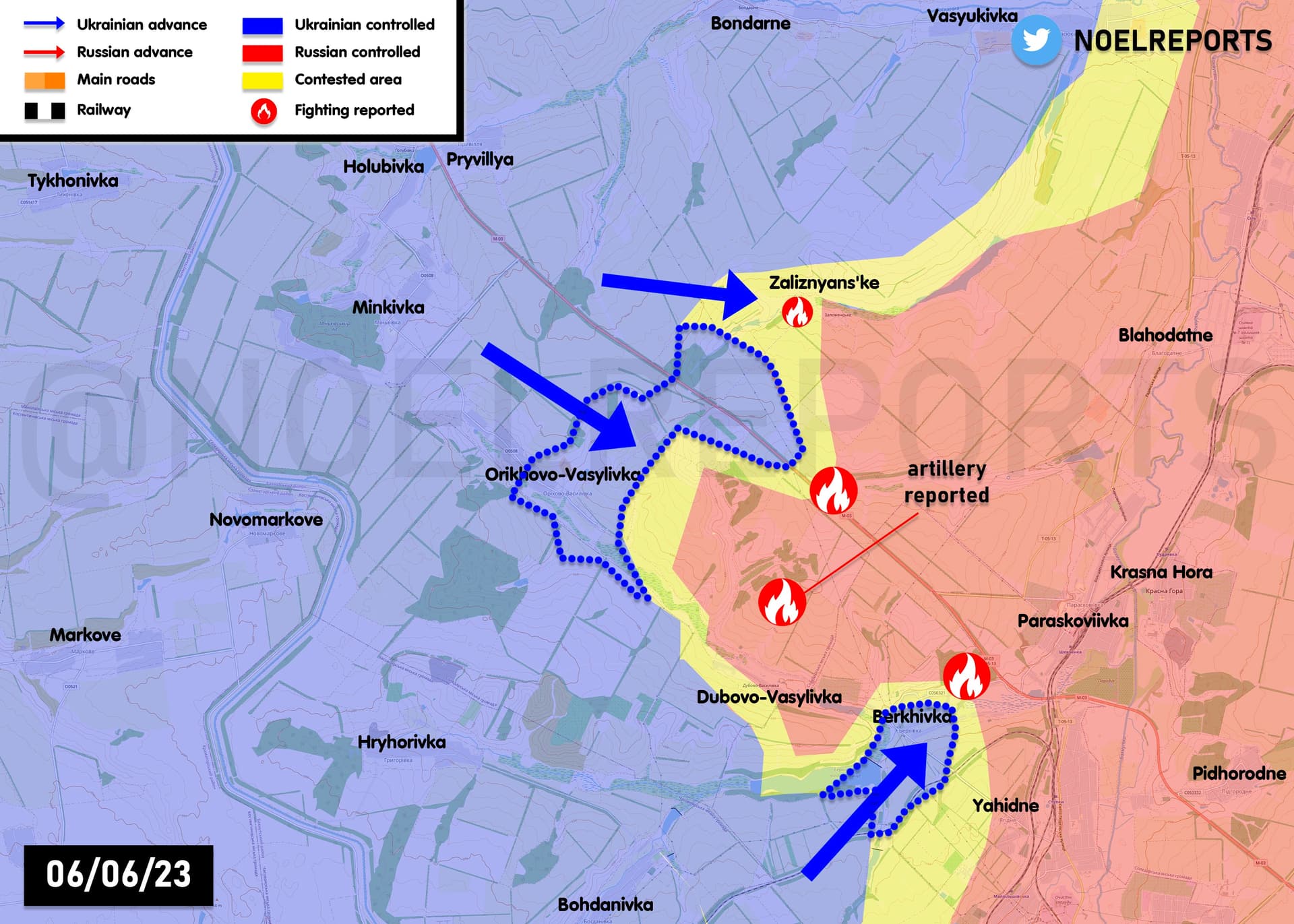
Looks like Ukraine could have the heights around Bakhmut quite soon:
https://twitter.com/_juvenile_123/status/1666079765089120256
Also shelling on Horlivka which suggests some interest in a route past Bakhmut I mentioned, south east towards Rostov and Taganrog:
https://twitter.com/rybar_en/status/1665861991720689664
They are very much on interior lines along the south and could turn up anywhere, including at the East end heading towards Taganrog or towards south of Donetsk and Horlivka if a force going past Bakhmut in that direction needed a more secure supply route and strong reinforcements, or needed help to escape from being blocked and cut off.
As @Benny40 mentioned if they take Bakhmut and are not prevented from going further, they will.
Once they have the heights, mobile armoured forces can pour across the canal as explained by Arty Green. Whether they can go much further remains to be seen.
L8R gone
2 Likes
Not sure the Ardennes campaign is a relevant comparison. The Wehrmacht was pretty much cooked , well over-stretched on two fronts and facing numerical ruin in both manpower and industrial capacity. It was really only a time grab, there was no conceivable outcome that would see them re-conquer France and the low countries. Though it did give the Americans a nasty reality check, and could have been worse had they not missed a fuel depot in the poor weather.
In this situation, Russia is entirely on the defensive, struggling with their own supply and manpower issues and trying to defend an extended front on foreign soil. In a sense, they’re more like Germany 1945 than UKr is, especially so if you view the manpower cost in capturing Bakhmut as a miniature Stalingrad. Ukr , so far, has managed to conserve its manpower and weaponry and European backing remains constant. What will be really interesting is whether they can get a concentration of armour at a breakthrough point and effectively turn a static campaign into a mobile leveraging of the rear areas to cut off Russian defensive forces.
5 Likes