The NT has recorded its hottest October on record.
Nearly 8 million hectares were burnt last month, an area bigger than the state of Tasmania.
The NT has had 24 days in a row of heatwave warnings.
The NT has recorded its hottest October on record.
Nearly 8 million hectares were burnt last month, an area bigger than the state of Tasmania.
The NT has had 24 days in a row of heatwave warnings.
I was listening to ABc radio and David Astle was talking about an early/awkward date he had with someone called Melissa. (The topic for discussion was bad dates.) Being the crossword guy word-nerd, he filled in some blank time by asking if she was aware her name was an anagram of ‘aimless’.
Didn’t work out for DA,
might have worked for Jamaica.
In the Philippines, President Ferdinand Marcos Jr. declared a state of national emergency on Thursday as another potentially powerful typhoon was expected to slam into the Philippines’ western coast Sunday night or Monday morning.
Kalmaegi left at least 188 people dead and 135 missing in the deadliest natural disaster to hit the country this year, the Office of Civil Defense said.
-
An unusually strong storm for the region in November, Kalmaegi packed sustained winds of about 183 kph (114 mph) with gusts reaching up to 220 kph (137 mph) over the South China Sea as it approached Vietnam.
-
Meanwhile, the next approaching storm, Fung-wong, was growing as it barrelled toward the Philippines over the Pacific. State forecasters said Fung-wong, known as Uwan in the Philippines, could grow to a massive estimated 1,400- kilometer (870-mile) diameter before it makes a landfall in northern Aurora province or nearby regions.
Iran President Masoud Pezeshkian said on Thursday: “If it doesn’t rain, we will have to start restricting water supplies in Tehran next month. If the drought continues, we will run out of water and be forced to evacuate the city.”
Christiana Figueres was executive secretary of the UN Framework Convention on Climate Change ten years in Paris 10 years ago. She wrote a very interesting article in The Economist which I have attempted to summarised:
Note: I cannot get an exact grip on what she means by “The Global South”, but I assume it means Latin America to Australia through Africa and Asia as she says "This sunbelt now hosts nearly half of investment-ready clean-industry projects outside China, sparking new industries—for green ammonia, fertiliser and clean fuels—creating skilled jobs, strengthening energy security and opening up new export markets"…YAY… Australia…
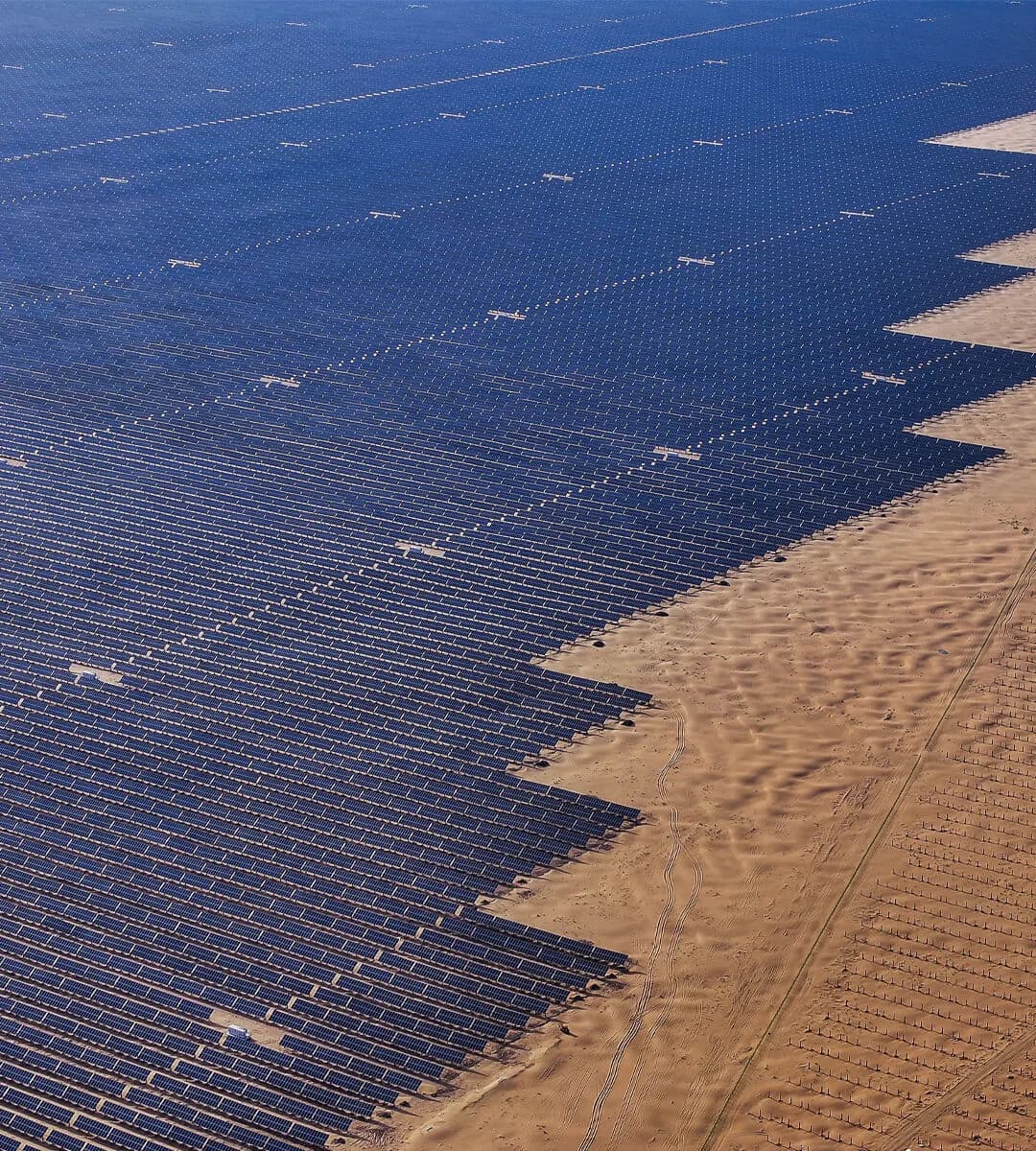
(Solar Panel) Shipments to Africa alone surged by 60% last year. These panels don’t just generate electricity; they generate huge savings for people and businesses. In Nigeria, for example, savings from avoiding expensive diesel can repay the cost of a solar panel within six months.
Pakistan, only recently almost entirely dependent on fossil fuels, now expects solar to supply 20% of its electricity by next year. Iran has just committed $2.3bn to expand solar power as a “strategic necessity”. In Oman the share of renewables in electricity production more than doubled in a frenetic first five months of 2025…
Renewables are growing at record speed: the world installed 15 times more solar capacity in 2024 than the IEA had predicted it would in a forecast in 2015; wind has exceeded the forecast three-fold. Clean energy now employs more people than fossil fuels.
By 2030 investment in cleaner energy must triple to around $2trn annually in emerging and developing economies. Nowhere is this more urgent than in Africa—home to 60% of the world’s “best solar resources”, according to the World Solar Council, yet recipient of less than 3% of global clean-energy investment.
The Trump administration clearly sees this as a threat to the fossil-fuel sector and its own dominance, hence its attempts to quash the rise of renewables at home and aggressively intervene in multilateral climate talks. But the transformation is unstoppable.
The SCALE of the renewables revolution in China is almost too vast for the human mind to grasp. By the end of last year, the country had installed 887 gigawatts of solar-power capacity—close to double Europe’s and America’s combined total.
China can produce almost a terawatt of renewable-energy capacity in a year. That is enough to supply as much energy as more than 300 big nuclear-power plants.
Remember all those conservative apologists saying “Why should we do anything when China uses so much fossil fuels”? Where are they now? They should be saying “Why are we letting China get so far ahead of us”.
This is what happens when you funnel billions of dollars into proxy armies with the aim of destroying your neighbours instead of investing that money into critical infrastructure for your own people.
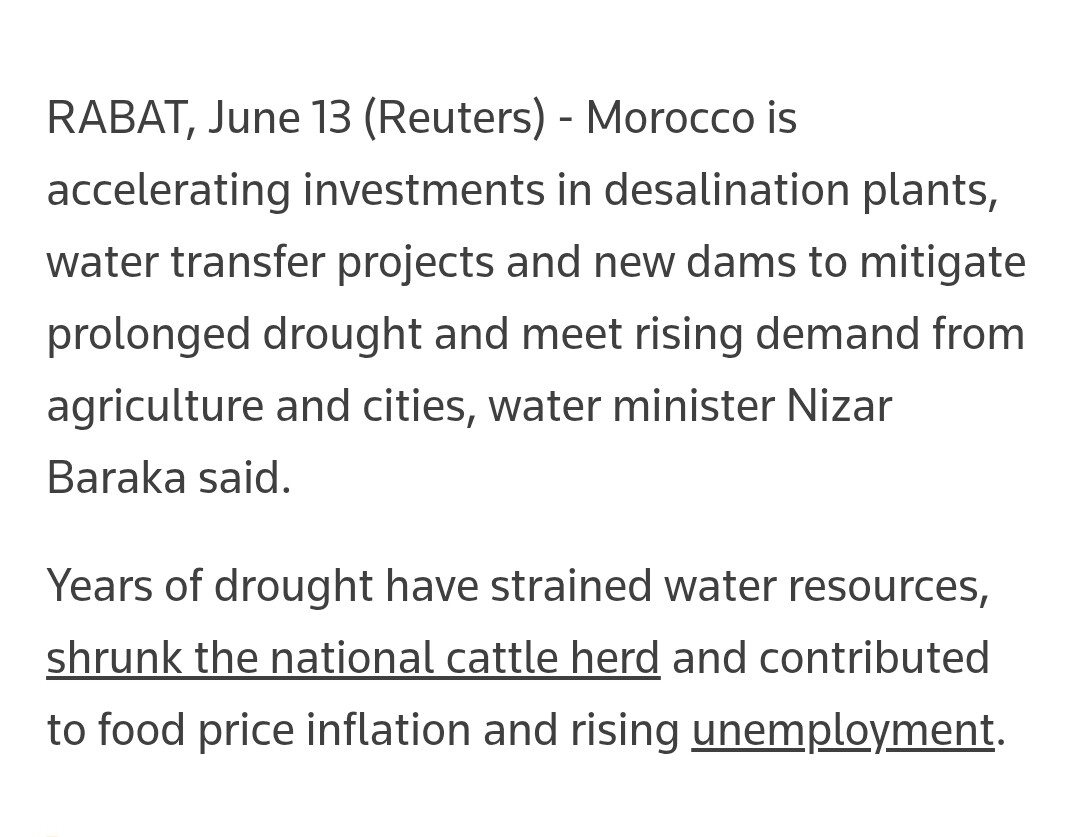
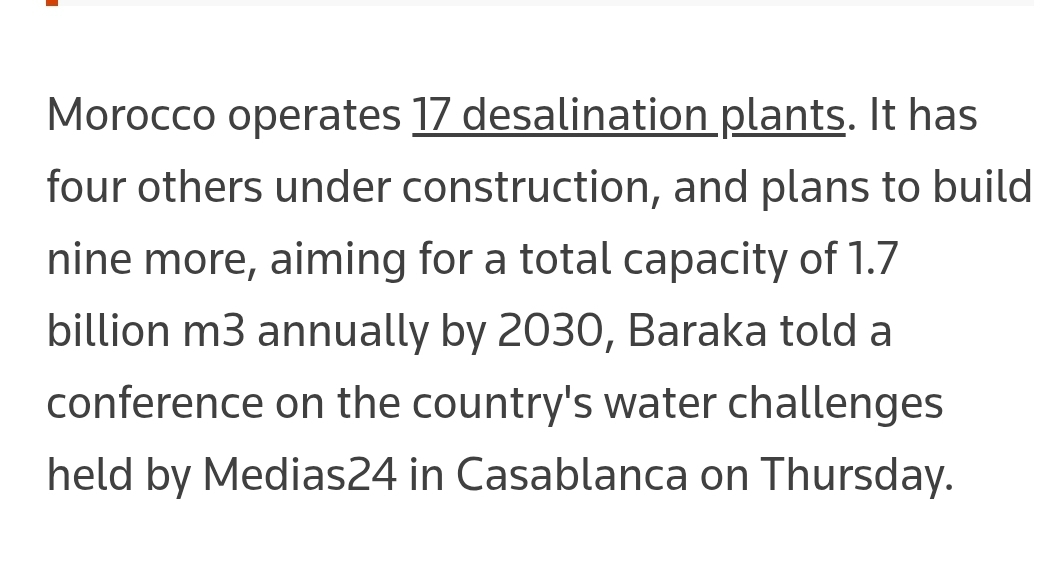
Yeah, Morocco has seen the writing on the wall and are acting.
Desalination is actually a really good variable demand sink that can use up plentiful solar, then shut down overnight or during cloudy periods.
Hadn’t thought of that. It actually makes desal in desert regions far more environmentally friendly than I had previously considered.
Umm, not funnelling money elsewhere is NOT going to make it rain.
Also to adapt a quote from climate change apologists, “What can they do to make it rain when the US is the largest CO2 polluter in the world”.
You have argued against this before, but I see desalination plants dumping excess salt to making our seas more hypersaline is the oceanic equivalent of dumping CO2 into the atmosphere. Morocco can dump their salt into the atlantic but many of those thirsty countries to their north and east are likely to make the Mediterranean saltier. No-one seems to be considering the impact of this.
I have not done the calculations, but I will assume the Greenland ice pack and Antarctic ice are pure water. As they melt over the next several hundred years, sea level will rise and sea surface salinity will tend to decrease slightly.
However, I recognise that the effluent from desalination plants causes local salinity increases, which will no doubt effect local ecology. Nonetheless, desalination plants net salt balance is close to 1:1 so overall no significant change in overall ocean salinity would be expected from desalination plant operation.
The point about the Mediterranean is a good one.
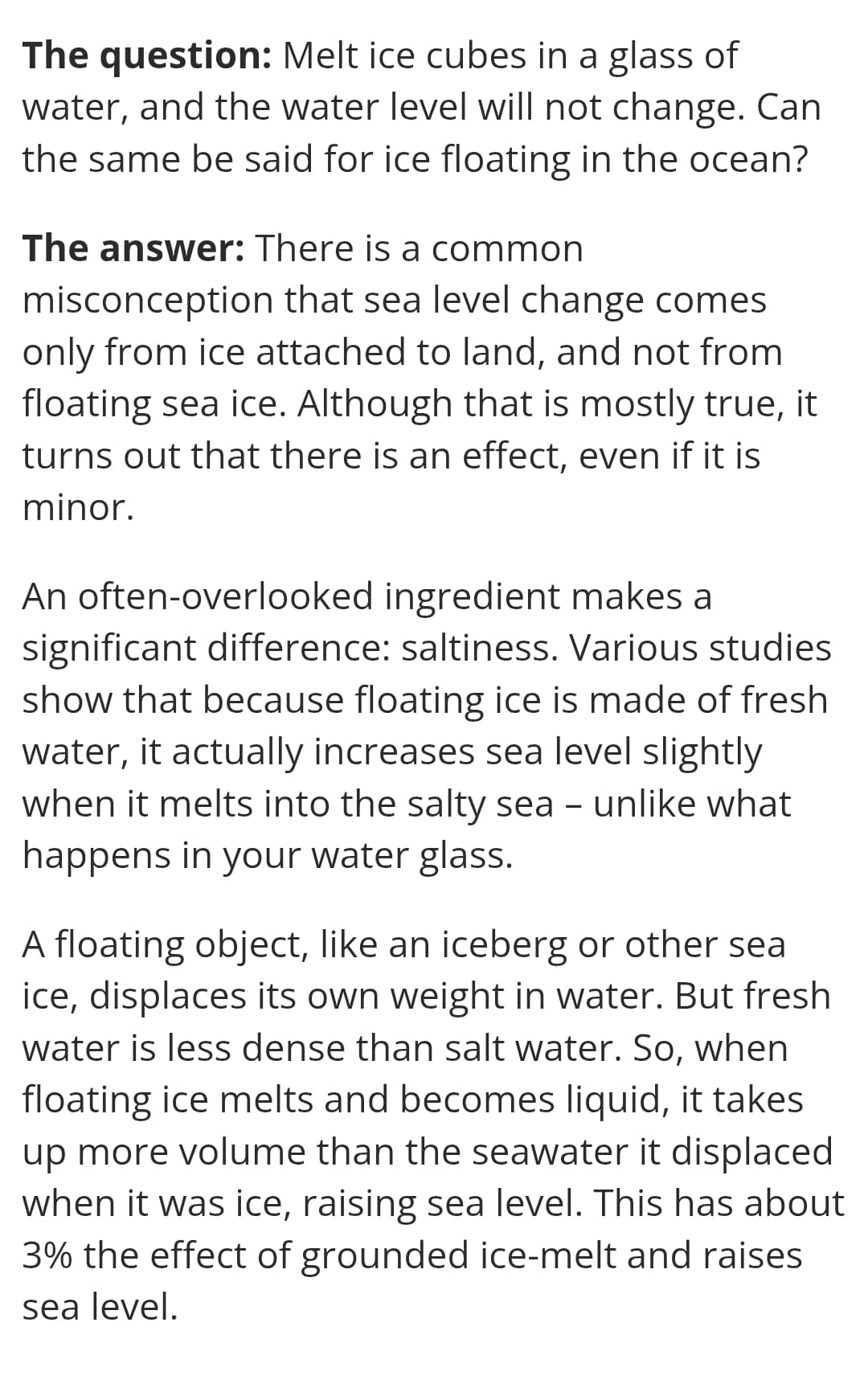
The net sea level rise due to ice pack melts is exactly zero. The mass of the ice pack displaces the exact same volume as the resultant water.
It’s called Archimedes principle. A simple demonstration is to put lots of ice in a drink. When it melts there is no change in the level of your drink.
I assume you’re just talking about sea ice? Land ice is a different matter.
With sea ice it’s minimal, but not exactly zero.
Ice currently locked up over land will definitely impact sea levels. That’s the mechanism that cut the land bridge to Tasmania. You can’t avoid losing land ice while you are losing sea ice.
Also, like most substances water expands when it’s heated. If the climate has warmed sufficiently that there’s lots of icecap melt, then the oceans will have warmed similarly and expanded. A warmer ocean has higher sea levels than a cooler one, even if they contain the same amount of water.
Yeah, it’s the huge amount of land ice on Greenland and Antarctica that’s going to be the source of major sea level rise.
This might be one for the dumb questions thread, but I have always wondered why we can’t use the salt from desal for commercial salt production rather than solar salt farms? Maybe has something to do with the economics.
Yes I was talking about floating sea ice.