Experts say it will also have even wider implications, jarring the economies that depend on South Korean thermal coal demand and technology.
Mr Bowen from ReMap Research said, in the first instance, exporters like Australia and Indonesia faced a rude shock.

1 Like
But it was someone’s else’s modelling lol

FF and Mining paying off the LNP to abandon net zero was never about them being in power and actually doing it, it was about paving the way for Labor to do ■■■■ all without anyone holding them to account
2 Likes
And silly me thought that is what Voters were for !
Obviously a majority of Voters do not agree with you with Grens vote looking shaky as well.
The talks were in the final hours of trying to agree on next steps to tackle climate but the fire has disrupted negotiations.
1 Like
The latest from James Hansen and his team at Columbia University:
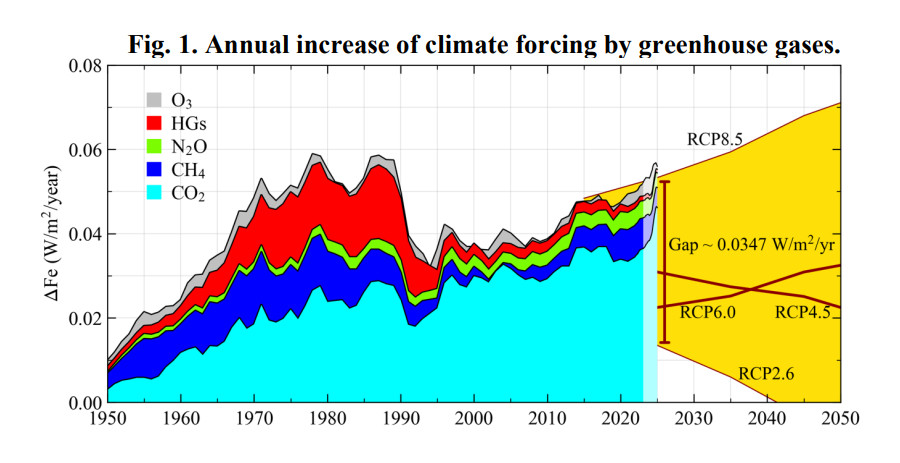
Does IPCC explain the core issues in a transparent fashion, understandable to policymakers? Despite great progress in clean energy development (solar, wind, geothermal), global warming has accelerated, as the growth rate of the human-made climate forcing is increasing, not declining (Fig. 1). The changing drive for climate change exposed by the colorful diagram – climate forcing caused by greenhouse gas (GHG) changes – is only part of the story, but it is the most important part and deserves greater exposure. However, IPCC’s method for projecting future GHG forcing – “integrated assessment models (IAMs)” that produce the RCP scenarios – are dark boxes. We must, and will, produce more transparent projections that are more clearly related to feasible policy choices.
Policy choices in the next 5-10 years will be crucial for determining the world that today’s young people and their children will live in. Although that was also true 10 years ago and 20 years ago, the situation is different now. Now we are well into the period of consequences and now the danger of passing the global irreversible point-of-no-return has increased markedly.
The present global approach for addressing climate change is not only ineffectual wishful-
thinking, it is irresponsible. Phasedown of GHG emissions requires effective policies on decadal
time scales, not mid-century targets that permit obfuscation of the absence of effective policy.
Reassessment of the climate change situation requires quantification of policy alternatives.
Reassessment must be based on the scientific method.
1 Like
Come on mate, all that is rubbish. Firstly there are far too many people who will just tow the party line regardless, present company potentially included, and the greens vote became shaky because of the last election cost of living become a more immediate concern than climate policy, that doesn’t mean a large chunk of the voters don’t want proper action on climate change 66% of the voting public want net zero for instance
1 Like
We live in a Democracy and the only people can hold a Government to account are Voters. Maybe other things are more important to Voters. Until Voters actually vote for Greens, then nothing much will change.
Polls indeed show the Coalition voters, 35% supported net zero and 38% were opposed. Labor and Greens voters shared identical results, with 60% in favour and 13% opposed.
Labor Government does support Net Zero by 2050. I will believe it if I ever saw it, but by 2050 I will be long dead.
Fina was the Northern Territory’s strongest cyclone to pass Darwin since the deadly Cyclone Tracy in 1974.
Iraq is now on the verge of catastrophe. The whole country is about to run out of potable water. Surrounding countries refuse to help them. Only a deluge will save them. There are 92 million inhabitants.
Visionaries of the past had a plan. Hydro power. There was no plan B. Now there are rolling blackouts. No water to drink or generate power. No water to grow food. They do have oil though so they have some power.
But the fault is no plan B. No solar power, no wind power, no desalination plants, no water.
They have lots of rockets, drones and partly purified uranium. The Islamic Republic has completely stuffed up planning and implementation of the basic needs of the country.
I think, as a continent that is already dry, we need to watch excessive population growth, in case there is a reduction in rainfall as a result of climate change.
Also, let’s ensure we have a plan B.
1 Like
The NTFL(W) round was cancelled.
They will not make it up later: every game is a nil-all draw.
1 Like
ESSINGTON SCHOOL IS CLOSED TOMORROW.
1 Like
Türkiye as well:
Dr. Güven Özdemir warned of escalating risk as reservoir levels continue to drop. “With Istanbul’s reservoirs hovering around 20% and some below that threshold, the danger is serious and growing. When reservoir capacity falls below 10%, the water becomes increasingly unusable due to sediment and bottom-layer water, complicating treatment and driving costs higher.”
Looking ahead, Özdemir stressed that precipitation in December and January, especially snowfall, is critical for replenishing water reserves. “If these rains and snows do not materialize, Istanbul and the wider region face serious water shortages.”
1 Like
Interesting discussion with Lex Fridman and a guy working on nuclear fusion.
Covers a lot of the basics of nuclear fission and delves into nuclear fusion and the different techniques in using fusion to generate power a bit deeper.
Lex can be annoying but if you can get past that, hang in there if you want to know a bit about nuclear fusion.
The guest is not totally truthful about the risk of byproducts from the fusion process. X-rays gamma rays, neutrons and certain isotopes such as beryllium 8 which are produced cannot be totally contained and can harm humans.
Worth watching still.
1 Like
This is a device that helps keeps the grid at around 50 Hz. It costs $137m. According to the article Australia might need up to 40 of these in an entirely renewable energy powered grid. That would total about $5.5b. For context, we have been spending about that much a year on large scale renewable energy (including batteries) construction.
Actually, this is trending up and is at about $8b/year. And this doesn’t include rooftop solar. So assuming these have a 20-25 year lifespan they shouldn’t add a huge amount to electricity prices.
2 Likes
1 Like
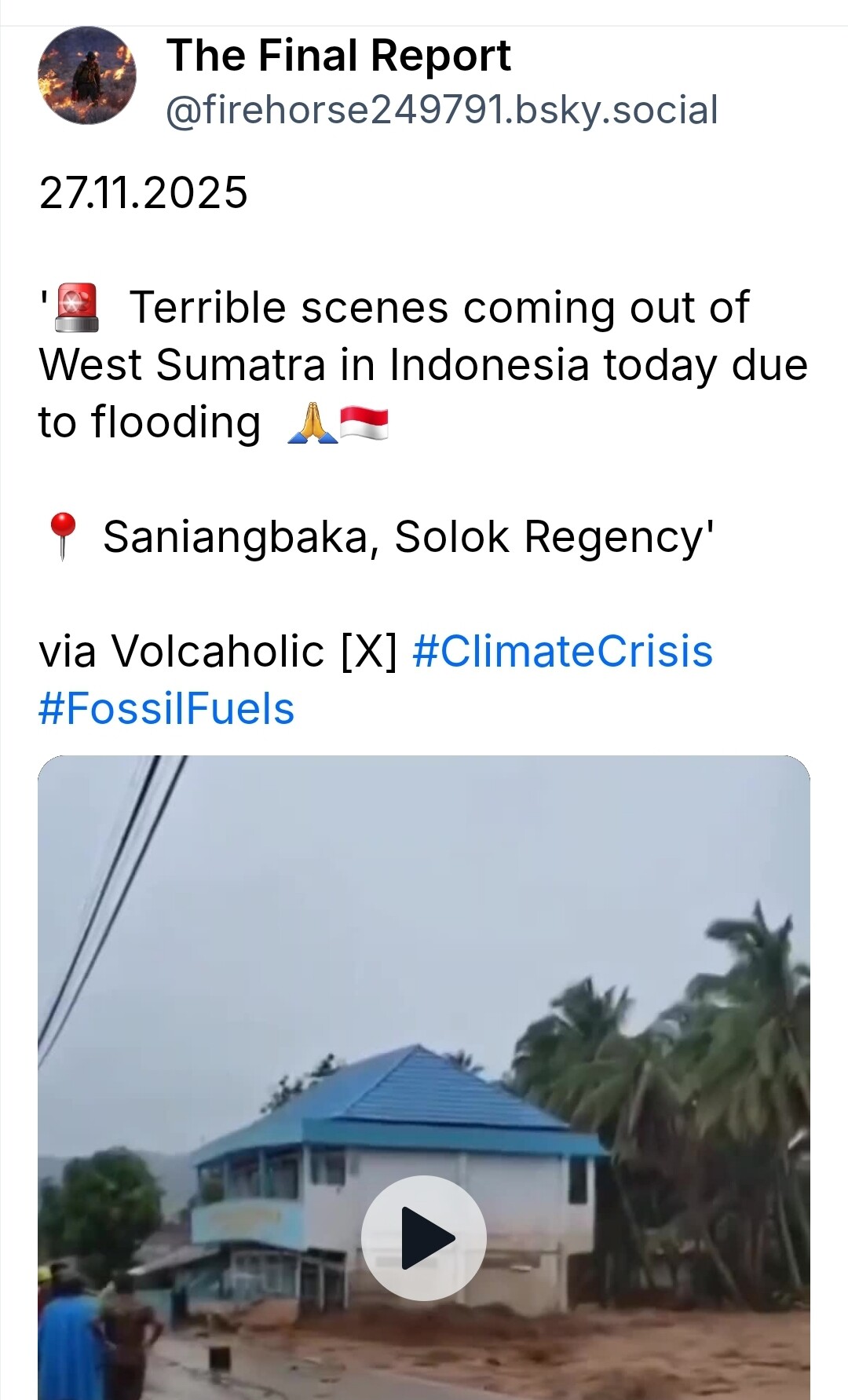
Hundreds of thousands of people have been displaced by deadly floods sweeping across Thailand and Vietnam, a crisis that has killed scores and stranded entire communities as meteorologists and climate analysts warn of heavier rains driven by La Nina and long-term warming.
The scale of the inundation has highlighted how a late-season monsoon surge, layered onto fragile flood-management systems, is overwhelming towns and cities from southern Thailand to Vietnam’s central coast, with Malaysia bracing itself for its turn as the severe weather moves south.
“This is the worst we have ever experienced,” said Choom, a Hat Yai Airbnb owner requesting to go by a nickname. “It’s been flood after flood. You can say it is climate change, but the lack of systematic flood management is just as much to blame,” he said, reflecting mounting anger at the failure to handle the annual flood scourge.
We aren’t prepared for what is here now, let alone what is coming.
1 Like