The ol tried & tested reboot fix.
3 Likes
She told me she tried everything multiple times and I’m too scared to question her. 
1 Like
Charge it then unplug it and shut down properly


1 Like
I was scared to question my daughter, but then she got married and had a Brisbane Bears supporter to intimidate. So I am now empowered to pretend I am in charge.
3 Likes
There is a lot of misleading information about Macs and viruses about. Years ago, I read that virus scanners found nearly as many viruses on Macs as Windows PCs. What they didn’t say was that almost all those viruses were Windows viruses that were unable to harm a Mac.
Are viruses written that can target a Mac? Yes. Of course. But the biggest difference between Mac and Windows is the delivery method for viruses. There is no one trusted source for Windows software, so it is downloaded from sites all over the web. Some useful, free apps contain malware. Some spoof sites fool you into downloading malicious versions of useful apps, and some genuinely useful free software is later sold to, or taken over by, people who decide to monetise it by adding malware. Mac users can download Mac software outside the Apple system, and do accept some risk when they do. This can’t happen ‘accidentally’, and you need to ignore the system warnings and choose to run any software that isn’t downloaded from the App Store.
Because it’s harder to get your malware installed on a Mac, much less spread between Macs, there’s more profit in writing them for Windows instead. And because fewer are written for Macs, it’s easier for Apple to target a much smaller quantity of new malware threats with security patches.
The end result of this is, in practical terms, for 99% of Mac users, they’ll never experience a virus on their systems. I say this after having looked after hundreds of Macs and PCs for dozens of companies, for over 2 decades.
I have yet to find, or be required to remove malware on any Mac. In the same time period, I have had to fix thousands of infections on many dozens, probably hundreds of PCs. Also add the number of times I’ve had to repair/rebuild/restore a PC because Windows has corrupted after an update, a restart, or no good reason at all. Not to mention all the times when a Windows/Office update breaks critical legacy apps for a business, and I need to find a workaround, so they can continue trading.
Macs are simply very clever hardware, combined with a very good OS. Even some of their better systems, at very high prices, probably work out cheaper to run for businesses, where they can be practically deployed, as an alternative to a Windows PC. Especially if you take into account management and downtime expenses and inconveniences.
However, if I wanted a gaming machine, I’d still custom build a PC.
6 Likes
System 7 killed the prevalence of viruses on the Mac, and they never really recovered.
That was in 1991.
2 Likes
Why bother writing malware for less than 10% of the market when you can target the other 90%
2 Likes
Because you would have HUGE bragging rights.
A decade ago, Mac OS had 8% of the desktop OS market, and Windows had 91%.
Fast forward to 6 months ago, and Mac OS now has over 20% of the desktop OS market, and Windows is down to below 70%. Linux and Chrome also now both own over 3% of the desktop OS market each.
The server OS market is dominated by Linux, with well over 60% of the market nowadays, and Windows servers are down to under 25% of market share. With many companies pricing server downtime in the hundreds of thousands of dollars per hour, the stability of Linux OS is likely even more of a driving factor than the OS and licensing costs of Windows Server systems.
If it wasn’t for Office, I think Windows market share would be way lower. I know quite a few businesses that have legacy products built around Office apps from years ago. I work for a couple of businesses who have legacy apps built around macros and Visual Basic scripts in Excel, which they have frequent issues with, but it’s difficult to transition those apps quickly. Most new software for them is being built on Linux, and they’d dearly like to re-code those legacy office apps on Linux and present via a browser, as they’d gain in efficiency and stability.
Gaming on Linux is becoming more common too, largely due to Steam’s work in allowing easier setup and access.
It’s not hard to see Windows becoming the fringe player in the next decade or two.
2 Likes
anybody here good at software development ? I have a project I need some help with
I’ve setup a mini pc for a plex server and was wondering if there is a remote control available to use it like a google tv or fire tv. Remote desktop is annoying.
i don’t want to “let me google that for you” like a condescending dckhead, but dude, cmon
also, top tip, set your browsers default search engine to udm14.com
spits back a regular old school google search without all the ai slop at the top
2 Likes
Plus usb infrared receiver
Plus Logitech harmony remote?
1 Like
Looking at replacing my clunky old PC with a laptop (and using old screen as a second screen).
Extent of my computing is iTunes, Any DVD player, Firefox and Microsoft Office (predominantly Word).
I presume any cheap & nasty laptop (that isn’t a Chromebook) with an external DVD player should do the trick? Don’t necessarily have a preference for screen size (I’m used to an iPad so being on the smaller size would t matter too much).
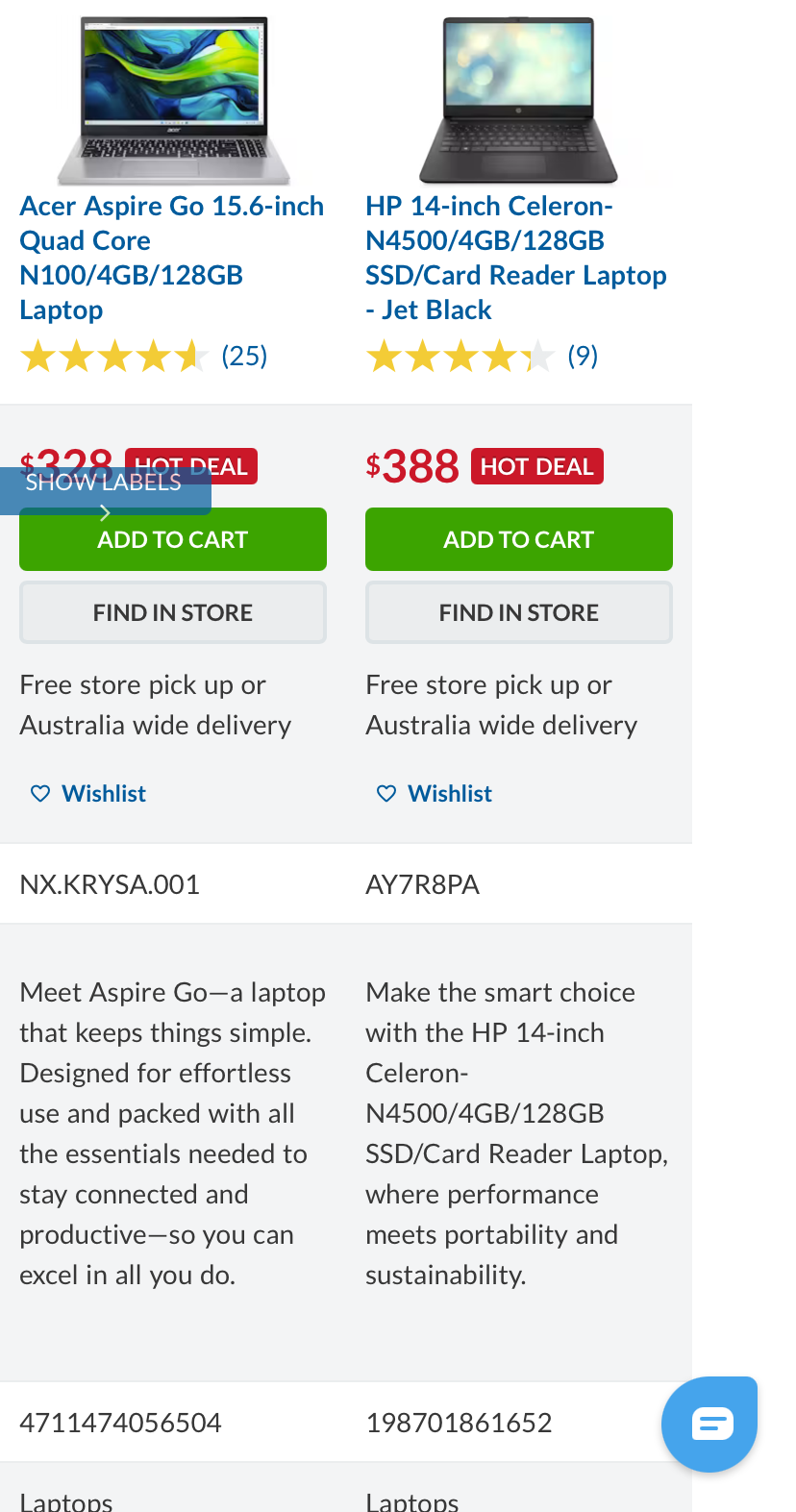
Cheapest locally (only have Harvey Norman within a 90 minute drive) is this:
https://www.harveynorman.com.au/acer-aspire-go-15-6-inch-quad-core-n100-4gb-128gb-laptop.html
1 Like
holy ■■■■ guys, the missing link, actual value from a consultant
I’ve heard nothing but good reports about the N100 processors. They’re cheap and very low power usage, so you’d think they’d lack in performance, like most previous budget CPU’s. But by all reports, they match it with Intel’s mainstream processors.
1 Like
Yeah but is a mouse interface what I really want? Plex you kind of use the arrow keys more than the mouse.
Been using duckduckgo